Murphy Douglas P, Bai Ou, Gorgey Ashraf S, Fox John, Lovegreen William T, Burkhardt Brian W, Atri Roozbeh, Marquez Juan S, Li Qi, Fei Ding-Yu
Hunter Holmes McGuire VA Medical Center, Department of Veterans Affairs, Richmond, VA, United States.
Department of Electrical and Computer Engineering, Florida International University, Miami, FL, United States.
Front Neurol. 2017 Dec 15;8:696. doi: 10.3389/fneur.2017.00696. eCollection 2017.
The purpose of this study was to establish the feasibility of manipulating a prosthetic knee directly by using a brain-computer interface (BCI) system in a transfemoral amputee. Although the other forms of control could be more reliable and quick (e.g., electromyography control), the electroencephalography (EEG)-based BCI may provide amputees an alternative way to control a prosthesis directly from brain.
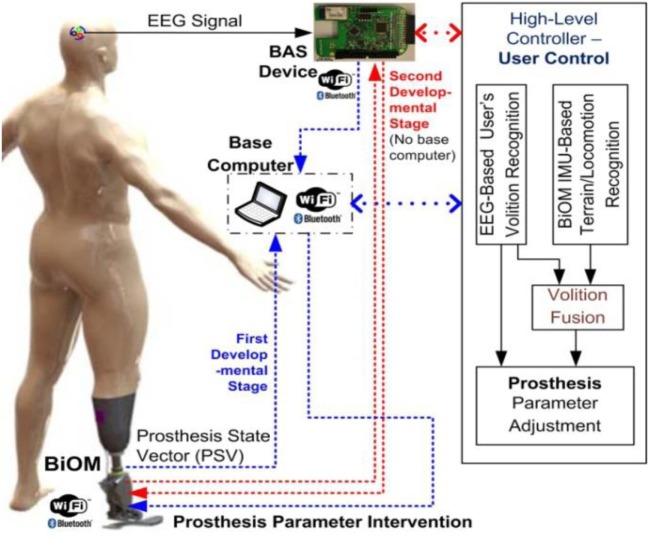
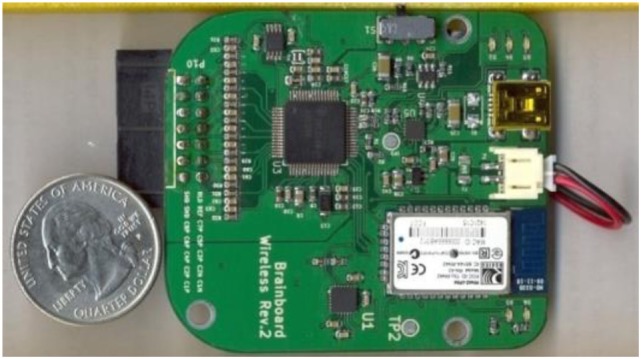
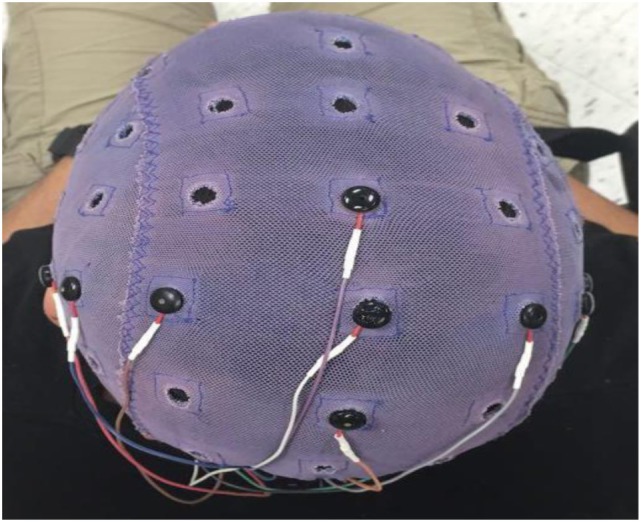
A transfemoral amputee subject was trained to activate a knee-unlocking switch through motor imagery of the movement of his lower extremity. Surface scalp electrodes transmitted brain wave data to a software program that was keyed to activate the switch when the event-related desynchronization in EEG reached a certain threshold. After achieving more than 90% reliability for switch activation by EEG rhythm-feedback training, the subject then progressed to activating the knee-unlocking switch on a prosthesis that turned on a motor and unlocked a prosthetic knee. The project took place in the prosthetic department of a Veterans Administration medical center. The subject walked back and forth in the parallel bars and unlocked the knee for swing phase and for sitting down. The success of knee unlocking through this system was measured. Additionally, the subject filled out a questionnaire on his experiences.
The success of unlocking the prosthetic knee mechanism ranged from 50 to 100% in eight test segments.
The performance of the subject supports the feasibility for BCI control of a lower extremity prosthesis using surface scalp EEG electrodes. Investigating direct brain control in different types of patients is important to promote real-world BCI applications.
本研究的目的是确定在经股骨截肢者中使用脑机接口(BCI)系统直接操控假肢膝关节的可行性。尽管其他控制形式可能更可靠、更快捷(例如肌电图控制),但基于脑电图(EEG)的BCI可能为截肢者提供一种直接从大脑控制假肢的替代方法。
一名经股骨截肢者受试者接受训练,通过想象下肢运动来激活膝关节解锁开关。头皮表面电极将脑电波数据传输到一个软件程序,该程序设定为当脑电图中的事件相关去同步化达到一定阈值时激活开关。在通过脑电图节律反馈训练使开关激活的可靠性达到90%以上后,受试者接着在一个能启动电机并解锁假肢膝关节的假肢上激活膝关节解锁开关。该项目在一家退伍军人管理局医疗中心的假肢科进行。受试者在双杠上来回行走,并在摆动期和坐下时解锁膝关节。测量通过该系统解锁膝关节的成功率。此外,受试者填写了一份关于其体验的问卷。
在八个测试阶段中,解锁假肢膝关节机构的成功率在50%至100%之间。
受试者的表现支持了使用头皮表面脑电图电极通过BCI控制下肢假肢的可行性。研究不同类型患者的直接脑控制对于推动BCI在现实世界中的应用很重要。