Kumar Sushil, Hash C Tom, Nepolean T, Satyavathi C Tara, Singh Govind, Mahendrakar Mahesh D, Yadav Rattan S, Srivastava Rakesh K
Plant Biotechnology Centre, Swami Keshwanand Rajasthan Agricultural University, Bikaner, India.
International Crops Research Institute for the Semi-Arid Tropics, Patancheru, India.
Front Plant Sci. 2017 Dec 20;8:1731. doi: 10.3389/fpls.2017.01731. eCollection 2017.
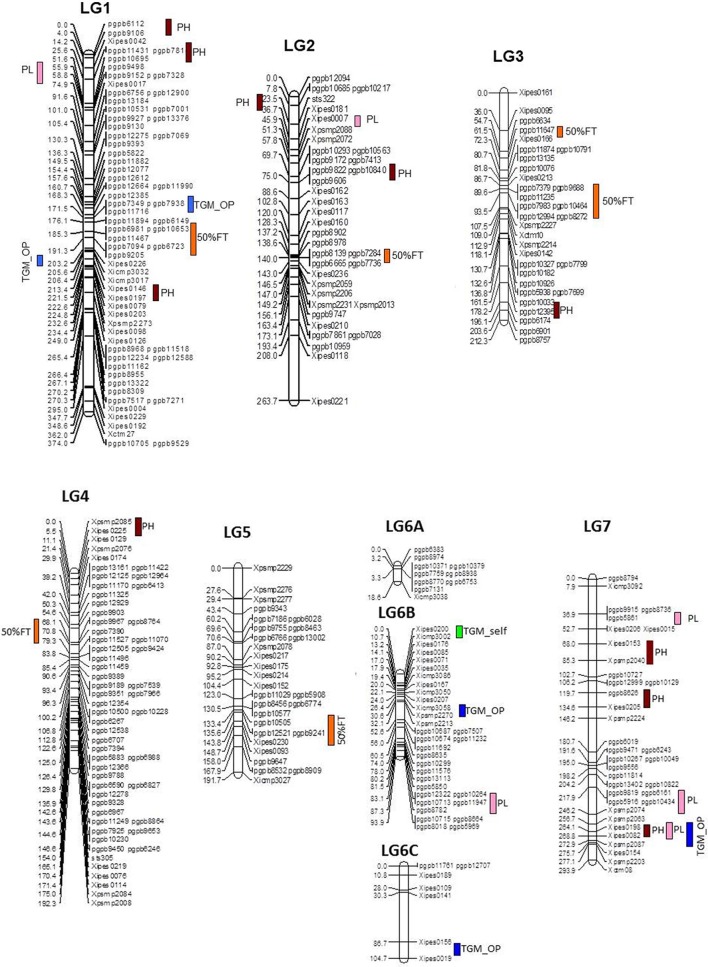
Pearl millet [ (L.) R. Br.] is a staple crop for the people of arid and semi-arid regions of the world. It is fast gaining importance as a climate resilient nutricereal. Exploiting the bold seeded, semi-dwarf, and early flowering genotypes in pearl millet is a key breeding strategy to enhance yield, adaptability, and for adequate food in resource-poor zones. Genetic variation for agronomic traits of pearl millet inbreds can be used to dissect complex traits through quantitative trait locus (QTL) mapping. This study was undertaken to map a set of agronomically important traits like flowering time (FT), plant height (PH), panicle length (PL), and grain weight (self and open-pollinated seeds) in the recombinant inbred line (RIL) population of ICMB 841-P3 × 863B-P2 cross. Excluding grain weight (open pollinated), heritabilities for FT, PH, PL, grain weight (selfed) were in high to medium range. A total of six QTLs for FT were detected on five chromosomes, 13 QTLs for PH on six chromosomes, 11 QTLs for PL on five chromosomes, and 14 QTLs for 1,000-grain weight (TGW) spanning five chromosomes. One major QTL on LG3 was common for FT and PH. Three major QTLs for PL, one each on LG1, LG2, and LG6B were detected. The large effect QTL for TGW (self) on LG6B had a phenotypic variance () of 62.1%. The for FT, TGW (self), and PL ranged from 22.3 to 59.4%. A total of 21 digenic interactions were discovered for FT ( = 18-40%) and PL ( = 13-19%). The epistatic effects did not reveal any significant QTL × QTL × environment (QQE) interactions. The mapped QTLs for flowering time and other agronomic traits in present experiment can be used for marker-assisted selection (MAS) and genomic selection (GS) breeding programs.
珍珠粟[(L.)R. Br.]是世界干旱和半干旱地区人们的主要粮食作物。作为一种适应气候变化的营养谷物,它正迅速变得重要起来。利用珍珠粟中种子大、半矮化和早花的基因型是提高产量、适应性以及为资源匮乏地区提供充足粮食的关键育种策略。珍珠粟自交系农艺性状的遗传变异可用于通过数量性状位点(QTL)定位来剖析复杂性状。本研究旨在对ICMB 841 - P3×863B - P2杂交组合的重组自交系(RIL)群体中的一组农艺重要性状进行定位,如开花时间(FT)、株高(PH)、穗长(PL)和粒重(自交和开放授粉种子)。除了粒重(开放授粉)外,FT、PH、PL、粒重(自交)的遗传力处于高到中等范围。在五条染色体上共检测到6个FT的QTL,在六条染色体上检测到13个PH的QTL,在五条染色体上检测到11个PL的QTL,以及在五条染色体上检测到14个千粒重(TGW)的QTL。LG3上的一个主要QTL在FT和PH中是共同的。检测到3个PL的主要QTL,分别位于LG1、LG2和LG6B上。LG6B上TGW(自交)的大效应QTL具有62.1%的表型变异()。FT、TGW(自交)和PL的变异范围为22.3%至59.4%。共发现21对FT(=18 - 40%)和PL(=13 - 19%)的双基因互作。上位性效应未揭示任何显著的QTL×QTL×环境(QQE)互作。本实验中定位的开花时间和其他农艺性状的QTL可用于标记辅助选择(MAS)和基因组选择(GS)育种计划。