Department of Biology, University of Maryland College Park, College Park, MD, USA.
Department of Biology, Emory University, Atlanta, GA, USA.
ISME J. 2018 Feb;12(2):585-597. doi: 10.1038/ismej.2017.194. Epub 2018 Jan 12.
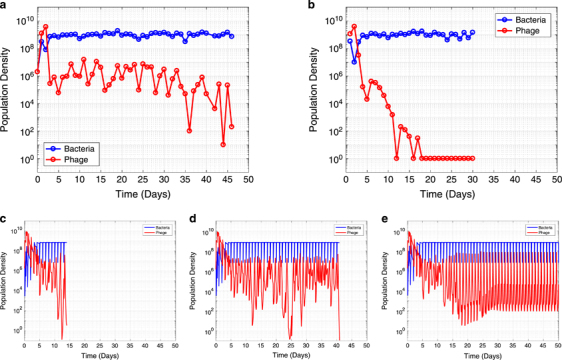
Bacteria and their viral pathogens face constant pressure for augmented immune and infective capabilities, respectively. Under this reciprocally imposed selective regime, we expect to see a runaway evolutionary arms race, ultimately leading to the extinction of one species. Despite this prediction, in many systems host and pathogen coexist with minimal coevolution even when well-mixed. Previous work explained this puzzling phenomenon by invoking fitness tradeoffs, which can diminish an arms race dynamic. Here we propose that the regular loss of immunity by the bacterial host can also produce host-phage coexistence. We pair a general model of immunity with an experimental and theoretical case study of the CRISPR-Cas immune system to contrast the behavior of tradeoff and loss mechanisms in well-mixed systems. We find that, while both mechanisms can produce stable coexistence, only immune loss does so robustly within realistic parameter ranges.
细菌及其病毒病原体分别面临增强免疫和感染能力的持续压力。在这种相互施加的选择机制下,我们预计会看到一场失控的进化军备竞赛,最终导致一个物种的灭绝。尽管有这样的预测,但在许多系统中,即使混合良好,宿主和病原体也能共存,很少发生共同进化。以前的工作通过引入适应性权衡来解释这种令人费解的现象,适应性权衡可以减弱军备竞赛的动态。在这里,我们提出细菌宿主经常失去免疫力也可以产生宿主-噬菌体共存。我们将一般的免疫模型与 CRISPR-Cas 免疫系统的实验和理论案例研究相结合,对比了混合系统中权衡和损失机制的行为。我们发现,虽然这两种机制都可以产生稳定的共存,但只有免疫丧失在现实的参数范围内才能稳健地实现。