Cavagnaro Daniel R, Aranovich Gabriel J, McClure Samuel M, Pitt Mark A, Myung Jay I
Mihaylo College of Business and Economics, California State University Fullerton.
University of California, San Francisco and San Francisco VA Medical Center.
J Risk Uncertain. 2016 Jun;52(3):233-254. doi: 10.1007/s11166-016-9242-y. Epub 2016 Sep 13.
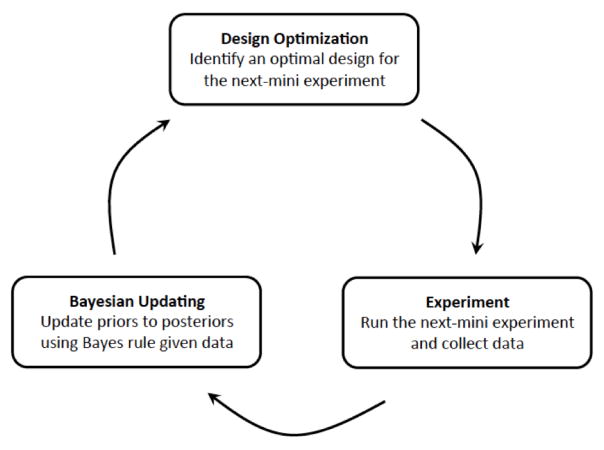
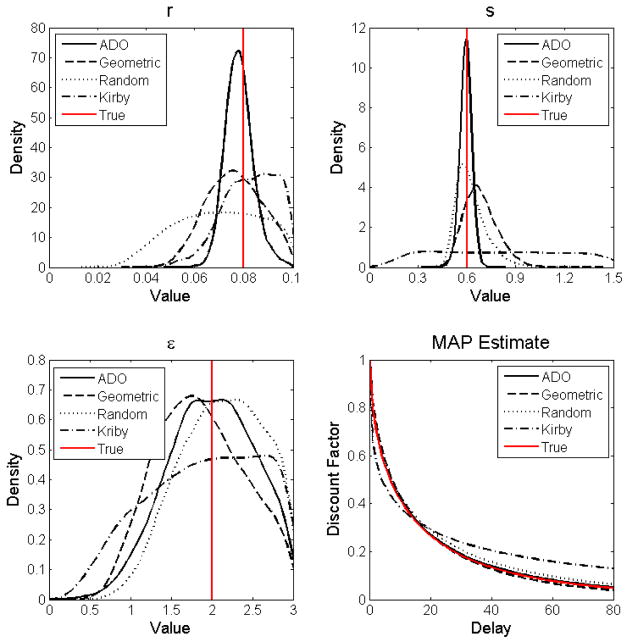
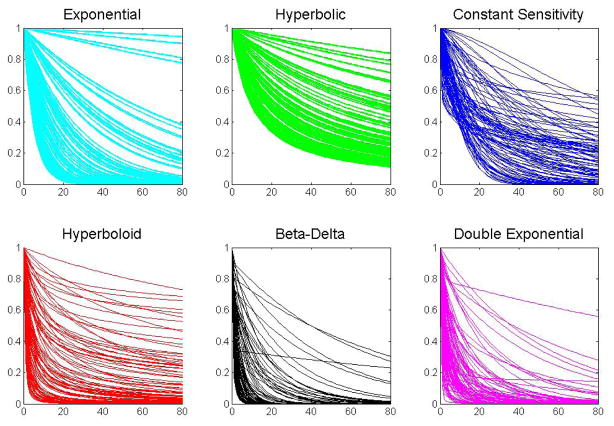
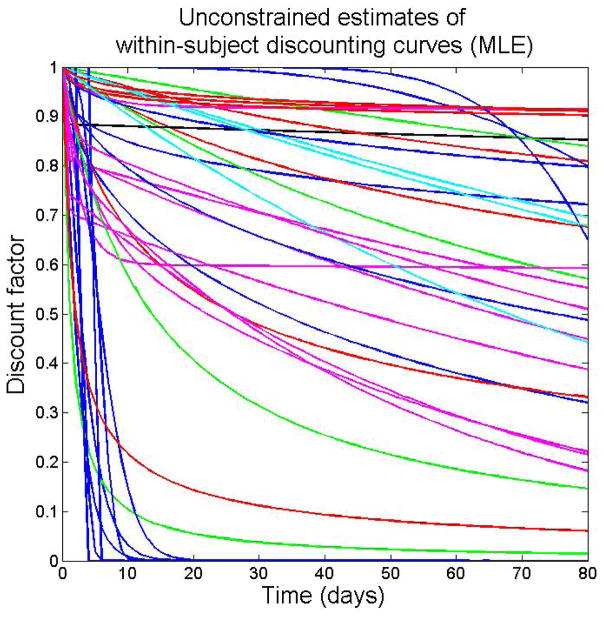
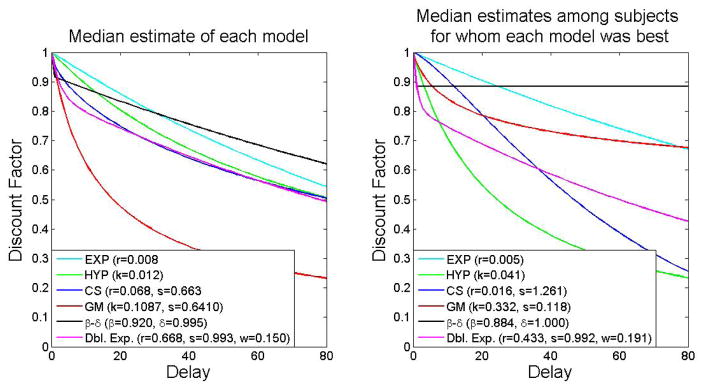
The tendency to discount the value of future rewards has become one of the best-studied constructs in the behavioral sciences. Although hyperbolic discounting remains the dominant quantitative characterization of this phenomenon, a variety of models have been proposed and consensus around the one that most accurately describes behavior has been elusive. To help bring some clarity to this issue, we propose an Adaptive Design Optimization (ADO) method for fitting and comparing models of temporal discounting. We then conduct an ADO experiment aimed at discriminating among six popular models of temporal discounting. Rather than supporting a single underlying model, our results show that each model is inadequate in some way to describe the full range of behavior exhibited across subjects. The precision of results provided by ADO further identify specific properties of models, such as accommodating both increasing and decreasing impatience, that are mandatory to describe temporal discounting broadly.
低估未来奖励价值的倾向已成为行为科学中研究最多的概念之一。尽管双曲线贴现仍然是这一现象的主要定量表征,但已经提出了各种模型,而对于最准确描述行为的模型达成共识却一直难以实现。为了帮助澄清这个问题,我们提出了一种自适应设计优化(ADO)方法来拟合和比较时间贴现模型。然后,我们进行了一项ADO实验,旨在区分六种流行的时间贴现模型。我们的结果并未支持单一的基础模型,而是表明每个模型在某种程度上都不足以描述所有受试者表现出的全部行为范围。ADO提供的结果精度进一步确定了模型的特定属性,例如适应不耐烦程度的增加和减少,这些属性对于广泛描述时间贴现来说是必不可少的。