Brigham and Women's Hospital, Harvard Medical School, Boston, USA.
College of Computer Science and Technology, Harbin Engineering University, Harbin, China; Brigham and Women's Hospital, Harvard Medical School, Boston, USA.
Neuroimage. 2018 May 1;171:341-354. doi: 10.1016/j.neuroimage.2018.01.006. Epub 2018 Jan 11.
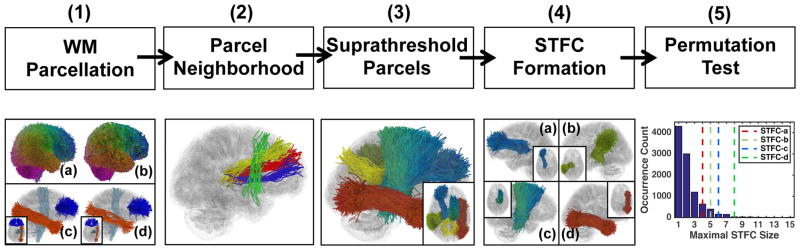
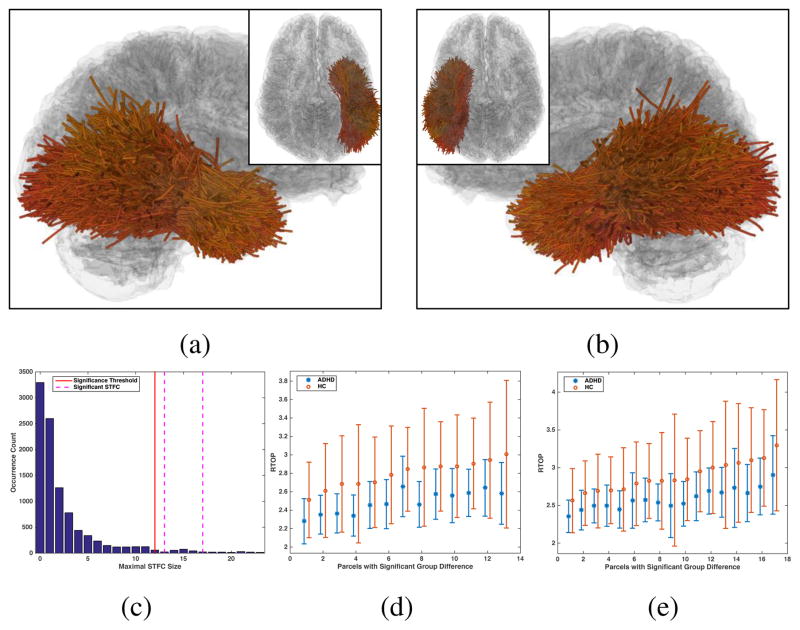
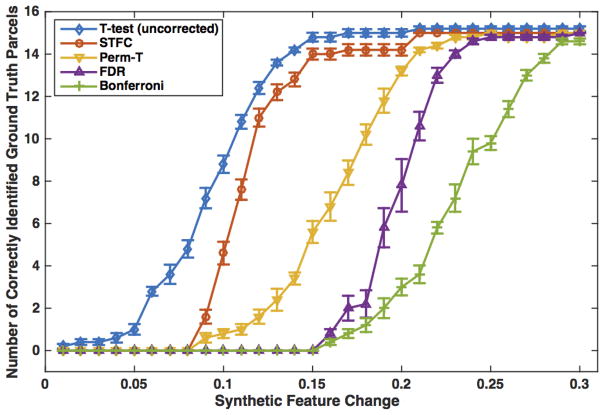
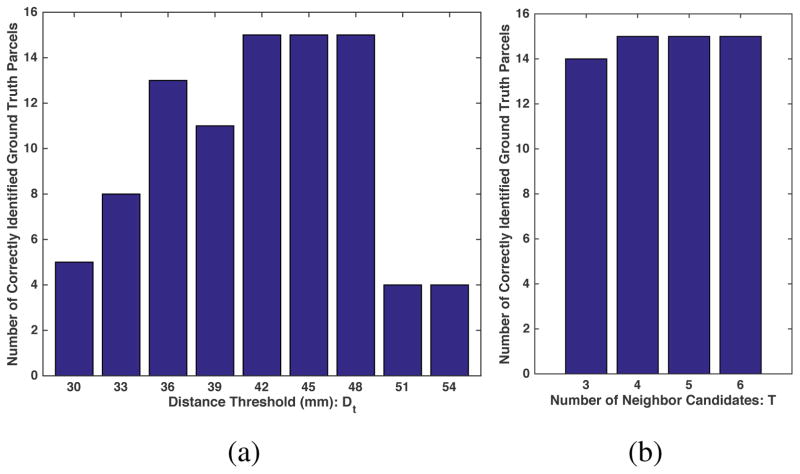
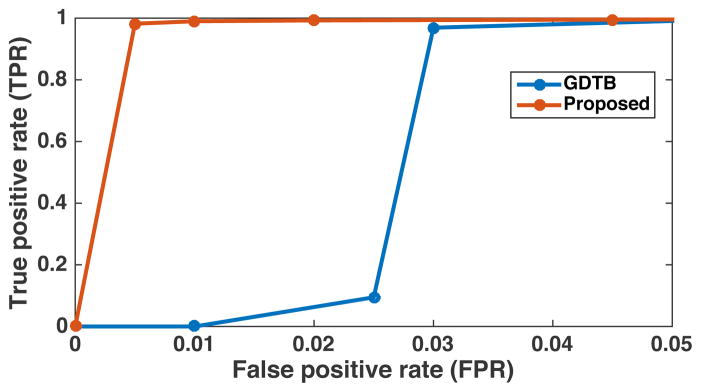
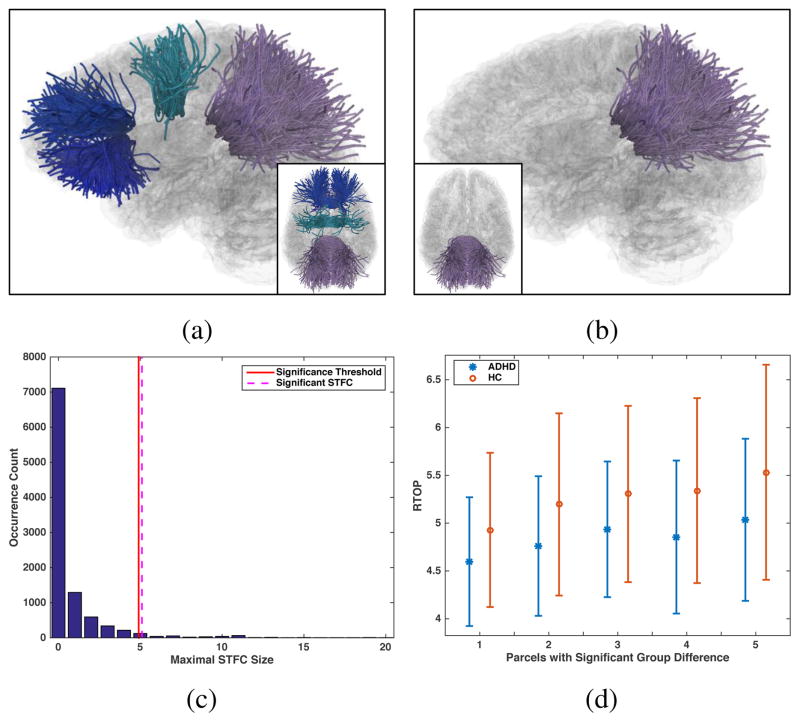
This work presents a suprathreshold fiber cluster (STFC) method that leverages the whole brain fiber geometry to enhance statistical group difference analyses. The proposed method consists of 1) a well-established study-specific data-driven tractography parcellation to obtain white matter tract parcels and 2) a newly proposed nonparametric, permutation-test-based STFC method to identify significant differences between study populations. The basic idea of our method is that a white matter parcel's neighborhood (nearby parcels with similar white matter anatomy) can support the parcel's statistical significance when correcting for multiple comparisons. We propose an adaptive parcel neighborhood strategy to allow suprathreshold fiber cluster formation that is robust to anatomically varying inter-parcel distances. The method is demonstrated by application to a multi-shell diffusion MRI dataset from 59 individuals, including 30 attention deficit hyperactivity disorder patients and 29 healthy controls. Evaluations are conducted using both synthetic and in-vivo data. The results indicate that the STFC method gives greater sensitivity in finding group differences in white matter tract parcels compared to several traditional multiple comparison correction methods.
本研究提出了一种超阈值纤维簇(STFC)方法,利用全脑纤维几何结构增强统计组间差异分析。该方法包括:1)一种成熟的基于研究的、数据驱动的束追踪分割方法,以获得白质束区;2)一种新提出的基于非参数、置换检验的 STFC 方法,用于识别研究人群之间的显著差异。我们方法的基本思想是,当进行多重比较校正时,一个白质束区的邻近区域(具有相似白质解剖结构的附近束区)可以支持该束区的统计学意义。我们提出了一种自适应束区邻域策略,以允许在解剖学上变化的束区间距下形成超阈值纤维簇。该方法通过应用于来自 59 个人的多壳扩散 MRI 数据集进行了演示,包括 30 名注意缺陷多动障碍患者和 29 名健康对照者。评估使用了合成数据和体内数据。结果表明,与几种传统的多重比较校正方法相比,STFC 方法在发现白质束区的组间差异方面具有更高的敏感性。