de Luis Miguel, Bartolomé Carmen, García Cardo Óscar, Álvarez-Jiménez Julio
Departamento de Ciencias de la Vida, Facultad de Biología, C.Ambientales y Químicas Universidad de Alcalá, Alcalá de Henares (Madrid), Spain.
Empresa Pública de Gestión Ambiental de Castilla-La Mancha (GEACAM), Cuenca, Spain.
PLoS One. 2018 Jan 16;13(1):e0190536. doi: 10.1371/journal.pone.0190536. eCollection 2018.
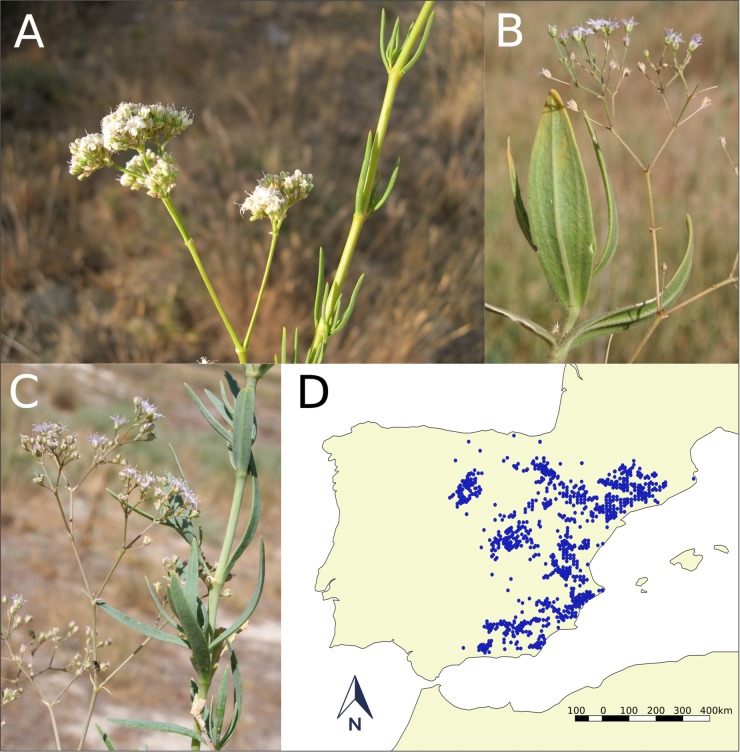
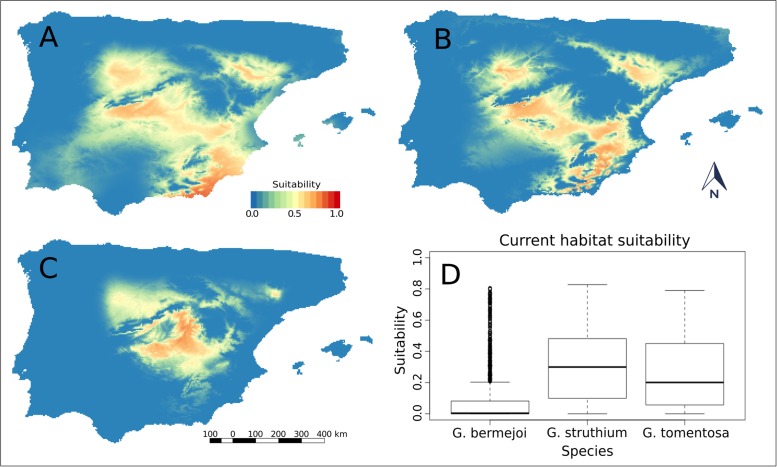
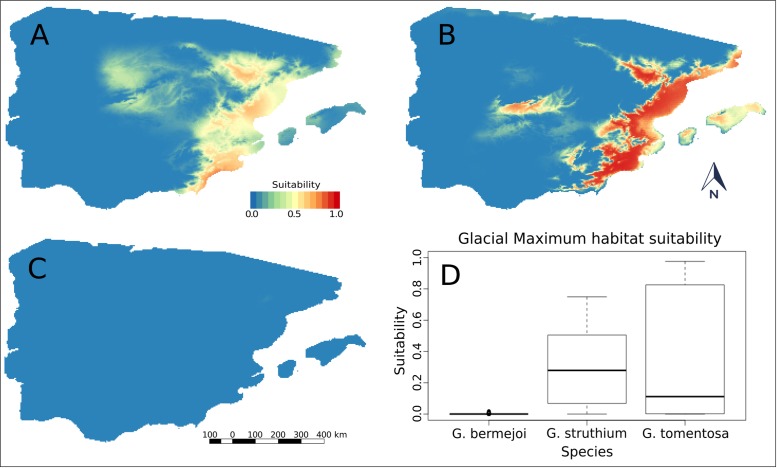
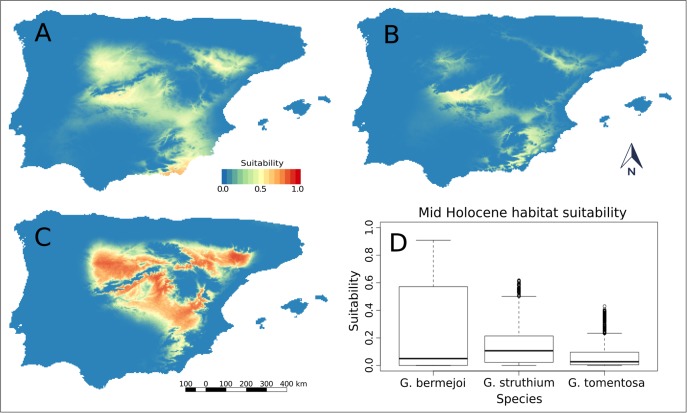
Gypsophila bermejoi G. López is an allopolyploid species derived from the parental G. struthium L. subsp. struthium and G. tomentosa L. All these plants are gypsophytes endemic to the Iberian Peninsula of particular ecological, evolutionary and biochemical interest. In this study, we present evidence of a possible repression on the process of G. bermejoi speciation by climatic factors. We modelled the ecological niches of the three taxa considered here using a maximum entropy approach and employing a series of bioclimatic variables. Subsequently, we projected these models onto the geographical space of the Iberian Peninsula in the present age and at two past ages: the Last Glacial Maximum and the mid-Holocene period. Furthermore, we compared these niches using the statistical method devised by Warren to calculate their degree of overlap. We also evaluated the evolution of the bioclimatic habitat suitability at those sites were the soil favors the growth of these species. Both the maximum entropy model and the degree of overlap indicated that the ecological behavior of the hybrid differs notably from that of the parental species. During the Last Glacial Maximum, the two parental species appear to take refuge in the western coastal strip of the Peninsula, a region in which there are virtually no sites where G. bermejoi could potentially be found. However, in the mid-Holocene period the suitability of G. bermejoi to sites with favorable soils shifts from almost null to a strong adaptation, a clear change in this tendency. These results suggest that the ecological niches of hybrid allopolyploids can be considerably different to those of their parental species, which may have evolutionary and ecologically relevant consequences. The data obtained indicate that certain bioclimatic variables may possibly repress the processes by which new species are formed. The difference in the ecological niche of G. bermejoi with respect to its parental species prevented it from prospering during the Last Glacial Maximum. However, the climatic change in the mid-Holocene period released this block and as such, it permitted the new species to establish itself. Accordingly, we favor a recent origin of the current populations of G. bermejoi.
贝氏丝石竹(Gypsophila bermejoi G. López)是一种异源多倍体物种,由亲本种硬叶丝石竹(G. struthium L. subsp. struthium)和绒毛丝石竹(G. tomentosa L.)杂交而来。所有这些植物都是伊比利亚半岛特有的适钙植物,具有特殊的生态、进化和生化研究价值。在本研究中,我们提供了气候因素可能抑制贝氏丝石竹物种形成过程的证据。我们使用最大熵方法并采用一系列生物气候变量,对这里所考虑的三个分类群的生态位进行了建模。随后,我们将这些模型投影到伊比利亚半岛当前以及两个过去时期的地理空间上:末次盛冰期和全新世中期。此外,我们使用沃伦设计的统计方法比较了这些生态位,以计算它们的重叠程度。我们还评估了在土壤有利于这些物种生长的地点,生物气候栖息地适宜性的演变情况。最大熵模型和重叠程度均表明,杂种的生态行为与亲本物种明显不同。在末次盛冰期,两个亲本物种似乎在半岛西部沿海地带避难,而在该地区几乎没有可能发现贝氏丝石竹的地点。然而,在全新世中期,贝氏丝石竹对土壤适宜地点的适应性从几乎为零转变为强烈适应,这一趋势发生了明显变化。这些结果表明,杂种异源多倍体的生态位可能与其亲本物种有很大不同,这可能具有进化和生态方面的相关后果。获得的数据表明,某些生物气候变量可能会抑制新物种形成的过程。贝氏丝石竹与其亲本物种在生态位上的差异使其在末次盛冰期无法繁荣。然而,全新世中期的气候变化消除了这一阻碍,因此,它使得新物种得以立足。因此,我们支持贝氏丝石竹当前种群起源较晚的观点。