Advanced Cellular Therapy Laboratory, Hematology Unit, S. Bortolo Hospital, ULSS 8 Berica, Contra' San Francesco 41, 36100, Vicenza, Italy.
BD Biosciences Italia, Milano, Italy.
Stem Cell Res Ther. 2018 Jan 16;9(1):10. doi: 10.1186/s13287-017-0755-3.
Mesenchymal stromal cells (MSC) are a heterogeneous population of multipotent progenitors used in the clinic because of their immunomodulatory properties and their ability to differentiate into multiple mesodermal lineages. Although bone marrow (BM) remains the most common MSC source, cord blood (CB) can be collected noninvasively and without major ethical concerns. Comparative studies comprehensively characterizing the MSC phenotype across several tissue sources are still lacking. This study provides a 246-antigen immunophenotypic analysis of BM- and CB-derived MSC aimed at identifying common and strongly expressed MSC markers as well as the existence of discriminating markers between the two sources.
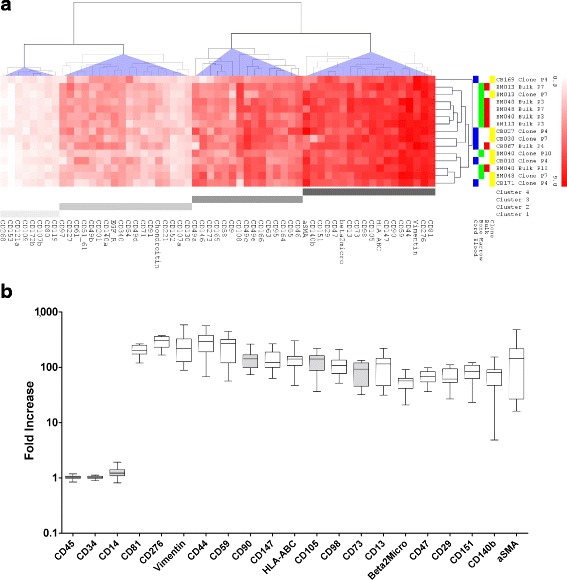
BM-MSC (n = 4) were expanded and analyzed as bulk (n = 6) or single clones isolated from the bulk culture (n = 3). CB-MSC (n = 6) were isolated and expanded as single clones in 5/6 samples. The BM-MSC and CB-MSC phenotype was investigated by flow cytometry using a panel of 246 monoclonal antibodies. To define the markers common to both sources, those showing the smallest variation between samples (coefficient of variation of log fold increase ≤ 0.5, n = 59) were selected for unsupervised hierarchical cluster analysis (HCL). Differentially expressed markers were identified by directly comparing the expression of all 246 antigens between BM-MSC and CB-MSC.
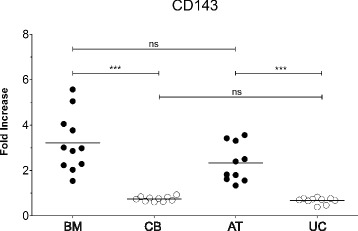
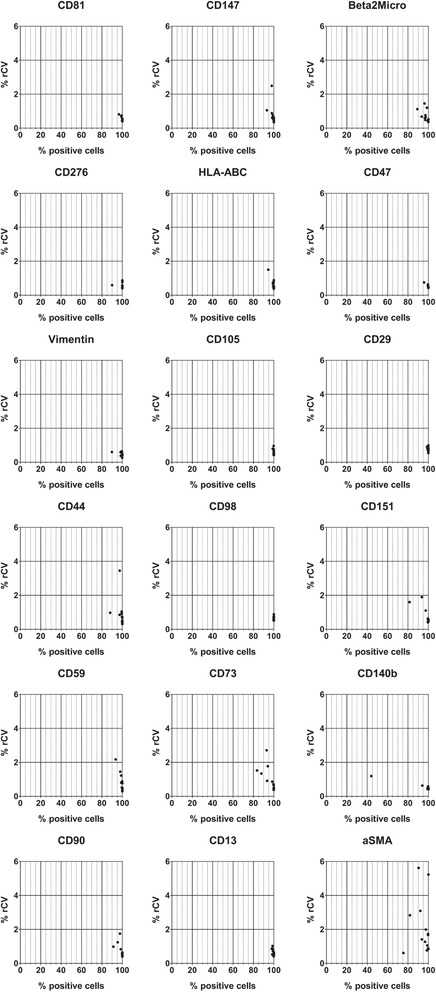
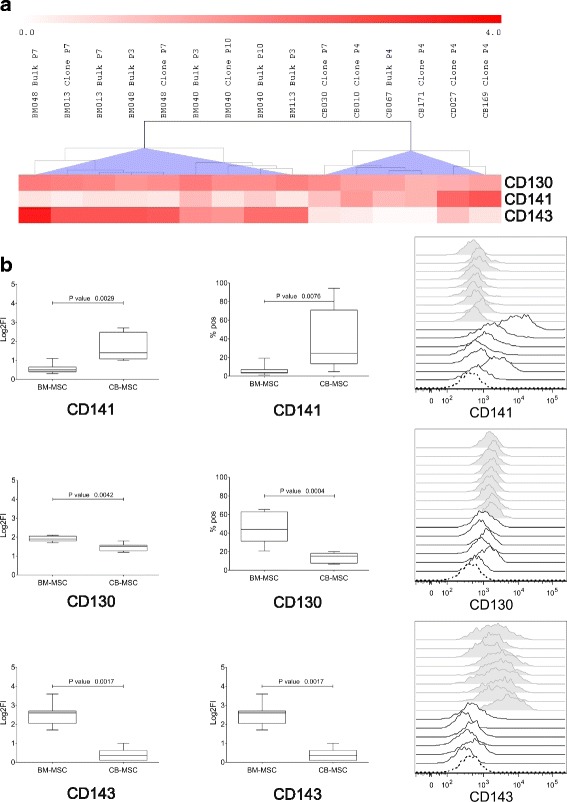
Based on HCL, 18 markers clustered as strongly expressed in BM-MSC and CB-MSC, including alpha-smooth muscle antigen (SMA), beta-2-microglobulin, CD105, CD13, CD140b, CD147, CD151, CD276, CD29, CD44, CD47, CD59, CD73, CD81, CD90, CD98, HLA-ABC, and vimentin. All except CD140b and alpha-SMA were suitable for the specific identification of ex-vivo expanded MSC. Notably, only angiotensin-converting enzyme (CD143) was exclusively expressed on BM-MSC. CD143 expression was tested on 10 additional BM-MSC and CB-MSC and on 10 umbilical cord- and adipose tissue-derived MSC samples, confirming that its expression is restricted to adult sources.
This is the first study that has comprehensively compared the phenotype of BM-MSC and CB-MSC. We have identified markers that could complement the minimal panel proposed for the in-vitro MSC definition, being shared and strongly expressed by BM- and CB-derived MSC. We have also identified CD143 as a marker exclusively expressed on MSC derived from adult tissue sources. Further studies will elucidate the biological role of CD143 and its potential association with tissue-specific MSC features.
间充质基质细胞(MSC)是一种多能祖细胞的异质群体,因其免疫调节特性和分化为多种中胚层谱系的能力而在临床上得到应用。尽管骨髓(BM)仍然是最常见的 MSC 来源,但脐带血(CB)可以无创采集,且不存在重大伦理问题。全面描述几种组织来源 MSC 表型的比较研究仍然缺乏。本研究对 BM 和 CB 来源的 MSC 进行了 246 种抗原免疫表型分析,旨在确定常见且强烈表达的 MSC 标志物,以及两种来源之间存在的鉴别标志物。
扩增 BM-MSC(n=4),并进行批量分析(n=6)或从批量培养物中分离出单个克隆进行分析(n=3)。在 5/6 的样本中,分离和扩增 CB-MSC 作为单个克隆。使用 246 种单克隆抗体的面板通过流式细胞术研究 BM-MSC 和 CB-MSC 的表型。为了确定两种来源共有的标志物,选择那些在样本间变异最小(对数倍增加的变异系数≤0.5,n=59)的标志物进行无监督层次聚类分析(HCL)。通过直接比较 BM-MSC 和 CB-MSC 之间所有 246 种抗原的表达来确定差异表达的标志物。
基于 HCL,18 种标志物被聚类为在 BM-MSC 和 CB-MSC 中强烈表达,包括α-平滑肌抗原(SMA)、β2-微球蛋白、CD105、CD13、CD140b、CD147、CD151、CD276、CD29、CD44、CD47、CD59、CD73、CD81、CD90、CD98、HLA-ABC 和波形蛋白。除了 CD140b 和α-SMA 之外,所有这些标志物都适合于体外扩增 MSC 的特异性识别。值得注意的是,只有血管紧张素转换酶(CD143)仅在 BM-MSC 上表达。在 10 个额外的 BM-MSC 和 CB-MSC 以及 10 个脐带和脂肪组织来源的 MSC 样本上测试了 CD143 的表达,证实其表达仅限于成人来源。
这是第一项全面比较 BM-MSC 和 CB-MSC 表型的研究。我们已经确定了一些标志物,可以补充体外 MSC 定义所建议的最小标志物面板,这些标志物在 BM 和 CB 来源的 MSC 中共同且强烈表达。我们还发现 CD143 是一种仅在来源于成人组织来源的 MSC 上表达的标志物。进一步的研究将阐明 CD143 的生物学作用及其与组织特异性 MSC 特征的潜在关联。