Popova Polina V, Klyushina Alexandra A, Vasilyeva Lyudmila B, Tkachuk Alexandra S, Bolotko Yana A, Gerasimov Andrey S, Pustozerov Evgenii A, Kravchuk Ekaterina N, Predeus Alexander, Kostareva Anna A, Grineva Elena N
Almazov National Medical Research Centre, Saint Petersburg, Russia.
Department of Internal Diseases and Endocrinology, Pavlov First Saint Petersburg State Medical University, Saint Petersburg, Russia.
Oncotarget. 2017 Dec 6;8(67):112024-112035. doi: 10.18632/oncotarget.22999. eCollection 2017 Dec 19.
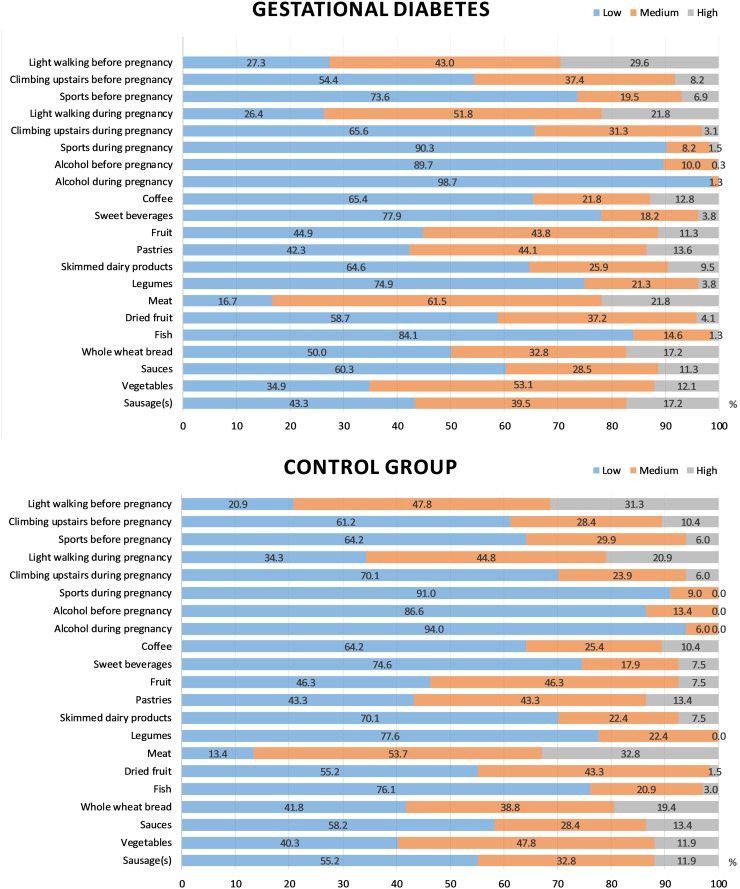
We hypothesized that the association of certain lifestyle parameters with gestational diabetes mellitus (GDM) risk would depend on susceptibility loci. In total, 278 Russian women with GDM and 179 controls completed questionnaires about lifestyle habits (food consumption, physical activity and smoking). GDM was diagnosed according to the criteria of the International Association of Diabetes and Pregnancy Study Groups. Maternal blood was sampled for genotyping single-nucleotide polymorphisms (SNPs) in (rs10830963 and rs1387153), (rs1799884), (rs5219), (rs4402960), (rs7903146 and rs12255372), (rs7754840), (rs1801278) and (rs9939609). Binary logistic regression revealed an interaction effect of sausage intake and the number of risk alleles of two SNPs (rs10830963 in and rs1799884 in ) on GDM risk (P < 0.001). Among women without risk alleles of these two SNPs, sausage consumption was positively associated with GDM risk (P trend = 0.045). This difference was not revealed in women carrying 1 or more risk alleles. The risk of GDM increased as the number of risk alles increased in participants with low and moderate sausage consumption (P trend <0.001 and 0.006, respectively), while the risk of GDM in women with high sausage consumption remained relatively high, independent of the number of risk alleles. These findings indicate that the association of sausage consumption with GDM risk can be determined based on the number of risk alleles of rs10830963 in and rs1799884 in .
我们推测某些生活方式参数与妊娠期糖尿病(GDM)风险之间的关联将取决于易感基因座。共有278名患有GDM的俄罗斯女性和179名对照者完成了关于生活习惯(食物摄入、体育活动和吸烟)的问卷调查。GDM根据国际糖尿病与妊娠研究组协会的标准进行诊断。采集孕妇血液样本,用于对(rs10830963和rs1387153)、(rs1799884)、(rs5219)、(rs4402960)、(rs7903146和rs12255372)、(rs7754840)、(rs1801278)和(rs9939609)中的单核苷酸多态性(SNP)进行基因分型。二元逻辑回归显示香肠摄入量与两个SNP(中的rs10830963和中的rs1799884)的风险等位基因数量对GDM风险存在交互作用(P < 0.001)。在没有这两个SNP风险等位基因的女性中,香肠消费与GDM风险呈正相关(P趋势 = 0.045)。在携带1个或更多风险等位基因的女性中未发现这种差异。在香肠摄入量低和中等的参与者中,随着风险等位基因数量的增加,GDM风险增加(P趋势分别<0.001和0.006),而香肠摄入量高的女性中GDM风险仍然相对较高,与风险等位基因数量无关。这些发现表明,香肠消费与GDM风险之间的关联可以根据中的rs10830963和中的rs1799884的风险等位基因数量来确定。