Department of Neurosurgery, Southwest Hospital, Third Military Medical University, Chongqing, China.
Neurosurgery Department of Guizhou, Medical University Affiliated Hospital, Guiyang, Guizhou, China.
J Am Heart Assoc. 2018 Jan 18;7(2):e007626. doi: 10.1161/JAHA.117.007626.
Many previous clinical studies have demonstrated that the nigrostriatal pathway, which plays a vital role in movement adjustment, is significantly impaired after stroke, according to medical imaging and autopsies. However, the basic pathomorphological changes have been poorly investigated to date. This study was designed to explore the pathomorphological changes, mechanism, and therapeutic method of nigrostriatal impairment after intracerebral hemorrhage (ICH).
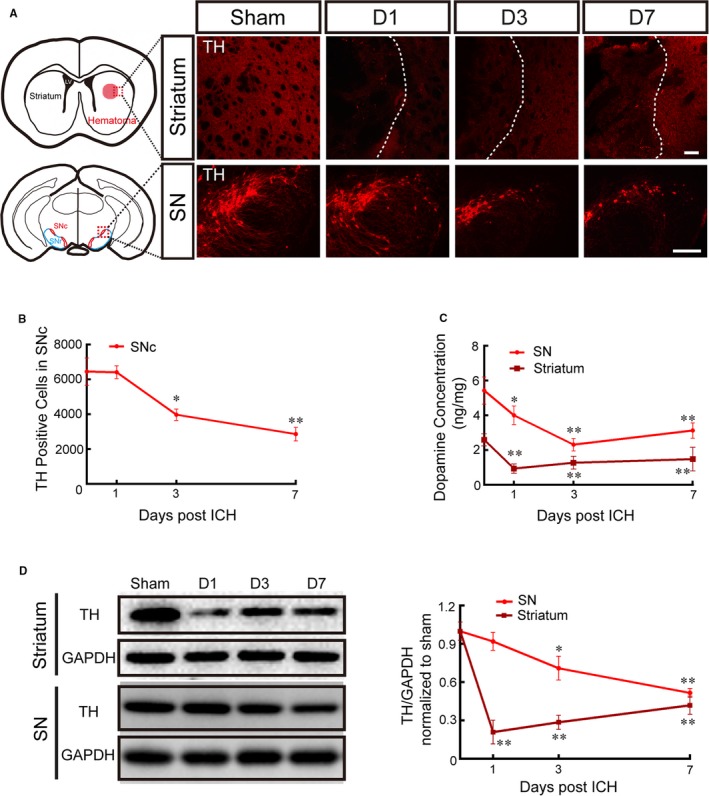
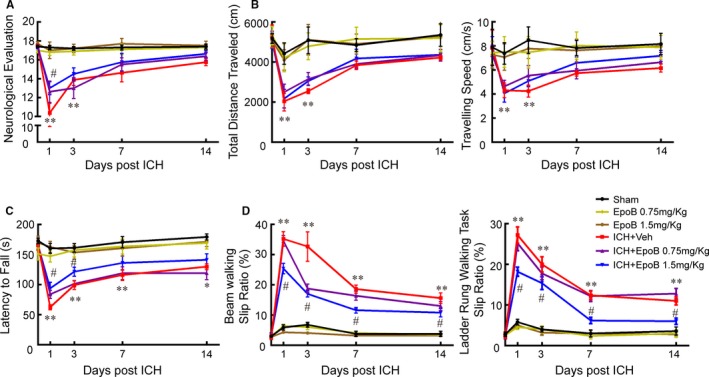
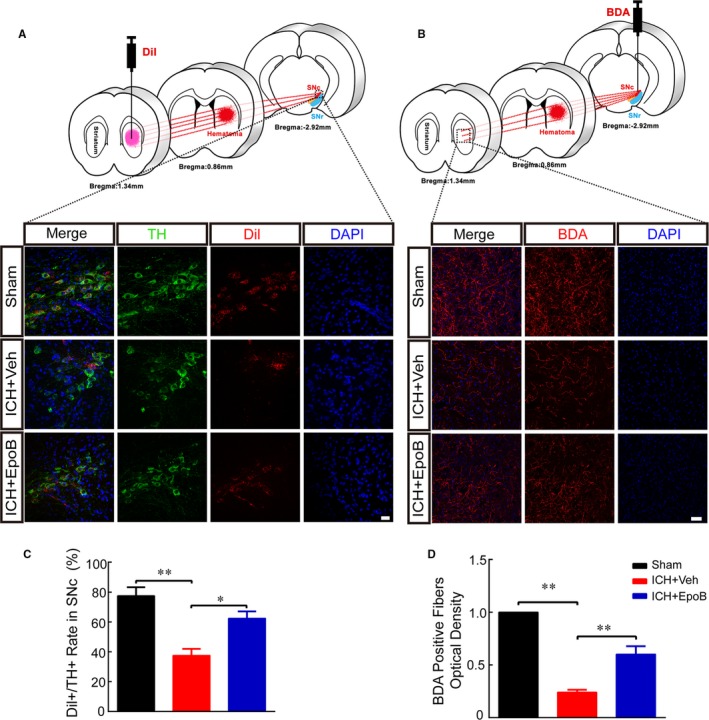
Intrastriatal injection of autologous blood or microtubule depolymerization reagent nocodazole was performed to mimic the pathology of ICH in C57/BL6 mice. Immunofluorescence, Western blotting, electron microscopy, functional behavioral tests, and anterograde and retrograde neural circuit tracking techniques were used in these mice. The data showed that the number of dopamine neurons and the dopamine concentration were severely decreased and that fine motor function was impaired after ICH. Microtubule depolymerization was the main contributor to the loss of dopamine neurons and to motor function deficits after ICH, as was also proven by intrastriatal injection of nocodazole. Moreover, administration of the microtubule stabilizer epothilone B (1.5 mg/kg) improved the integrity of the nigrostriatal pathway neural circuit, increased the number of dopamine neurons (4598±896 versus 3125±355; =0.034) and the dopamine concentration (4.28±0.99 versus 3.08±0.75 ng/mg; =0.041), and enhanced fine motor functional recovery associated with increased acetylated α-tubulin expression to maintain microtubule stabilization after ICH.
Our results clarified the pathomorphological changes of the nigrostriatal pathway after ICH and found that epothilone B helped alleviate nigrostriatal pathway injury after ICH, associated with promoting α-tubulin acetylation to maintain microtubule stabilization, thus facilitating motor recovery.
许多先前的临床研究表明,在影像学和尸检中,对运动调节起关键作用的黑质纹状体通路在中风后明显受损。然而,迄今为止,基本的病理形态变化仍未得到充分研究。本研究旨在探讨脑出血(ICH)后黑质纹状体损伤的病理形态变化、机制和治疗方法。
在 C57/BL6 小鼠纹状体内注射自体血或微管解聚试剂诺考达唑,模拟 ICH 病理。免疫荧光、Western blot、电镜、功能行为测试以及顺行和逆行神经回路追踪技术用于这些小鼠。结果显示,ICH 后多巴胺神经元数量和多巴胺浓度严重减少,精细运动功能受损。微管解聚是 ICH 后多巴胺神经元丢失和运动功能缺陷的主要原因,这也通过纹状体内注射诺考达唑得到了证明。此外,微管稳定剂埃博霉素 B(1.5mg/kg)的给药改善了黑质纹状体通路神经回路的完整性,增加了多巴胺神经元的数量(4598±896 比 3125±355;=0.034)和多巴胺浓度(4.28±0.99 比 3.08±0.75 ng/mg;=0.041),并增强了精细运动功能的恢复,与增加乙酰化 α-微管蛋白表达以维持 ICH 后微管稳定有关。
我们的研究结果阐明了 ICH 后黑质纹状体通路的病理形态变化,并发现埃博霉素 B 有助于减轻 ICH 后黑质纹状体通路损伤,与促进 α-微管蛋白乙酰化以维持微管稳定有关,从而促进运动功能恢复。