Dimsdale-Zucker Halle R, Ritchey Maureen, Ekstrom Arne D, Yonelinas Andrew P, Ranganath Charan
Center for Neuroscience, University of California, Davis, CA, 95618, USA.
Department of Psychology, University of California, Davis, CA, 95618, USA.
Nat Commun. 2018 Jan 18;9(1):294. doi: 10.1038/s41467-017-02752-1.
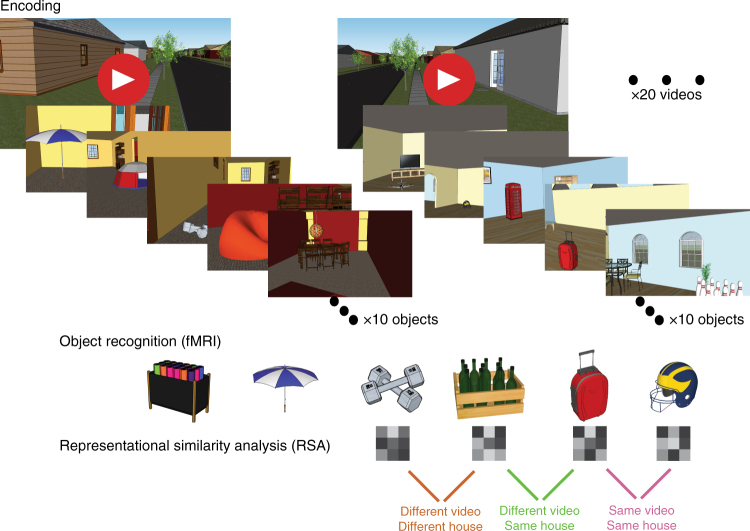
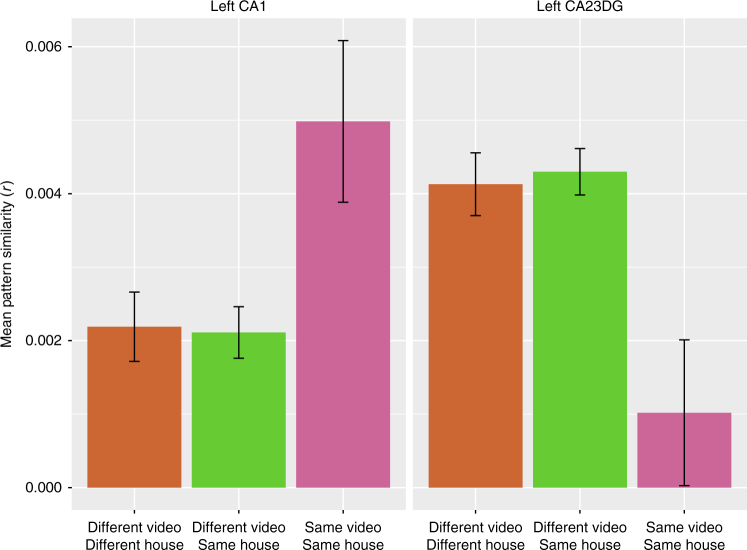
The hippocampus plays a critical role in spatial and episodic memory. Mechanistic models predict that hippocampal subfields have computational specializations that differentially support memory. However, there is little empirical evidence suggesting differences between the subfields, particularly in humans. To clarify how hippocampal subfields support human spatial and episodic memory, we developed a virtual reality paradigm where participants passively navigated through houses (spatial contexts) across a series of videos (episodic contexts). We then used multivariate analyses of high-resolution fMRI data to identify neural representations of contextual information during recollection. Multi-voxel pattern similarity analyses revealed that CA1 represented objects that shared an episodic context as more similar than those from different episodic contexts. CA23DG showed the opposite pattern, differentiating between objects encountered in the same episodic context. The complementary characteristics of these subfields explain how we can parse our experiences into cohesive episodes while retaining the specific details that support vivid recollection.
海马体在空间记忆和情景记忆中起着关键作用。机制模型预测,海马体亚区具有不同的计算专长,对记忆有不同的支持作用。然而,几乎没有实证证据表明这些亚区之间存在差异,尤其是在人类身上。为了阐明海马体亚区如何支持人类的空间记忆和情景记忆,我们开发了一种虚拟现实范式,让参与者在一系列视频(情景背景)中被动地在房屋(空间背景)中导航。然后,我们使用高分辨率功能磁共振成像数据的多变量分析来识别回忆过程中情境信息的神经表征。多体素模式相似性分析表明,CA1将共享情景背景的物体表征为比来自不同情景背景的物体更相似。CA23DG则呈现相反的模式,区分在同一情景背景中遇到的物体。这些亚区的互补特征解释了我们如何能够将自己的经历解析为连贯的情节,同时保留支持生动回忆的具体细节。