Adams Natalie L, Rose Tanith C, Hawker Jeremy, Violato Mara, O'Brien Sarah J, Barr Benjamin, Howard Victoria J K, Whitehead Margaret, Harris Ross, Taylor-Robinson David C
NIHR Health Protection Research Unit in Gastrointestinal Infections, Liverpool, United Kingdom.
Department of Public Health and Policy, University of Liverpool, Liverpool, United Kingdom.
PLoS One. 2018 Jan 23;13(1):e0191633. doi: 10.1371/journal.pone.0191633. eCollection 2018.
The association between socioeconomic status (SES) and health is well-documented; however limited evidence on the relationship between SES and gastrointestinal (GI) infections exists, with published studies producing conflicting results. This systematic review aimed to assess the association between SES and GI infection risk, and explore possible sources of heterogeneity in effect estimates reported in the literature.
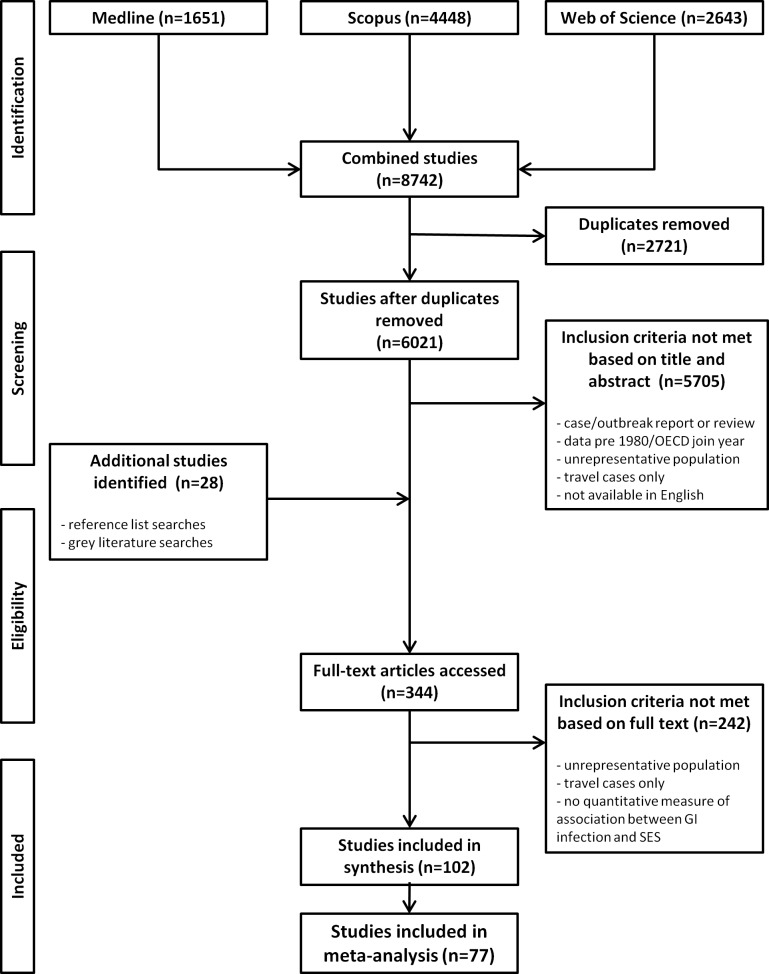
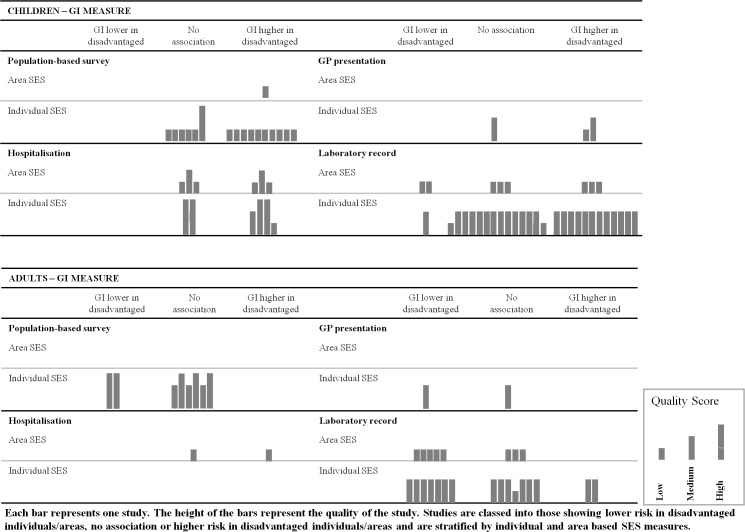
MEDLINE, Scopus, Web of Science and grey literature were searched from 1980 to October 2015 for studies reporting an association between GI infections and SES in a representative population sample from a member-country of the Organisation for Economic Co-operation and Development. Harvest plots and meta-regression were used to investigate potential sources of heterogeneity such as age; level of SES variable; GI infection measurement; and predominant mode of transmission. The protocol was registered on PROSPERO: CRD42015027231.
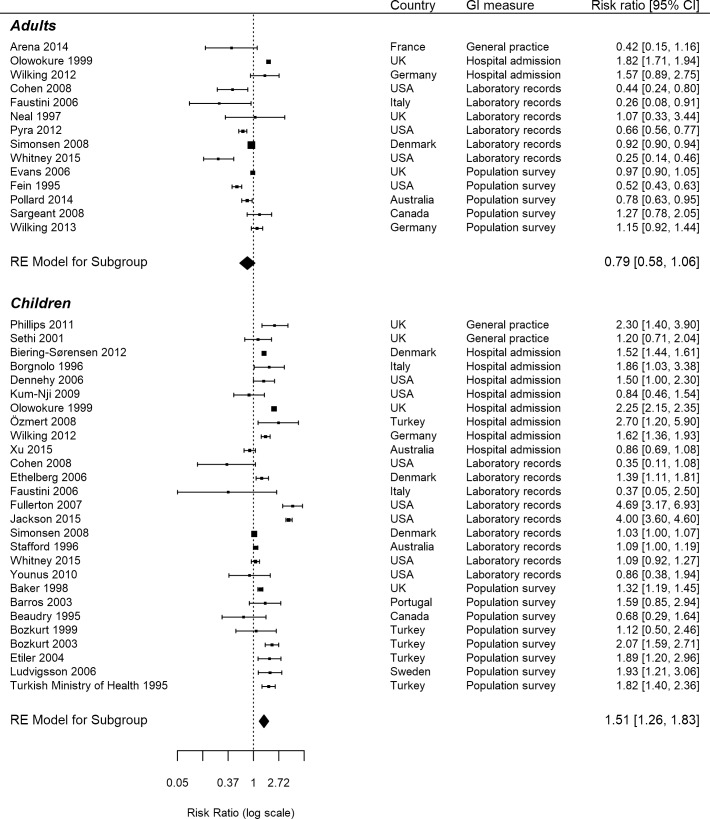
In total, 6021 studies were identified; 102 met the inclusion criteria. Age was identified as the only statistically significant potential effect modifier of the association between SES and GI infection risk. For children, GI infection risk was higher for those of lower SES versus high (RR 1.51, 95% CI;1.26-1.83), but there was no association for adults (RR 0.79, 95% CI;0.58-1.06). In univariate analysis, the increased risk comparing low and high SES groups was significantly higher for pathogens spread by person-to-person transmission, but lower for environmental pathogens, as compared to foodborne pathogens.
Disadvantaged children, but not adults, have greater risk of GI infection compared to their more advantaged counterparts. There was high heterogeneity and many studies were of low quality. More high quality studies are needed to investigate the association between SES and GI infection risk, and future research should stratify analyses by age and pathogen type. Gaining further insight into this relationship will help inform policies to reduce inequalities in GI illness in children.
社会经济地位(SES)与健康之间的关联已有充分文献记载;然而,关于SES与胃肠道(GI)感染之间关系的证据有限,已发表的研究结果相互矛盾。本系统评价旨在评估SES与GI感染风险之间的关联,并探讨文献中报道的效应估计异质性的可能来源。
检索1980年至2015年10月期间的MEDLINE、Scopus、科学网和灰色文献,查找在经济合作与发展组织成员国的代表性人群样本中报告GI感染与SES之间关联的研究。采用收获图和Meta回归分析来调查潜在的异质性来源,如年龄、SES变量水平、GI感染测量方法以及主要传播方式。该方案已在国际前瞻性系统评价注册库(PROSPERO)注册:CRD42015027231。
共识别出6021项研究;102项符合纳入标准。年龄被确定为SES与GI感染风险之间关联的唯一具有统计学意义的潜在效应修饰因素。对于儿童,SES较低者的GI感染风险高于SES较高者(风险比[RR]1.5⒈95%置信区间[CI]:1.26 - 1.83),但成年人之间无关联(RR0.79,95%CI:0.58 - 1.06)。在单变量分析中,与食源性病原体相比,经人际传播的病原体导致的低SES组与高SES组之间的风险增加显著更高,而环境性病原体导致的风险增加则较低。
与条件较好的儿童相比,处境不利的儿童GI感染风险更高,但成年人并非如此。存在高度异质性,且许多研究质量较低。需要更多高质量研究来调查SES与GI感染风险之间的关联,未来研究应按年龄和病原体类型进行分层分析。进一步深入了解这种关系将有助于制定政策,以减少儿童GI疾病方面的不平等现象。