Department of Psychiatry, Emory University School of Medicine, Emory Veterans Program, 12 Executive Park Drive, Atlanta, GA, 30329, USA.
Department of Medical and Clinical Psychology, Uniformed Services University of the Health Sciences (USUHS), DoD, 4301 Jones Bridge Road, Bethesda, MD, 20814, USA; Section on Growth and Obesity, Program in Developmental Endocrinology and Genetics, Eunice Kennedy Shriver National Institute of Child Health and Human Development (NICHD), National Institutes of Health (NIH), DHHS, 10 Center Drive, Bethesda, MD, 20892, USA.
Appetite. 2018 Apr 1;123:367-389. doi: 10.1016/j.appet.2018.01.019. Epub 2018 Jan 31.
Attentional bias (AB) may be one mechanism contributing to the development and/or maintenance of disordered eating. AB has traditionally been measured using reaction time in response to a stimulus. Novel methods for AB measurement include eye tracking to measure visual fixation on a stimulus, and electroencephalography to measure brain activation in response to a stimulus. This systematic review summarizes, critiques, and integrates data on AB gathered using the above-mentioned methods in those with binge eating behaviors, including binge eating, loss of control eating, and bulimia nervosa.
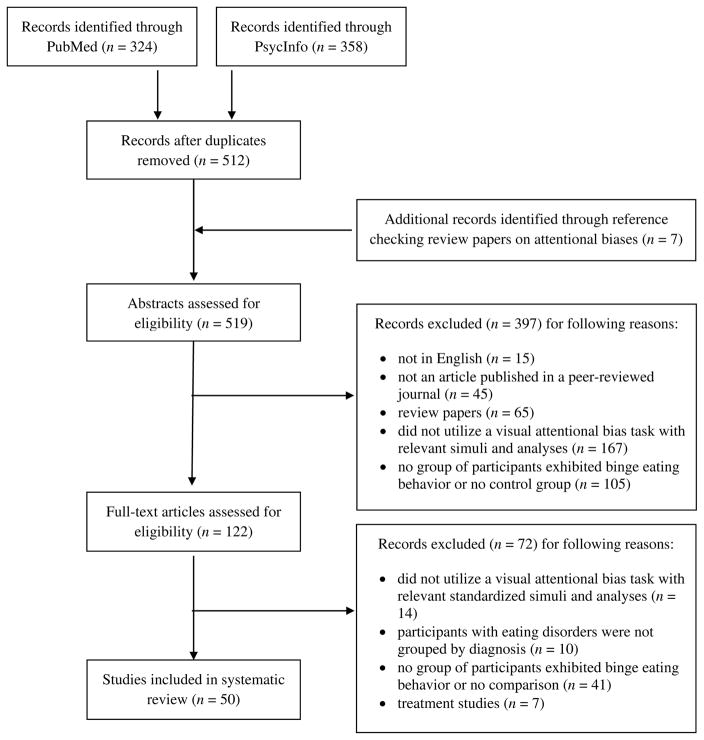
Literature searches on PubMed and PsycInfo were conducted using combinations of terms related to binge eating and biobehavioral AB paradigms. Studies using AB paradigms with three categories of stimuli were included: food, weight/shape, and threat. For studies reporting means and standard deviations of group bias scores, Hedges' g effect sizes for group differences in AB were calculated.
Fifty articles met inclusion criteria and were reviewed. Individuals who binge eat in the absence of compensatory behaviors show an increased AB to food cues, but few studies have examined such individuals' AB toward weight/shape and threatening stimuli. Individuals with bulimia nervosa consistently show an increased AB to shape/weight cues and socially threatening stimuli, but findings for AB to food cues are mixed.
While there are important research gaps, preliminary evidence suggests that the combination of AB to disorder-specific cues (i.e., food and weight/shape) and AB toward threat may be a potent contributor to binge eating. This conclusion underscores previous findings on the interaction between negative affect and AB to disorder-specific cues. Recommendations for future research are provided.
注意偏向(AB)可能是导致饮食失调发展和/或维持的机制之一。AB 传统上是通过对刺激的反应时间来衡量的。AB 的新测量方法包括眼动追踪,以测量对刺激的视觉固定;以及脑电图,以测量对刺激的大脑激活。本系统综述总结、评价并整合了使用上述方法在有暴食行为的个体中(包括暴食、失控进食和神经性贪食症)测量 AB 的数据。
使用与暴食和生物行为 AB 范式相关的术语在 PubMed 和 PsycInfo 上进行文献检索。纳入了使用三种刺激类别(食物、体重/体型和威胁)的 AB 范式的研究。对于报告组偏差得分均值和标准差的研究,计算了 AB 组间差异的 Hedges'g 效应大小。
有 50 篇文章符合纳入标准并进行了综述。在没有补偿性行为的情况下暴食的个体对食物线索表现出增加的 AB,但很少有研究检查过这些个体对体重/体型和威胁性刺激的 AB。神经性贪食症患者始终表现出对体型/体重线索和社会威胁性刺激的 AB 增加,但对食物线索的 AB 结果则不一致。
尽管存在重要的研究差距,但初步证据表明,对特定于障碍的线索(即食物和体重/体型)和对威胁的 AB 的结合可能是暴食的一个重要因素。这一结论强调了先前关于负性情绪与特定于障碍的线索的 AB 之间相互作用的发现。提供了对未来研究的建议。