
球孢子菌属物种中转座元件的分析
Analysis of Transposable Elements in Coccidioides Species.
作者信息
Kirkland Theo N, Muszewska Anna, Stajich Jason E
机构信息
Departments of Pathology and Medicine, School of Medicine, University of California, San Diego, CA 92037, USA.
Institute of Biochemistry and Biophysics, Polish Academy of Sciences, 02-106 Warsaw, Poland.
出版信息
J Fungi (Basel). 2018 Jan 19;4(1):13. doi: 10.3390/jof4010013.
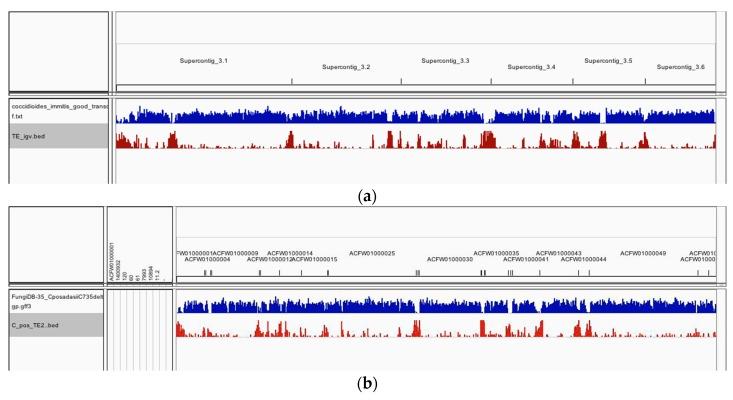
and are primary pathogenic fungi that cause disease in immunologically-normal animals and people. The organism is found exclusively in arid regions of the Southwestern United States, Mexico, and South America, but not in other parts of the world. This study is a detailed analysis of the transposable elements (TE) in spp. As is common in most fungi, Class I and Class II transposons were identified and the LTR superfamily is the most common. The minority of transposons contained regions highly homologous to polyprotein domains. Phylogenetic analysis of the integrase and reverse transcriptase sequences revealed that many, but not all, of the reverse transcriptase and integrase domains clustered by species suggesting extensive transposition after speciation of the two spp. The TEs were clustered and the distribution is enriched for the ends on contigs. Analysis of gene expression data from found that protein-coding genes within 1 kB of or TEs were poorly expressed. The expression of genes within 1 kB of TEs was also significantly lower compared to all genes but the difference in expression was smaller than . orthologs of -associated genes were also likely to be TE-associated. In both and the TEs were preferentially associated with genes annotated with protein kinase gene ontology terms. These observations suggest that TE may play a role in influencing gene expression in spp. Our hope is that these bioinformatic studies of the potential TE influence on expression and evolution of will prompt the development of testable hypotheses to better understand the role of TEs in the biology and gene regulation of spp.
[此处原文中两个真菌名称缺失,暂无法准确翻译]是主要的致病真菌,可在免疫功能正常的动物和人类中引发疾病。这种生物体仅在美国西南部、墨西哥和南美洲的干旱地区被发现,世界其他地区则没有。本研究是对[此处原文中真菌名称缺失,暂无法准确翻译]属物种中转座元件(TE)的详细分析。正如大多数真菌中常见的那样,鉴定出了I类和II类转座子,其中LTR超家族最为常见。少数[此处原文中真菌名称缺失,暂无法准确翻译]转座子包含与多蛋白结构域高度同源的区域。对整合酶和逆转录酶序列的系统发育分析表明,许多(但并非全部)[此处原文中真菌名称缺失,暂无法准确翻译]逆转录酶和整合酶结构域按物种聚类,这表明在这两个[此处原文中真菌名称缺失,暂无法准确翻译]属物种形成后发生了广泛的转座。转座元件聚集在一起,其分布在重叠群末端富集。对[此处原文中真菌名称缺失,暂无法准确翻译]的基因表达数据进行分析发现,距离[此处原文中真菌名称缺失,暂无法准确翻译]或[此处原文中真菌名称缺失,暂无法准确翻译]转座元件1 kB内的蛋白质编码基因表达较差。与所有基因相比,距离[此处原文中真菌名称缺失,暂无法准确翻译]转座元件1 kB内的[此处原文中真菌名称缺失,暂无法准确翻译]基因表达也显著较低,但表达差异小于[此处原文中数据缺失,暂无法准确翻译]。与[此处原文中真菌名称缺失,暂无法准确翻译]相关基因的直系同源基因也可能与转座元件相关。在[此处原文中两个真菌名称缺失,暂无法准确翻译]中,转座元件都优先与注释为蛋白激酶基因本体术语的基因相关联。这些观察结果表明,转座元件可能在影响[此处原文中真菌名称缺失,暂无法准确翻译]属物种的基因表达中发挥作用。我们希望这些关于转座元件对[此处原文中真菌名称缺失,暂无法准确翻译]表达和进化潜在影响的生物信息学研究,将促使提出可检验的假设,以更好地理解转座元件在[此处原文中真菌名称缺失,暂无法准确翻译]属物种生物学和基因调控中的作用。




 Zotero 插件