Ottino-González Jonatan, Jurado María A, García-García Isabel, Segura Bàrbara, Marqués-Iturria Idoia, Sender-Palacios María J, Tor Encarnació, Prats-Soteras Xavier, Caldú Xavier, Junqué Carme, Garolera Maite
Departament de Psicologia Clínica i Psicobiologia, Universitat de Barcelona, Barcelona, Spain.
Institut de Neurociències, Universitat de Barcelona, Barcelona, Spain.
Front Hum Neurosci. 2017 Dec 22;11:639. doi: 10.3389/fnhum.2017.00639. eCollection 2017.
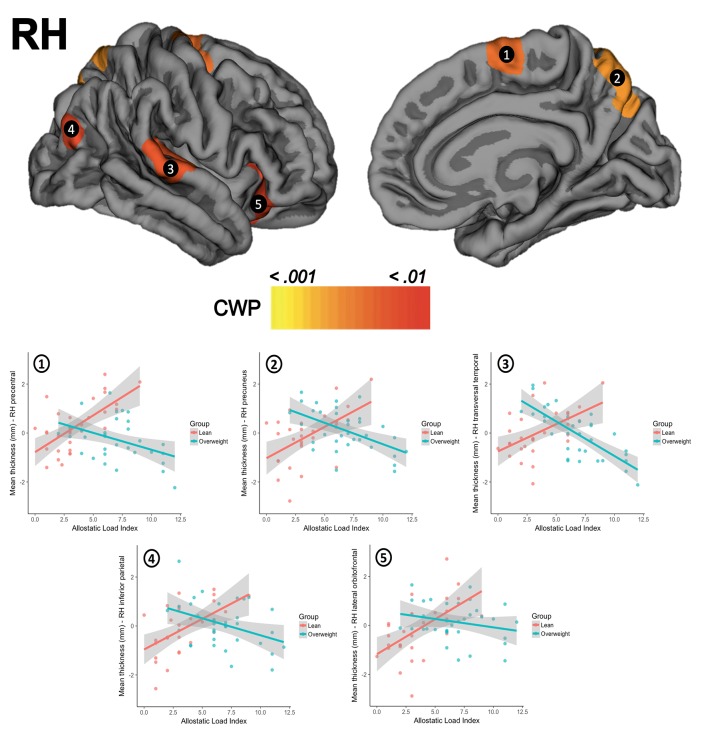
Overweight (body mass index or BMI ≥ 25 kg/m) and stress interact with each other in complex ways. Overweight promotes chronic low-inflammation states, while stress is known to mediate caloric intake. Both conditions are linked to several avoidable health problems and to cognitive decline, brain atrophy, and dementia. Since it was proposed as a framework for the onset of mental illness, the allostatic load model has received increasing attention. Although changes in health and cognition related to overweight and stress are well-documented separately, the association between allostatic load and brain integrity has not been addressed in depth, especially among overweight subjects. Thirty-four healthy overweight-to-obese and 29 lean adults underwent blood testing, neuropsychological examination, and magnetic resonance imaging to assess the relationship between cortical thickness and allostatic load, represented as an index of 15 biomarkers (this is, systolic and diastolic arterial tension, glycated hemoglobin, glucose, creatinine, total cholesterol, HDL and LDL cholesterol, triglycerides, c-reactive protein, interleukin-6, insulin, cortisol, fibrinogen, and leptin). Allostatic load indexes showed widespread positive and negative significant correlations ( < 0.01) with cortical thickness values depending on body-weight status. The increase of allostatic load is linked to changes in the gray matter composition of regions monitoring behavior, sensory-reward processing, and general cognitive function.
超重(体重指数即BMI≥25kg/m²)与压力以复杂的方式相互作用。超重会引发慢性低炎症状态,而压力已知会影响热量摄入。这两种情况都与一些可避免的健康问题以及认知能力下降、脑萎缩和痴呆有关。自从作为精神疾病发病的一个框架被提出以来,应激负荷模型受到了越来越多的关注。尽管与超重和压力相关的健康及认知变化已分别得到充分记录,但应激负荷与脑完整性之间的关联尚未得到深入研究,尤其是在超重人群中。34名健康的超重至肥胖成年人以及29名瘦成年人接受了血液检测、神经心理学检查和磁共振成像,以评估皮质厚度与应激负荷之间的关系,应激负荷用15种生物标志物(即收缩压和舒张压、糖化血红蛋白、血糖、肌酐、总胆固醇、高密度脂蛋白和低密度脂蛋白胆固醇、甘油三酯、c反应蛋白、白细胞介素-6、胰岛素、皮质醇、纤维蛋白原和瘦素)的指数来表示。应激负荷指数根据体重状况与皮质厚度值呈现出广泛的显著正相关和负相关(P<0.01)。应激负荷的增加与监测行为、感觉奖励处理和一般认知功能区域的灰质组成变化有关。