Institute of Biophysics of the Czech Academy of Sciences, Královopolská 135, 612 65 Brno, Czech Republic.
Rimstone Laboratory, RLI, Carlsbad, CA 92010, USA.
Nucleic Acids Res. 2018 Feb 28;46(4):1624-1634. doi: 10.1093/nar/gky035.
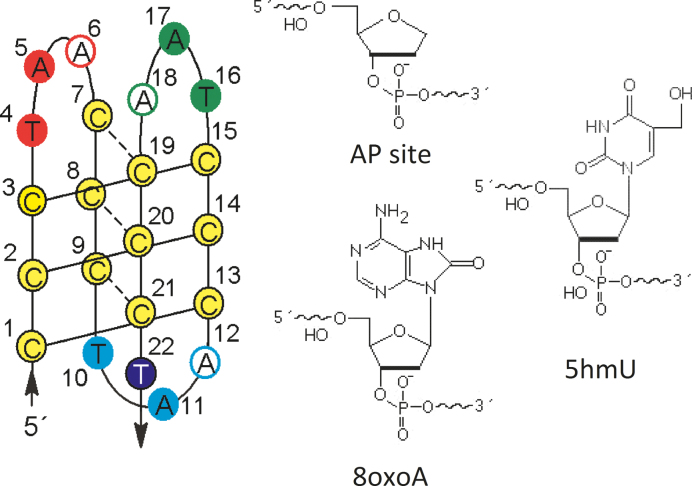
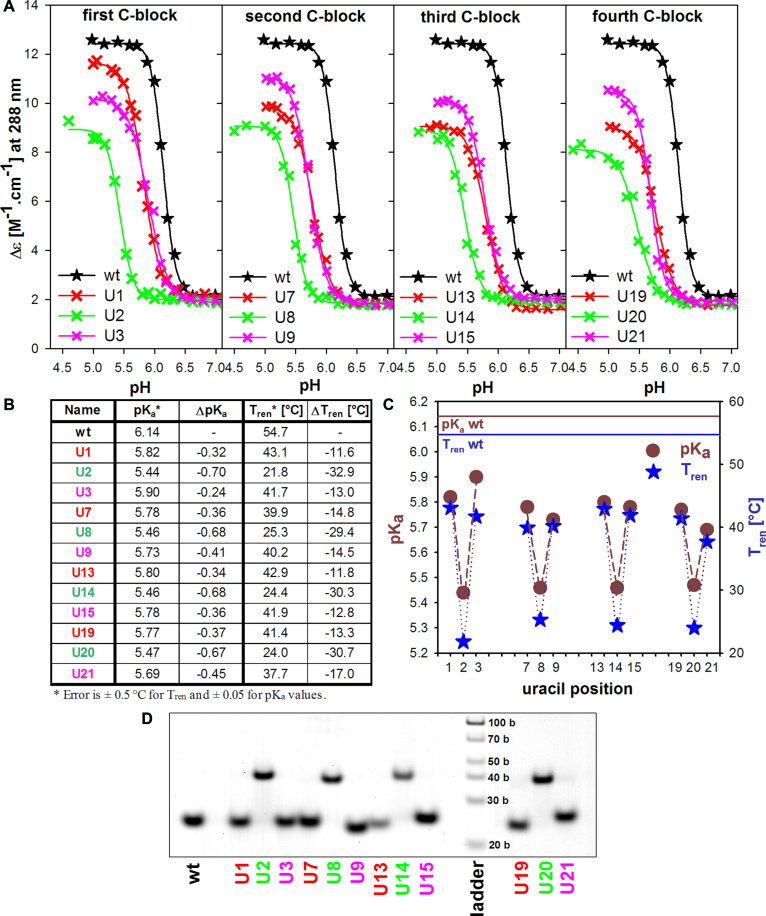
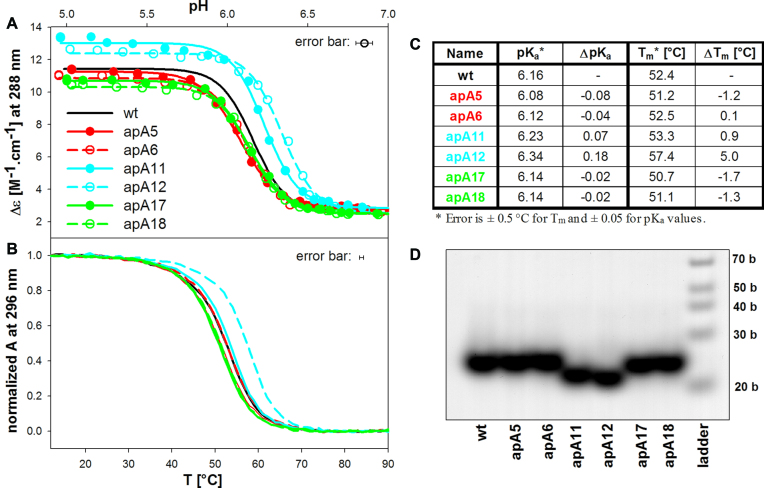
i-Motif (iM) is a four stranded DNA structure formed by cytosine-rich sequences, which are often present in functionally important parts of the genome such as promoters of genes and telomeres. Using electronic circular dichroism and UV absorption spectroscopies and electrophoretic methods, we examined the effect of four naturally occurring DNA base lesions on the folding and stability of the iM formed by the human telomere DNA sequence (C3TAA)3C3T. The results demonstrate that the TAA loop lesions, the apurinic site and 8-oxoadenine substituting for adenine, and the 5-hydroxymethyluracil substituting for thymine only marginally disturb the formation of iM. The presence of uracil, which is formed by enzymatic or spontaneous deamination of cytosine, shifts iM formation towards substantially more acidic pH values and simultaneously distinctly reduces iM stability. This effect depends on the position of the damage sites in the sequence. The results have enabled us to formulate additional rules for iM formation.
i- 基序 (iM) 是由富含胞嘧啶的序列形成的四链 DNA 结构,这些序列通常存在于基因组中功能重要的部分,如基因启动子和端粒。我们使用电子圆二色性和紫外吸收光谱以及电泳方法,研究了四种天然存在的 DNA 碱基损伤对由人类端粒 DNA 序列 (C3TAA)3C3T 形成的 iM 折叠和稳定性的影响。结果表明,TAA 环损伤、无嘌呤位点和 8-氧代腺嘌呤取代腺嘌呤,以及 5-羟甲基尿嘧啶取代胸腺嘧啶,仅略微干扰 iM 的形成。由胞嘧啶酶促或自发脱氨形成的尿嘧啶的存在将 iM 的形成推向更酸性的 pH 值,并同时明显降低 iM 的稳定性。这种影响取决于损伤部位在序列中的位置。这些结果使我们能够制定 iM 形成的其他规则。