Demisse Abayneh Girma, Alemu Fentahun, Gizaw Mahlet Abayneh, Tigabu Zemene
School of Medicine, College of Medicine and Health Science, University of Gondar, Gondar, Ethiopia.
Pediatric Health Med Ther. 2017 May 12;8:57-64. doi: 10.2147/PHMT.S130309. eCollection 2017.
The neonatal period is a highly vulnerable time for an infant completing many of the physiologic adjustments required for life outside the uterus. As a result, there are high rates of morbidity and mortality. The three major causes of mortality in developing countries include prematurity, infection, and perinatal asphyxia. The aim of this study was to identify the patterns of neonatal admission and factors associated with mortality among neonates admitted at the Neonatal Intensive Care Unit (NICU) of University of Gondar Hospital.
A retrospective cross-sectional study was conducted among all admitted neonates in the NICU of University of Gondar referral hospital from December 1, 2015 to August 31, 2016. Information was extracted retrospectively during admission from patient records and death certificates, using a pretested questionnaire. The data were entered and analyzed using SPSS version 20, and -values <0.05 were considered statistically significant.
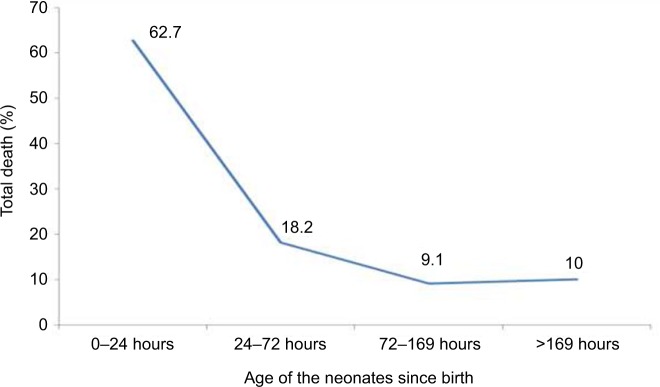
A total of 769 neonates was included in the study. There were 448 (58.3%) male neonates, and 398 (51.8%) neonates were rural residents. More than two-thirds of the 587 deliveries (76.3%) were performed in tertiary hospitals. Neonatal morbidity included hypothermia 546 (71%), sepsis 522 (67.9%), prematurity 250 (34.9%), polycythemia 242 (31.5%), hypoglycemia 142 (18.5), meconium aspiration syndrome 113 (14.7%), and perinatal asphyxia 96 (12.5%). The overall mortality was 110 (14.3%; 95% confidence interval [CI]: 11.9-16.9) of which 69 (62.7%) deaths occurred in the first 24 hours of age. In the multivariate analysis, mortality was associated with perinatal asphyxia (adjusted odds ratio [AOR]: 5.97; 95% CI: 3.06-11.64), instrumental delivery (AOR: 2.99; 95% CI: 1.08-8.31), and early onset neonatal sepsis (AOR: 2.66; 95% CI: 1.62-6.11).
Hypothermia, sepsis, and prematurity were the main reasons for NICU admission. Neonates often died within the first 24 hours of age. Implementing a better referral link and timely intervention could decrease neonatal mortality and morbidities in Gondar, Ethiopia.
新生儿期对于完成子宫外生活所需的许多生理调节的婴儿来说是一个极易受到伤害的时期。因此,发病率和死亡率很高。发展中国家的三大死亡原因包括早产、感染和围产期窒息。本研究的目的是确定贡德尔大学医院新生儿重症监护病房(NICU)收治的新生儿的入院模式以及与死亡率相关的因素。
对2015年12月1日至2016年8月31日在贡德尔大学转诊医院NICU收治的所有新生儿进行回顾性横断面研究。使用预先测试的问卷,在入院时从患者记录和死亡证明中回顾性提取信息。数据使用SPSS 20版录入和分析,P值<0.05被认为具有统计学意义。
本研究共纳入769例新生儿。有448例(58.3%)为男性新生儿,398例(51.8%)新生儿为农村居民。587例分娩中超过三分之二(76.3%)在三级医院进行。新生儿疾病包括体温过低546例(71%)、败血症522例(67.9%)、早产250例(34.9%)、红细胞增多症242例(31.5%)、低血糖142例(18.5%)、胎粪吸入综合征113例(14.7%)和围产期窒息96例(12.5%)。总体死亡率为110例(14.3%;95%置信区间[CI]:11.9 - 16.9),其中69例(62.7%)死亡发生在出生后24小时内。在多变量分析中,死亡率与围产期窒息(调整优势比[AOR]:5.97;95% CI:3.06 - 11.64)、器械助产(AOR:2.99;95% CI:1.08 - 8.31)和早发性新生儿败血症(AOR:2.66;95% CI:1.62 - 6.11)相关。
体温过低、败血症和早产是入住NICU的主要原因。新生儿通常在出生后24小时内死亡。在埃塞俄比亚的贡德尔,建立更好的转诊联系并及时进行干预可以降低新生儿死亡率和发病率。