Department of Biomedical Engineering, The City College of the City University of New York, United States.
Laboratory of Neurosciences (LIM-27), Department and Institute of Psychiatry, University of Sao Paulo, Sao Paulo, Brazil.
Brain Stimul. 2018 May-Jun;11(3):465-480. doi: 10.1016/j.brs.2017.12.008. Epub 2017 Dec 29.
Neuropsychiatric disorders are a leading source of disability and require novel treatments that target mechanisms of disease. As such disorders are thought to result from aberrant neuronal circuit activity, neuromodulation approaches are of increasing interest given their potential for manipulating circuits directly. Low intensity transcranial electrical stimulation (tES) with direct currents (transcranial direct current stimulation, tDCS) or alternating currents (transcranial alternating current stimulation, tACS) represent novel, safe, well-tolerated, and relatively inexpensive putative treatment modalities.
This report seeks to promote the science, technology and effective clinical applications of these modalities, identify research challenges, and suggest approaches for addressing these needs in order to achieve rigorous, reproducible findings that can advance clinical treatment.
The National Institute of Mental Health (NIMH) convened a workshop in September 2016 that brought together experts in basic and human neuroscience, electrical stimulation biophysics and devices, and clinical trial methods to examine the physiological mechanisms underlying tDCS/tACS, technologies and technical strategies for optimizing stimulation protocols, and the state of the science with respect to therapeutic applications and trial designs.
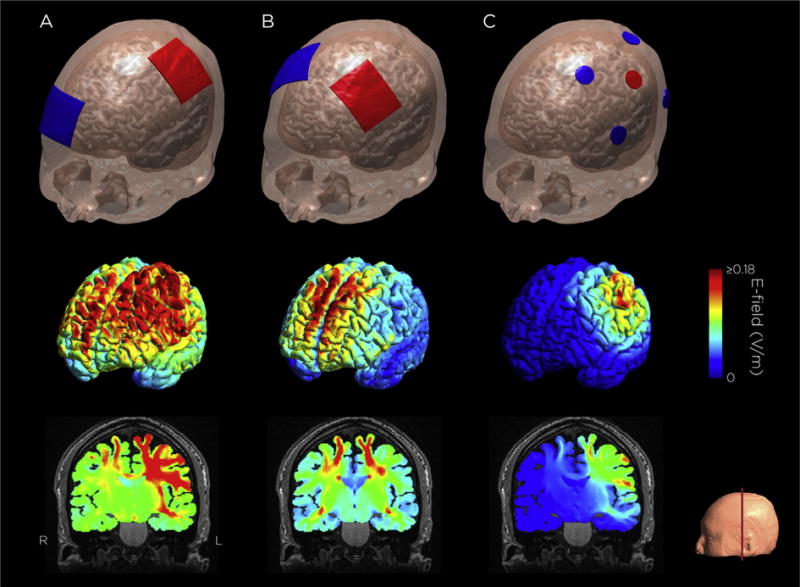
Advances in understanding mechanisms, methodological and technological improvements (e.g., electronics, computational models to facilitate proper dosing), and improved clinical trial designs are poised to advance rigorous, reproducible therapeutic applications of these techniques. A number of challenges were identified and meeting participants made recommendations made to address them.
These recommendations align with requirements in NIMH funding opportunity announcements to, among other needs, define dosimetry, demonstrate dose/response relationships, implement rigorous blinded trial designs, employ computational modeling, and demonstrate target engagement when testing stimulation-based interventions for the treatment of mental disorders.
神经精神疾病是导致残疾的主要原因,需要针对疾病机制的新型治疗方法。由于这些疾病被认为是由于异常的神经元回路活动引起的,因此神经调节方法越来越受到关注,因为它们具有直接操纵回路的潜力。使用直流电(经颅直流电刺激,tDCS)或交流电(经颅交流电刺激,tACS)的低强度经颅电刺激(tES)是一种新颖、安全、耐受良好且相对便宜的潜在治疗方法。
本报告旨在促进这些方法的科学、技术和有效临床应用,确定研究挑战,并提出解决这些需求的方法,以获得可推进临床治疗的严格、可重复的发现。
美国国立精神卫生研究院(NIMH)于 2016 年 9 月召开了一次研讨会,汇集了基础和人类神经科学、电刺激生物物理学和设备以及临床试验方法方面的专家,以研究 tDCS/tACS 的生理机制、优化刺激方案的技术和技术策略,以及治疗应用和试验设计方面的科学现状。
在理解机制、方法学和技术改进(例如电子学、促进适当剂量的计算模型)方面的进展,以及改进临床试验设计,都有望推进这些技术的严格、可重复的治疗应用。确定了一些挑战,并为解决这些挑战提出了会议参与者的建议。
这些建议与 NIMH 资助机会公告的要求一致,除其他需求外,还包括定义剂量测定、证明剂量-反应关系、实施严格的盲法试验设计、采用计算建模,并在测试基于刺激的干预措施治疗精神障碍时证明靶点结合。