Toliczenko-Bernatowicz Dorota, Matuszczak Ewa, Tylicka Marzena, Szymańska Beata, Komarowska Marta, Gorodkiewicz Ewa, Debek Wojciech, Hermanowicz Adam
Paediatric Surgery Department,Medical University of Bialystok, Bialystok, Poland.
Biophysics Department Medical University of Bialystok, Bialystok, Poland.
PLoS One. 2018 Feb 5;13(2):e0191806. doi: 10.1371/journal.pone.0191806. eCollection 2018.
The ubiquitin-proteasome system regulate p53, caspase and Bcl-2 family proteins, and is crucial for the degradation of the defective germ cells in testes. Purpose: to evaluate the concentration of ubiquitin carboxyl-terminal hydrolase 1 (UCHL1) in the blood plasma of boys with cryptorchidism and if there is any correlation with patient age.
Patients-50 boys aged 1-4 years (median = 2,4y.) with unilateral cryptorchidism. Exclusion criteria were: previous human chorionic gonadotropin treatment, an abnormal karyotype, endocrine or immunological disorders or any long-term medication. The control group-50 healthy, age matched boys (aged 1-4 years, median = 2,1y.), admitted to the Pediatric Surgery Department for planned herniotomy. To investigate UCHL1 in blood plasma of boys with cryptorchidism, we used a novel technique Surface PLASMON RESONANCE Imaging (SPRI).
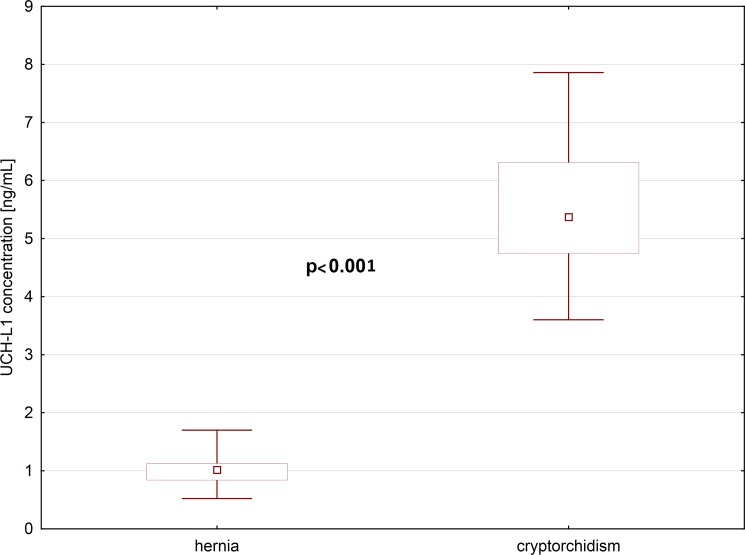
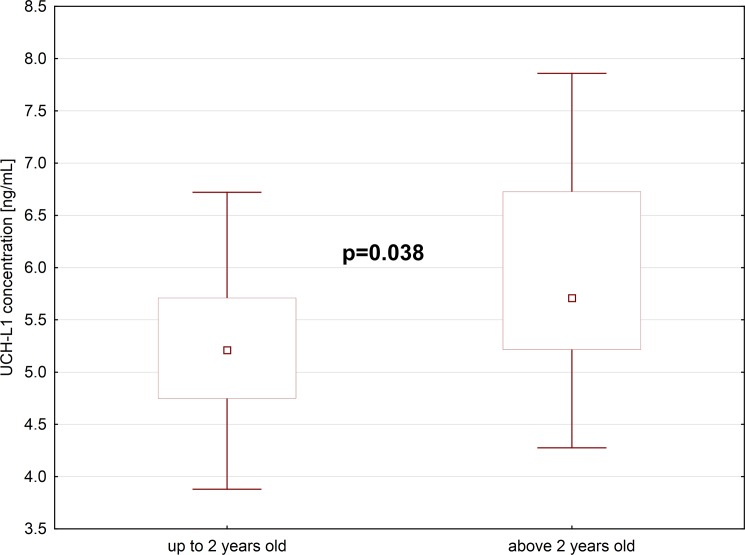
The median concentration of UCHL1 in the blood plasma of boys with cryptorchidism, was 5-folds higher than in boys with inguinal hernia, whose testicles were located in the scrotum. We also noticed statistically significant difference between UCHL1 levels in boys with cryptorchidism up to 2 years old, and above 2 years old. Older boys, whose testicles since birth were located in the inguinal pouch or in the abdominal cavity, had higher concentration of UCHL1 in their blood plasma, than boys from younger group. In the group of cryptorchid boys, we also found slightly lower concentrations of INSL3, without statistical significance and no correlation with UCHL1 levels.
Uchl1 concentrations in the blood plasma of boys with cryptorchidism, may reflect the heat-induced apoptosis of germ cells. Higher UCHL1 concentrations in older boys with undescended testicles, probably express intensity of germ cell apoptosis, more extensive when testicles are subjected to heat-stress for longer period. Further analyses of UCHL1 may help to elucidate its role in mechanisms influencing spermatogenesis.
泛素-蛋白酶体系统调节p53、半胱天冬酶和Bcl-2家族蛋白,对睾丸中缺陷生殖细胞的降解至关重要。目的:评估隐睾症男孩血浆中泛素羧基末端水解酶1(UCHL1)的浓度,以及其与患者年龄是否存在相关性。
研究对象为50名年龄在1至4岁(中位数=2.4岁)的单侧隐睾症男孩。排除标准为:既往接受过人绒毛膜促性腺激素治疗、核型异常、内分泌或免疫紊乱或任何长期用药史。对照组为50名年龄匹配的健康男孩(1至4岁,中位数=2.1岁),因计划行疝修补术入住小儿外科。为研究隐睾症男孩血浆中的UCHL1,我们采用了一种新技术——表面等离子体共振成像(SPRI)。
隐睾症男孩血浆中UCHL1的中位数浓度比睾丸位于阴囊内的腹股沟疝男孩高5倍。我们还注意到,2岁及以下和2岁以上隐睾症男孩的UCHL1水平存在统计学显著差异。自出生以来睾丸位于腹股沟袋或腹腔内的年龄较大男孩,其血浆中UCHL1的浓度高于较年轻组的男孩。在隐睾症男孩组中,我们还发现抑制素3(INSL3)的浓度略低,但无统计学意义,且与UCHL1水平无相关性。
隐睾症男孩血浆中的Uchl1浓度可能反映了热诱导的生殖细胞凋亡。睾丸未降的年龄较大男孩中较高的UCHL1浓度,可能表明生殖细胞凋亡的强度,当睾丸长期受到热应激时,这种凋亡更为广泛。对UCHL1的进一步分析可能有助于阐明其在影响精子发生机制中的作用。