Jin Min Jin, Kim Ji Sun, Kim Sungkean, Hyun Myoung Ho, Lee Seung-Hwan
Clinical Emotion and Cognition Research Laboratory, Inje University, Goyang, South Korea.
Department of Psychology, Chung-Ang University, Seoul, South Korea.
Front Psychiatry. 2018 Jan 22;8:314. doi: 10.3389/fpsyt.2017.00314. eCollection 2017.
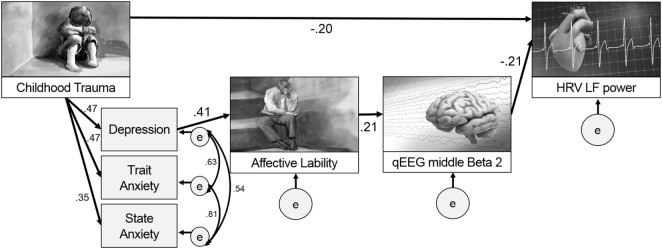
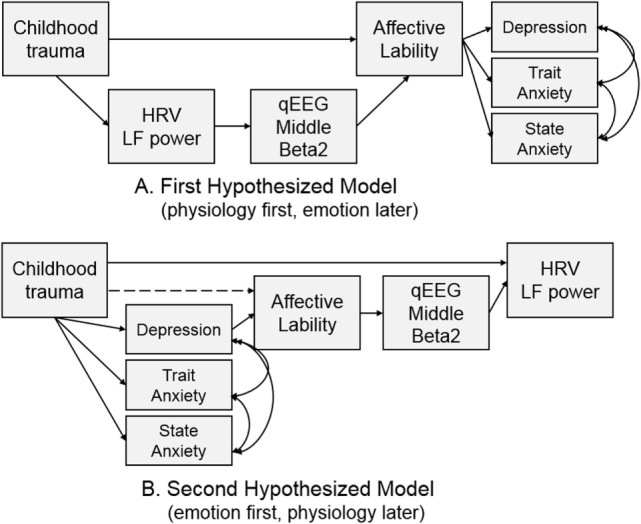
Childhood trauma is known to be related to emotional problems, quantitative electroencephalography (EEG) indices, and heart rate variability (HRV) indices in adulthood, whereas directions among these factors have not been reported yet. This study aimed to evaluate pathway models in young and healthy adults: (1) one with physiological factors first and emotional problems later in adulthood as results of childhood trauma and (2) one with emotional problems first and physiological factors later. A total of 103 non-clinical volunteers were included. Self-reported psychological scales, including the Childhood Trauma Questionnaire (CTQ), State-Trait Anxiety Inventory, Beck Depression Inventory, and Affective Lability Scale were administered. For physiological evaluation, EEG record was performed during resting eyes closed condition in addition to the resting-state HRV, and the quantitative power analyses of eight EEG bands and three HRV components were calculated in the frequency domain. After a normality test, Pearson's correlation analysis to make path models and path analyses to examine them were conducted. The CTQ score was significantly correlated with depression, state and trait anxiety, affective lability, and HRV low-frequency (LF) power. LF power was associated with beta2 (18-22 Hz) power that was related to affective lability. Affective lability was associated with state anxiety, trait anxiety, and depression. Based on the correlation and the hypothesis, two models were composed: a model with pathways from CTQ score to affective lability, and a model with pathways from CTQ score to LF power. The second model showed significantly better fit than the first model (AIC = 63.403 > AIC = 46.003), which revealed that child trauma could affect emotion, and then physiology. The specific directions of relationships among emotions, the EEG, and HRV in adulthood after childhood trauma was discussed.
众所周知,童年创伤与成年后的情绪问题、定量脑电图(EEG)指标和心率变异性(HRV)指标有关,然而这些因素之间的关系尚未见报道。本研究旨在评估年轻健康成年人中的路径模型:(1)一种模型是童年创伤导致成年后首先出现生理因素,随后出现情绪问题;(2)另一种模型是首先出现情绪问题,随后出现生理因素。共纳入103名非临床志愿者。使用了自我报告的心理量表,包括儿童创伤问卷(CTQ)、状态-特质焦虑量表、贝克抑郁量表和情感不稳定性量表。对于生理评估,除了静息状态下的HRV外,还在闭眼静息状态下进行EEG记录,并在频域中计算八个EEG频段和三个HRV成分的定量功率分析。经过正态性检验后,进行Pearson相关分析以建立路径模型,并进行路径分析以检验这些模型。CTQ评分与抑郁、状态和特质焦虑、情感不稳定性以及HRV低频(LF)功率显著相关。LF功率与与情感不稳定性相关的β2(18 - 22Hz)功率相关。情感不稳定性与状态焦虑、特质焦虑和抑郁相关。基于相关性和假设,构建了两个模型:一个是从CTQ评分到情感不稳定性的路径模型,另一个是从CTQ评分到LF功率的路径模型。第二个模型的拟合度明显优于第一个模型(AIC = 63.403 > AIC = 46.003),这表明儿童创伤可能先影响情绪,进而影响生理。本文还讨论了童年创伤后成年期情绪、EEG和HRV之间关系的具体方向。