Department of Digestive and Oncological Surgery, Univ. Lille, Claude Huriez University Hospital, Place de Verdun, 59037, Lille, Cedex, France.
Univ. Lille, UMR-S 1172 - JPArc - Centre de Recherche Jean-Pierre AUBERT Neurosciences et Cancer, F-59000, Lille, France.
BMC Cancer. 2018 Feb 6;18(1):139. doi: 10.1186/s12885-018-3991-8.
While the incidence of esophageal and gastric cancers is increasing, the prognosis of these cancers remains bleak. Endoscopy and surgery are the standard treatments for localized tumors, but multimodal treatments, associated chemotherapy, targeted therapies, immunotherapy, radiotherapy, and surgery are needed for the vast majority of patients who present with locally advanced or metastatic disease at diagnosis. Although survival has improved, most patients still present with advanced disease at diagnosis. In addition, most patients exhibit a poor or incomplete response to treatment, experience early recurrence and have an impaired quality of life. Compared with several other cancers, the therapeutic approach is not personalized, and research is much less developed. It is, therefore, urgent to hasten the development of research protocols, and consequently, develop a large, ambitious and innovative tool through which future scientific questions may be answered. This research must be patient-related so that rapid feedback to the bedside is achieved and should aim to identify clinical-, biological- and tumor-related factors that are associated with treatment resistance. Finally, this research should also seek to explain epidemiological and social facets of disease behavior.
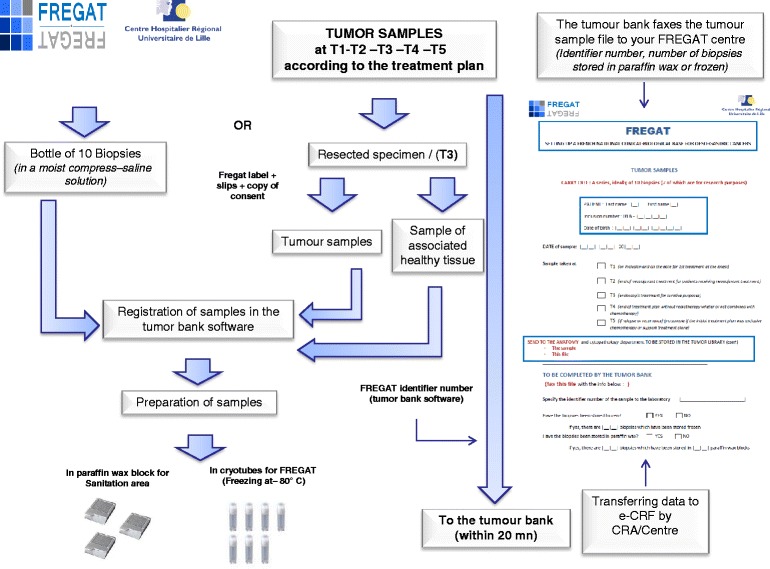
The prospective FREGAT database, established by the French National Cancer Institute, is focused on adult patients with carcinomas of the esophagus and stomach and on whatever might be the tumor stage or therapeutic strategy. The database includes epidemiological, clinical, and tumor characteristics data as well as follow-up, human and social sciences quality of life data, along with a tumor and serum bank.
This innovative method of research will allow for the banking of millions of data for the development of excellent basic, translational and clinical research programs for esophageal and gastric cancer. This will ultimately improve general knowledge of these diseases, therapeutic strategies and patient survival. This database was initially developed in France on a nationwide basis, but currently, the database is available for worldwide contributions with respect to the input of patient data or the request for data for scientific projects.
The FREGAT database has a dedicated website ( www.fregat-database.org ) and is registered on the Clinicaltrials.gov site, number NCT 02526095 , since August 8, 2015.
尽管食管癌和胃癌的发病率在不断上升,但这些癌症的预后仍然不容乐观。内镜检查和手术是局部肿瘤的标准治疗方法,但对于绝大多数在诊断时就出现局部晚期或转移性疾病的患者,需要采用多模态治疗,包括化疗、靶向治疗、免疫治疗、放疗和手术。尽管生存状况有所改善,但大多数患者在诊断时仍处于晚期疾病。此外,大多数患者对治疗的反应较差或不完全,早期复发且生活质量受损。与其他几种癌症相比,治疗方法不是个性化的,研究也相对较少。因此,迫切需要加快研究方案的制定,进而开发一个大型、雄心勃勃和创新的工具,以回答未来的科学问题。这项研究必须与患者相关,以便快速将反馈应用于临床,并应旨在确定与治疗耐药性相关的临床、生物学和肿瘤相关因素。最后,这项研究还应寻求解释疾病行为的流行病学和社会方面。
由法国国家癌症研究所建立的前瞻性 FREGAT 数据库,专注于成人食管癌和胃癌患者,无论肿瘤分期或治疗策略如何。该数据库包括流行病学、临床和肿瘤特征数据以及随访、人类和社会科学的生活质量数据,以及肿瘤和血清库。
这种创新的研究方法将允许为食管癌和胃癌的优秀基础、转化和临床研究计划储存数百万数据。这最终将提高对这些疾病、治疗策略和患者生存的总体认识。该数据库最初在法国全国范围内开发,但目前,该数据库可用于全球范围内的患者数据输入或请求用于科学项目的数据。
FREGAT 数据库有一个专门的网站(www.fregat-database.org),自 2015 年 8 月 8 日起在 Clinicaltrials.gov 网站上注册,编号为 NCT 02526095。