Chakar Bassam, Senny Frédéric, Poirrier Anne-Lise, Cambron Laurent, Fanielle Julien, Poirrier Robert
University Hospital of Liege, Sleep Center - Department of Neurology - Liège - Liège - Belgium.
High School HELMo-Gramme, Electronic and Informatic Unit - Liège - Liège - Belgium.
Sleep Sci. 2017 Jul-Sep;10(3):122-127. doi: 10.5935/1984-0063.20170021.
In a device based on midsagittal jaw movements analysis, we assessed a sleep-wake automatic detector as an objective method to measure sleep in healthy adults by comparison with wrist actigraphy against polysomnography (PSG).
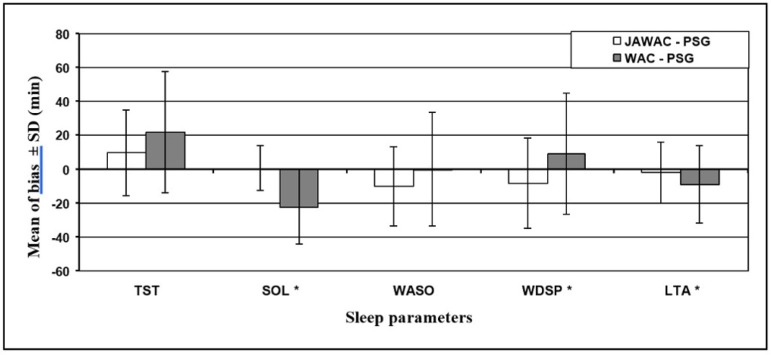
Simultaneous and synchronized in-lab PSG, wrist actigraphy and jaw movements were carried out in 38 healthy participants. Epoch by epoch analysis was realized to assess the ability to sleep-wake distinction. Sleep parameters as measured by the three devices were compared. This included three regularly reported parameters: total sleep time, sleep onset latency, and wake after sleep onset. Also, two supplementary parameters, wake during sleep period and latency time, were added to measure quiet wakefulness state.
The jaw movements showed sensitivity level equal to actigraphy 96% and higher specificity level (64% and 48% respectively). The level of agreement between the two devices was high (87%). The analysis of their disagreement by discrepant resolution analysis used PSG as resolver revealed that jaw movements was right (58.9%) more often than actigraphy (41%). In sleep parameters comparison, the coefficient correlation of jaw movements was higher than actigraphy in all parameters. Moreover, its ability to distinct sleep-wake state allowed for a more effective estimation of the parameters that measured the quiet wakefulness state.
Midsagittal jaw movements analysis is a reliable method to measure sleep. In healthy adults, this device proved to be superior to actigraphy in terms of estimation of all sleep parameters and distinction of sleep-wake status.
在一种基于矢状面颌运动分析的设备中,我们评估了一种睡眠-觉醒自动检测器,将其作为一种客观方法,通过与腕部活动记录仪对比多导睡眠图(PSG)来测量健康成年人的睡眠情况。
对38名健康参与者进行了同步且在实验室中的PSG、腕部活动记录仪和颌运动监测。进行逐段分析以评估睡眠-觉醒区分能力。比较了三种设备测量的睡眠参数。这包括三个经常报告的参数:总睡眠时间、入睡潜伏期和睡眠中觉醒时间。此外,还增加了两个补充参数,即睡眠期间觉醒和潜伏期时间,以测量安静觉醒状态。
颌运动显示出与活动记录仪相当的敏感度水平(96%)和更高的特异度水平(分别为64%和48%)。两种设备之间的一致性水平较高(87%)。通过以PSG作为解析器的差异分辨率分析对它们的不一致性进行分析,结果显示颌运动正确的情况(58.9%)比活动记录仪(41%)更常见。在睡眠参数比较中,颌运动在所有参数中的系数相关性均高于活动记录仪。此外,其区分睡眠-觉醒状态的能力使得能够更有效地估计测量安静觉醒状态的参数。
矢状面颌运动分析是一种可靠的睡眠测量方法。在健康成年人中,该设备在所有睡眠参数的估计和睡眠-觉醒状态区分方面均优于活动记录仪。