Collaboration for Outcomes Research and Evaluation, Faculty of Pharmaceutical Sciences, University of British Columbia, 2405 Wesbrook Mall, Vancouver, BC, V6T 1Z3, Canada.
Centre for Clinical Epidemiology and Evaluation, Vancouver Coastal Health Institute, Vancouver, Canada.
Respir Res. 2018 Feb 7;19(1):26. doi: 10.1186/s12931-018-0731-1.
A significant proportion of patients with chronic obstructive pulmonary disease (COPD) remain undiagnosed. Characterizing these patients can increase our understanding of the 'hidden' burden of COPD and the effectiveness of case detection interventions.
We conducted a systematic review and meta-analysis to compare patient and disease factors between patients with undiagnosed persistent airflow limitation and those with diagnosed COPD. We searched MEDLINE and EMBASE for observational studies of adult patients meeting accepted spirometric definitions of COPD. We extracted and pooled summary data on the proportion or mean of each risk factor among diagnosed and undiagnosed patients (unadjusted analysis), and coefficients for the adjusted association between risk factors and diagnosis status (adjusted analysis).
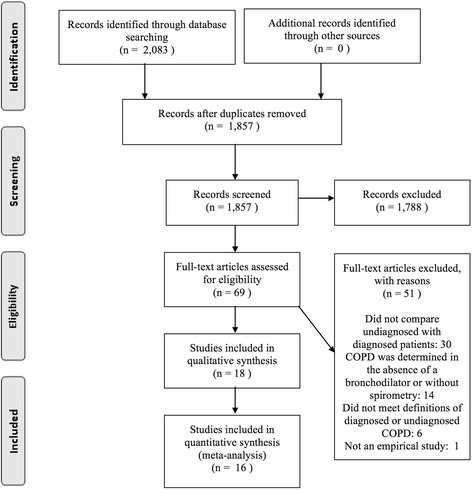
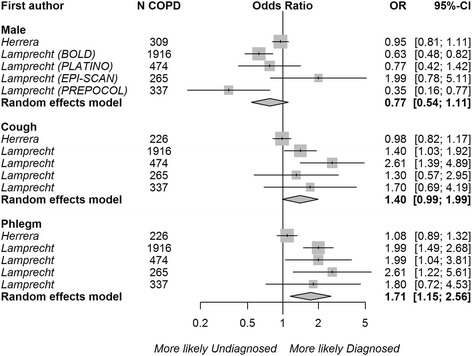
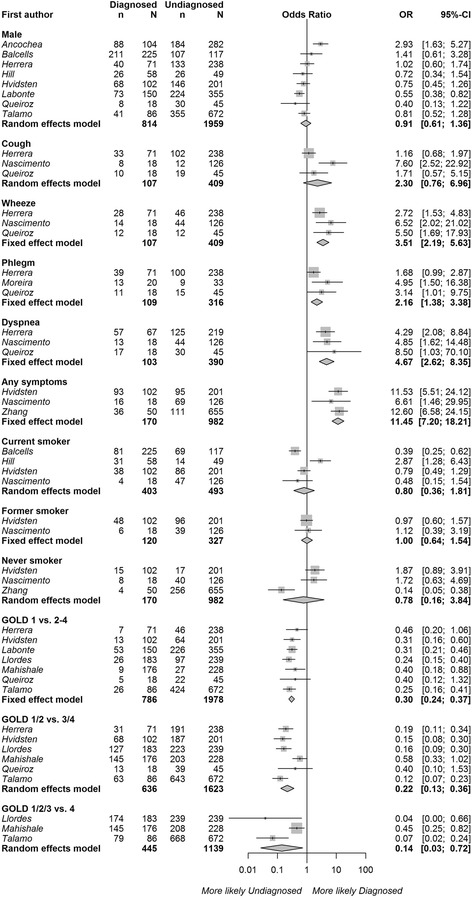
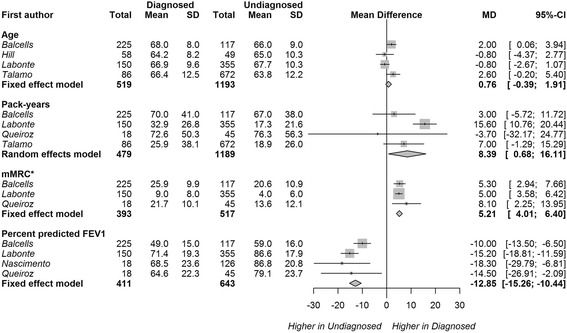
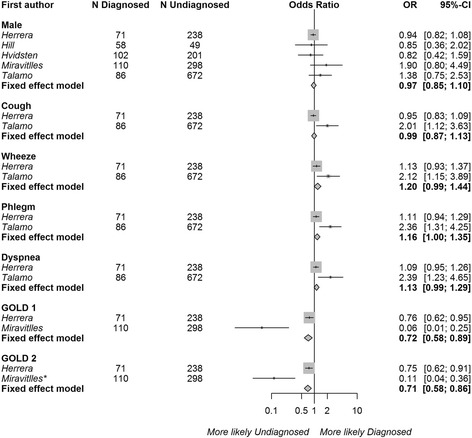
Two thousand eighty-three records were identified through database searching and 16 articles were used in the meta-analyses. Diagnosed patients were less likely to have mild (v. moderate to very severe) COPD (odds ratio [OR] 0.30, 95%CI 0.24-0.37, 6 studies) in unadjusted analysis. This association remained significant but its strength was attenuated in the adjusted analysis (OR 0.72, 95%CI 0.58-0.89, 2 studies). Diagnosed patients were more likely to report respiratory symptoms such as wheezing (OR 3.51, 95%CI 2.19-5.63, 3 studies) and phlegm (OR 2.16, 95% CI 1.38-3.38, 3 studies), had more severe dyspnea (mean difference in modified Medical Research Council scale 0.52, 95%CI 0.40-0.64, 3 studies), and slightly greater smoking history than undiagnosed patients. Patient age, sex, current smoking status, and the presence of coughing were not associated with a previous diagnosis.
Undiagnosed patients had less severe airflow obstruction and fewer respiratory symptoms than diagnosed patients. The lower disease burden in undiagnosed patients may significantly delay the diagnosis of COPD.
相当一部分慢性阻塞性肺疾病(COPD)患者未被诊断。对这些患者进行特征描述可以帮助我们更好地理解 COPD 的“隐匿”负担,以及病例发现干预的效果。
我们进行了一项系统综述和荟萃分析,比较了未被诊断的持续性气流受限患者和已被诊断的 COPD 患者之间的患者和疾病因素。我们检索了 MEDLINE 和 EMBASE 数据库,纳入了符合接受的肺量计 COPD 定义的成年患者的观察性研究。我们提取并汇总了已诊断和未诊断患者中每个危险因素的比例或平均值(未调整分析),以及危险因素与诊断状态之间的调整关联系数(调整分析)。
通过数据库检索确定了 2083 条记录,16 篇文章用于荟萃分析。在未调整分析中,与确诊患者相比,未确诊患者更有可能患有轻度(中重度至非常严重)COPD(比值比[OR]0.30,95%CI0.24-0.37,6 项研究)。这种关联在调整分析中仍然显著,但强度减弱(OR0.72,95%CI0.58-0.89,2 项研究)。与确诊患者相比,已确诊患者更有可能报告喘息(OR3.51,95%CI2.19-5.63,3 项研究)和咳痰(OR2.16,95%CI1.38-3.38,3 项研究)等呼吸道症状,呼吸困难更严重(改良医学研究理事会量表的平均差异为 0.52,95%CI0.40-0.64,3 项研究),且吸烟史略长于未确诊患者。患者年龄、性别、当前吸烟状况和咳嗽的存在与之前的诊断无关。
与已确诊患者相比,未确诊患者的气流受限程度较轻,呼吸道症状较少。未确诊患者的疾病负担较低可能会显著延迟 COPD 的诊断。