Canestrari Carla, Branchini Erika, Bianchi Ivana, Savardi Ugo, Burro Roberto
Department of Education, Cultural Heritage and Tourism, University of Macerata, Macerata, Italy.
Department of Human Sciences, University of Verona, Verona, Italy.
Front Psychol. 2018 Jan 24;8:2297. doi: 10.3389/fpsyg.2017.02297. eCollection 2017.
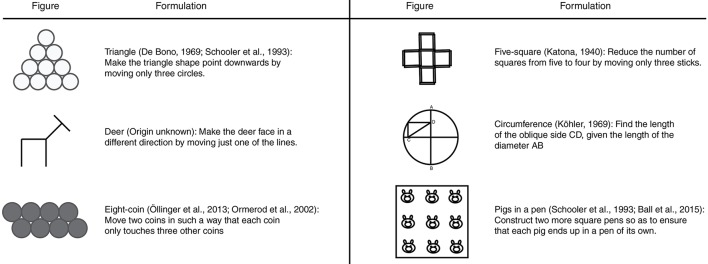
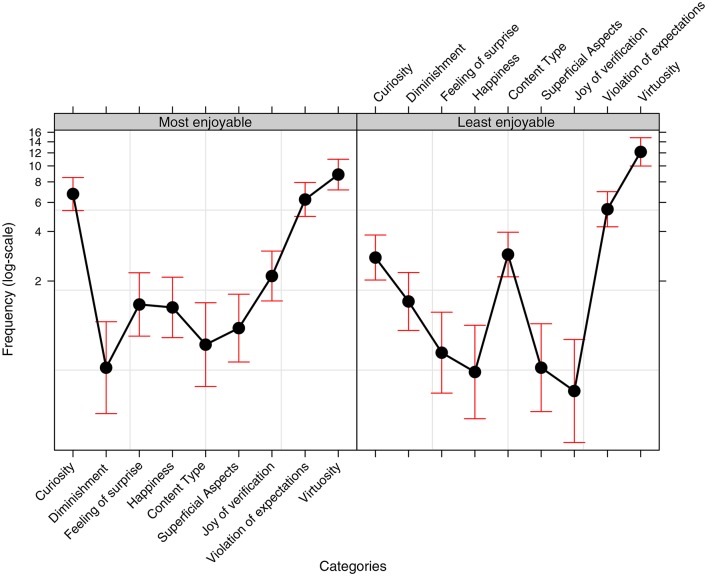
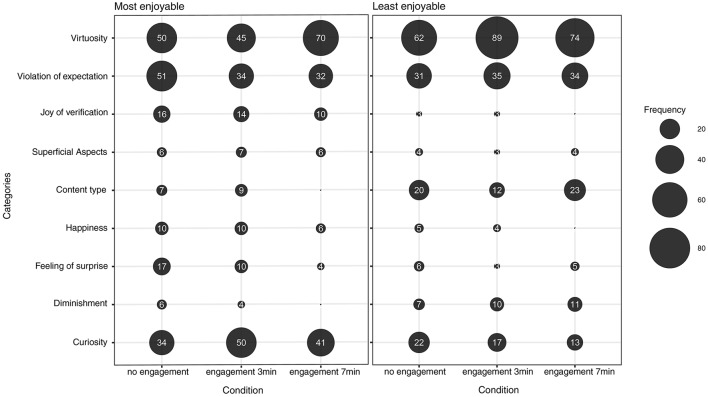
In this paper, a parallel analysis of the enjoyment derived from humor and insight problem solving is presented with reference to a "general" Theory of the Pleasures of the Mind (TPM) (Kubovy, 1999) rather than to "local" theories regarding what makes humor and insight problem solving enjoyable. The similarity of these two cognitive activities has already been discussed in previous literature in terms of the cognitive mechanisms which underpin getting a joke or having an insight experience in a problem solving task. The paper explores whether we can learn something new about the similarities and differences between humor and problem solving by means of an investigation of what makes them pleasurable. In the first part of the paper, the framework for this joint analysis is set. Two descriptive studies are then presented in which the participants were asked to report on their experiences relating to solving visuo-spatial insight problems (Study 1) or understanding cartoons (Study 2) in terms of whether they were enjoyable or otherwise. In both studies, the responses were analyzed with reference to a set of categories inspired by the TPM. The results of Study 1 demonstrate that finding the solution to a problem is associated with a positive evaluation, and the most frequent explanations for this were reported as being Curiosity, Virtuosity and Violation of expectations. The results of Study 2 suggest that understanding a joke (Joy of verification) and being surprised by it (Feeling of surprise) were two essential conditions: when they were not present, the cartoons were perceived as not enjoyable. However, this was not enough to explain the motivations for the choice of the most enjoyable cartoons. Recognizing a Violation of expectations and experiencing a Diminishment in the cleverness or awareness initially attributed to the characters in the cartoon were the aspects which were most frequently indicated by the participants to explain why they enjoyed the joke. These findings are evaluated in the final discussion, together with their limitations and potential future developments.
本文参照“心灵愉悦的一般理论”(TPM)(库博维,1999),对从幽默和顿悟问题解决中获得的愉悦进行了并行分析,而非参照关于使幽默和顿悟问题解决变得愉悦的“局部”理论。这两种认知活动的相似性在以往文献中已从支撑在解决问题任务中理解一个笑话或获得顿悟体验的认知机制方面进行过讨论。本文探讨我们是否能通过调查使幽默和问题解决变得愉悦的因素,来了解它们之间异同的新情况。在本文的第一部分,设定了这种联合分析的框架。接着呈现了两项描述性研究,在研究中要求参与者就解决视觉空间顿悟问题(研究1)或理解卡通片(研究2)的体验进行报告,说明这些体验是否令人愉悦。在两项研究中,均参照受TPM启发的一组类别对回答进行了分析。研究1的结果表明,找到问题的解决方案与积极评价相关,对此最常见的解释是好奇心、精湛技艺和违背预期。研究2的结果表明,理解一个笑话(验证的喜悦)和为之感到惊讶(惊讶之感)是两个基本条件:当缺少这些条件时,卡通片被认为不令人愉悦。然而,这不足以解释选择最令人愉悦的卡通片的动机。参与者最常指出的用以解释他们为何喜欢这个笑话的方面是,认识到违背预期以及体验到最初赋予卡通片中角色的聪明或意识的减弱。在最后的讨论中对这些发现进行了评估,同时也讨论了它们的局限性以及潜在的未来发展。