Obermayr Eva, Maritschnegg Elisabeth, Agreiter Christiane, Pecha Nina, Speiser Paul, Helmy-Bader Samir, Danzinger Sabine, Krainer Michael, Singer Christian, Zeillinger Robert
Molecular Oncology Group, Department of Obstetrics and Gynecology, Comprehensive Cancer Center, Medical University of Vienna, Waehringer Guertel 18-20, 1090 Vienna, Austria.
Department of Obstetrics and Gynecology, Clinical Division for General Gynecology and Gynecological Oncology, Comprehensive Cancer Center, Medical University of Vienna, Waehringer Guertel 18-20, 1090 Vienna, Austria.
Oncotarget. 2017 Nov 28;9(1):812-823. doi: 10.18632/oncotarget.22549. eCollection 2018 Jan 2.
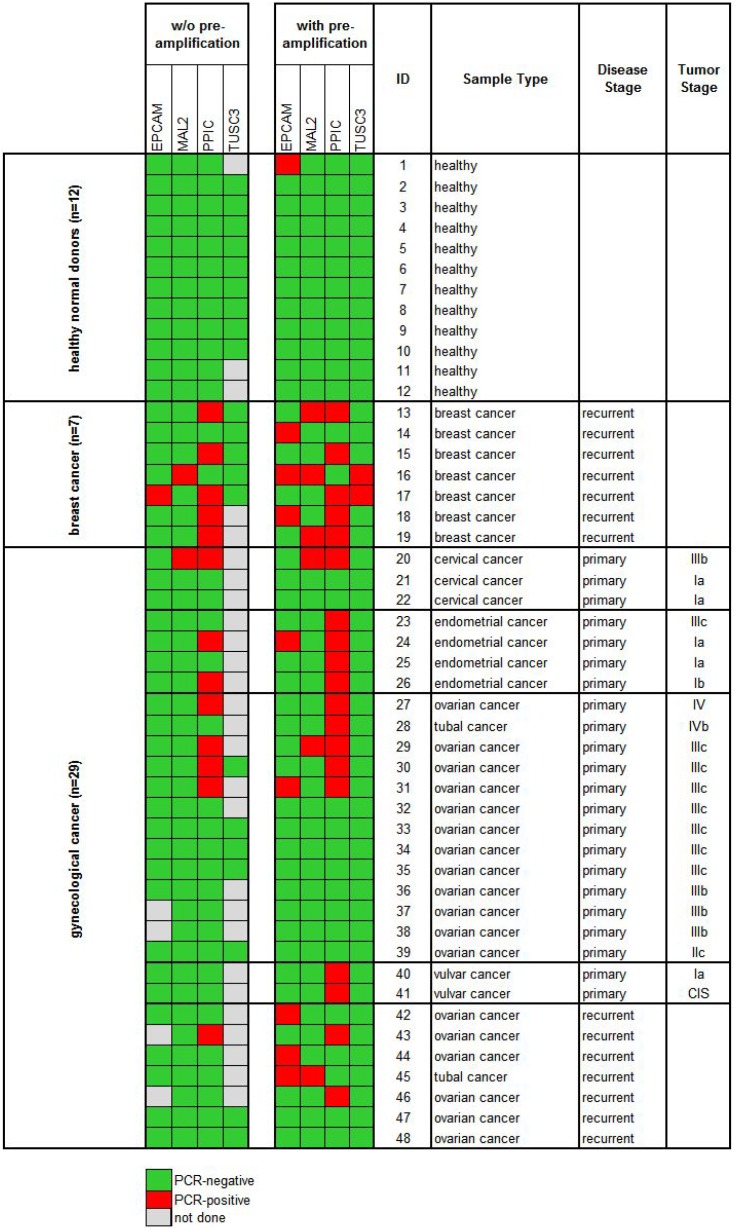
RT-qPCR is a highly sensitive approach to detect rare transcripts, as derived from circulating tumor cells (CTCs) in the blood of cancer patients. However, the presence of unwanted leukocytes often leads to false positive results. Here, we evaluated whether the micro-fluidic Parsortix™ technology is appropriate to remove these leukocytes and thereby finally to improve the overall approach. In this study, we established a workflow including the micro-fluidic Parsortix™ technology for the molecular detection of CTC related transcripts. Background levels of , , , and were efficiently removed due to an up to 10-fold depletion of leukocytes. The presence of these gene markers was observed in Parsortix™-enriched blood samples from patients with primary and recurrent gynecological cancer (32% and 14%), as well as in 86% of the metastatic breast cancer samples, at a very high specificity. In the ovarian cancer samples, was the most prominent gene marker, contributing to all positive cases and at least to 70% of the positive cases after pre-amplification of the respective target genes. Expanding the analytical panel up to 29 gene markers further increased the positivity rate (primary gynecological cancer: 95%, recurrent gynecological cancer: 100%, metastatic breast cancer: 92%). The established workflow strongly improved the overall molecular analysis of the target cells by the efficient removal of contaminating cells, and, thereby offers great promise for the molecular characterization of CTCs.
逆转录定量聚合酶链反应(RT-qPCR)是一种检测罕见转录本的高灵敏度方法,这些转录本来源于癌症患者血液中的循环肿瘤细胞(CTC)。然而,不需要的白细胞的存在常常导致假阳性结果。在此,我们评估了微流控Parsortix™技术是否适合去除这些白细胞,从而最终改进整体方法。在本研究中,我们建立了一个工作流程,包括用于分子检测与CTC相关转录本的微流控Parsortix™技术。由于白细胞减少了多达10倍, 、 、 和 的背景水平被有效去除。在原发性和复发性妇科癌症患者的Parsortix™富集血样中(分别为32%和14%)以及86%的转移性乳腺癌样本中,以非常高的特异性观察到了这些基因标志物的存在。在卵巢癌样本中, 是最突出的基因标志物,在各自靶基因预扩增后,所有阳性病例以及至少70%的阳性病例都有该标志物。将分析面板扩展到29个基因标志物进一步提高了阳性率(原发性妇科癌症:95%,复发性妇科癌症:100%,转移性乳腺癌:92%)。所建立的工作流程通过有效去除污染细胞,极大地改进了对靶细胞的整体分子分析,因此为CTC的分子特征分析带来了巨大希望。