Laboratory of Molecular and Cellular Pharmacology of the Purinergic Transmission, Dipartimento di Scienze Farmacologiche e Biomolecolari, Università degli Studi di Milano, Via Balzaretti 9, Milan, 20133, Italy.
Centro Cardiologico Monzino, Via Parea, 4, Milano, 20138, Italy.
Glia. 2018 May;66(5):1118-1130. doi: 10.1002/glia.23305. Epub 2018 Feb 9.
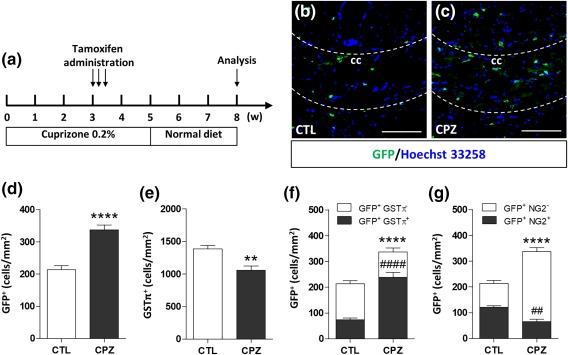
Promoting remyelination is recognized as a novel strategy to foster repair in neurodegenerative demyelinating diseases, such as multiple sclerosis. In this respect, the receptor GPR17, recently emerged as a new target for remyelination, is expressed by early oligodendrocyte precursors (OPCs) and after a certain differentiation stage it has to be downregulated to allow progression to mature myelinating oligodendrocytes. Here, we took advantage of the first inducible GPR17 reporter mouse line (GPR17-iCreER xCAG-eGFP mice) allowing to follow the final fate of GPR17 cells by tamoxifen-induced GFP-labeling to unveil the destiny of these cells in two demyelination models: experimental autoimmune encephalomyelitis (EAE), characterized by marked immune cell activation and inflammation, and cuprizone induced demyelination, where myelin dysfunction is achieved by a toxic insult. In both models, demyelination induced a strong increase of fluorescent GFP cells at damaged areas. However, only in the cuprizone model reacting GFP cells terminally differentiated to mature oligodendrocytes, thus contributing to remyelination. In EAE, GFP cells were blocked at immature stages and never became myelinating oligodendrocytes. We suggest these strikingly distinct fates be due to different permissiveness of the local CNS environment. Based on previously reported GPR17 activation by emergency signals (e.g., Stromal Derived Factor-1), we propose that a marked inflammatory milieu, such as that reproduced in EAE, induces GPR17 overactivation resulting in impaired downregulation, untimely and prolonged permanence in OPCs, leading, in turn, to differentiation blockade. Combined treatments with remyelinating agents and anti-inflammatory drugs may represent new potential adequate strategies to halt neurodegeneration and foster recovery.
促进髓鞘再生被认为是促进神经退行性脱髓鞘疾病(如多发性硬化症)修复的一种新策略。在这方面,最近出现的髓鞘再生新靶点 GPR17,由早期少突胶质前体细胞(OPC)表达,在特定分化阶段后必须下调以允许向成熟髓鞘形成的少突胶质细胞分化。在这里,我们利用了第一个诱导型 GPR17 报告小鼠系(GPR17-iCreER xCAG-eGFP 小鼠),通过用他莫昔芬诱导 GFP 标记来追踪 GPR17 细胞的最终命运,从而揭示这些细胞在两种脱髓鞘模型中的命运:实验性自身免疫性脑脊髓炎(EAE),其特征是明显的免疫细胞激活和炎症,以及杯状醇诱导的脱髓鞘,其中髓鞘功能障碍是通过毒性损伤实现的。在这两种模型中,脱髓鞘在受损区域引起大量荧光 GFP 细胞的强烈增加。然而,只有在杯状醇模型中,反应 GFP 细胞终末分化为成熟的少突胶质细胞,从而有助于髓鞘再生。在 EAE 中,GFP 细胞被阻滞在不成熟阶段,从未成为髓鞘形成的少突胶质细胞。我们认为这些明显不同的命运是由于局部中枢神经系统环境的不同许可。基于先前报道的 GPR17 被紧急信号(例如基质衍生因子-1)激活,我们提出,EAE 中复制的明显炎症环境会导致 GPR17 过度激活,从而导致下调受损、过早和持久的 OPC 滞留,进而导致分化阻滞。联合使用髓鞘再生剂和抗炎药物可能代表一种新的潜在适当策略,可以阻止神经退行性变并促进恢复。