Department of Pediatrics, College of Medicine, St. Vincent's Hospital, The Catholic University of Korea, Republic of Korea.
Department of Biostatistics, College of Medicine, The Catholic University of Korea, Republic of Korea.
Diabetes Res Clin Pract. 2018 Apr;138:169-176. doi: 10.1016/j.diabres.2018.01.030. Epub 2018 Feb 8.
To investigate the metabolic risk factors according to the degree of obesity in Korean adolescents.
Among 7197 subjects aged 10-18 years who participated in the 2007-2014 K-NHANES, 1326 adolescents (M = 744, F = 582) with age and sex specific body mass index (BMI) ≥85th percentile were included. These adolescents with obesity were classified as: overweight, obesity, severe obesity, and extreme severe obesity. For assessing central obesity, the subjects were further-classified as: normal waist obese, abdominal obesity I, abdominal obesity II and abdominal obesity III.
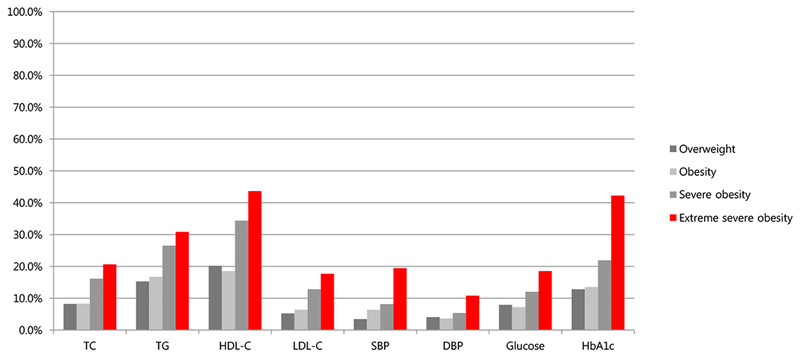
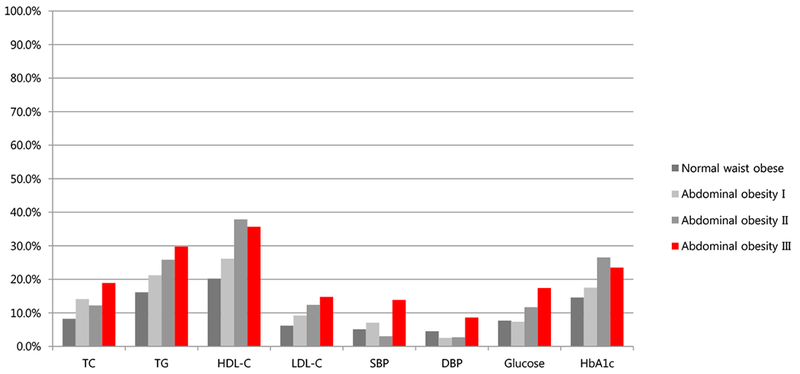
The prevalence of overweight, obesity, severe obesity and extreme severe obesity were 5.6%, 6.2%, 5.9% and 0.9% in Korean adolescents. With increasing levels of obese category, the incidence of metabolic risk factors such as HDL-C < 40 mg/dL or <50 mg/dL in girls older than 16 years-old (20.2%, 18.5%, 34.4%, 43.6%, P < .0001), TG ≥ 150 mg/dL (15.3%, 16.7%, 26.5%, 30.9%, P < .003), HbA1C ≥ 5.8% (12.8%, 13.5%, 21.9%, 42.2%, P < .006), SBP ≥ 130 mg/dL (3.5%, 6.4%, 8.1%, 19.5%, P < .003) significantly increased. With increasing levels of central obese category, the incidence of metabolic risk factors such as HDL-C < 40 mg/dL or <50 mg/dL in girls older than 16 years-old (20.2%, 26.2%, 37.9%, 35.7%, P < .0007), TG ≥ 150 mg/dL (16.1%, 21.2%, 25.8%, 29.8%, P < .004), glucose ≥ 100 mg/dL (7.7%, 7.3%, 11.7%, 17.4%, P < .009) and SBP ≥ 130 mg/dL (5.1%, 7.1%, 3.0%, 13.9%, P < .002) significantly increased.
Adolescents with severe obesity have more metabolic risk factors compared to adolescents with less severe degree of obesity.
根据韩国青少年肥胖程度调查代谢危险因素。
在 2007-2014 年参与韩国国家健康营养调查(K-NHANES)的 7197 名 10-18 岁的受试者中,选取年龄和性别特异性身体质量指数(BMI)≥第 85 百分位的 1326 名青少年(男 744 名,女 582 名)。将这些肥胖青少年分为超重、肥胖、重度肥胖和极度肥胖。为评估中心性肥胖,将受试者进一步分为正常腰围肥胖、腹部肥胖 I、腹部肥胖 II 和腹部肥胖 III。
韩国青少年中,超重、肥胖、重度肥胖和极度肥胖的发生率分别为 5.6%、6.2%、5.9%和 0.9%。随着肥胖程度的增加,女孩中高密度脂蛋白胆固醇(HDL-C)<40mg/dL 或<50mg/dL(年龄大于 16 岁)、甘油三酯(TG)≥150mg/dL、糖化血红蛋白(HbA1C)≥5.8%、收缩压(SBP)≥130mg/dL 的代谢危险因素发生率显著增加(20.2%、18.5%、34.4%、43.6%,P<.0001)。随着中心性肥胖程度的增加,女孩中高密度脂蛋白胆固醇(HDL-C)<40mg/dL 或<50mg/dL(年龄大于 16 岁)、甘油三酯(TG)≥150mg/dL、血糖≥100mg/dL 和 SBP≥130mg/dL 的代谢危险因素发生率显著增加(20.2%、26.2%、37.9%、35.7%,P<.0007)。
与肥胖程度较轻的青少年相比,重度肥胖的青少年具有更多的代谢危险因素。