Department of Pediatrics, Yonsei University College of Medicine, Seoul, Korea.
Biostatistics Collaboration Unit, Department of Research Affairs, Yonsei University College of Medicine, Seoul, Korea.
Yonsei Med J. 2021 Apr;62(4):344-351. doi: 10.3349/ymj.2021.62.4.344.
Metabolic syndrome (MetS) comprises a cluster of risk factors for future cardiovascular and metabolic diseases. Only a few recent studies have reported the trend in the prevalence of MetS in youth. This study aimed to analyze trends in the prevalence of MetS and nutrient intake in the last 10 years and investigate the changes in MetS components among Korean children and adolescents.
We analyzed the data of 9513 children and adolescents aged 10-19 years from the 2008-2017 Korean National Health and Nutrition Examination Surveys. Diagnosis of MetS was based on the International Diabetes Federation (IDF) and modified National Cholesterol Education Program-Adult Treatment Panel III (NCEP-ATP III) criteria.
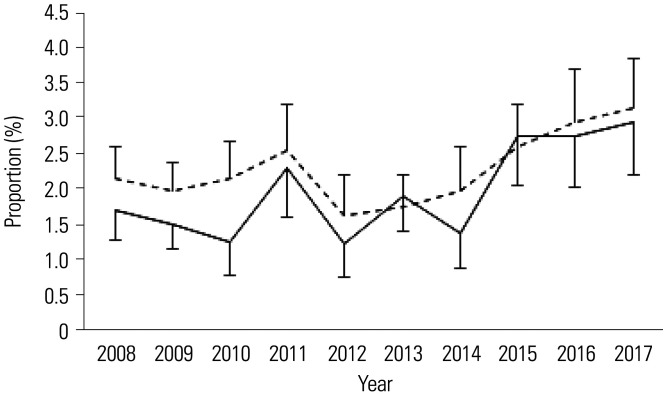
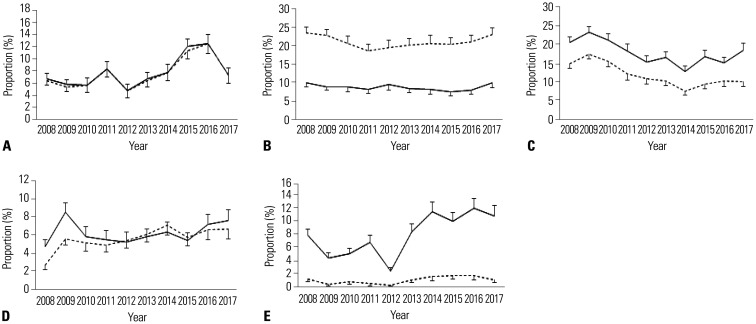
Based on the IDF criteria, MetS prevalence increased from 1.53% in 2008 to 3.19% in 2017 (=0.007). Based on the NCEP-ATP III criteria, MetS prevalence increased from 2.18% in 2008 to 3.19% in 2017; however, the increase was not statistically significant. Daily calorie and fat intakes increased significantly during the study period. Among the risk factors that MetS comprises, the prevalence rates of central obesity, low high-density lipoprotein cholesterol levels, and high fasting glucose levels increased significantly.
Over the last 10 years, the prevalence of MetS has grown significantly with increasing calorie and fat intake in Korean children and adolescents. Central obesity and high-density lipoprotein cholesterol and fasting glucose levels have worsened. Therefore, active support and close monitoring are required to control MetS and prevent further increase in the prevalence of cardiovascular diseases.
代谢综合征(MetS)由未来心血管和代谢疾病的一系列风险因素组成。只有少数最近的研究报告了青年人中 MetS 患病率的趋势。本研究旨在分析过去 10 年 MetS 患病率和营养素摄入的趋势,并调查韩国儿童和青少年中 MetS 成分的变化。
我们分析了 2008 年至 2017 年韩国国家健康和营养检查调查中 9513 名 10-19 岁儿童和青少年的数据。MetS 的诊断基于国际糖尿病联合会(IDF)和改良的国家胆固醇教育计划-成人治疗小组 III(NCEP-ATP III)标准。
根据 IDF 标准,MetS 的患病率从 2008 年的 1.53%增加到 2017 年的 3.19%(=0.007)。根据 NCEP-ATP III 标准,MetS 的患病率从 2008 年的 2.18%增加到 2017 年的 3.19%;然而,这种增加并不具有统计学意义。在研究期间,每日卡路里和脂肪摄入量显著增加。在 MetS 所包含的危险因素中,中心性肥胖、低高密度脂蛋白胆固醇水平和高空腹血糖水平的患病率显著增加。
在过去的 10 年中,韩国儿童和青少年的 MetS 患病率随着卡路里和脂肪摄入的增加而显著增加。中心性肥胖以及高密度脂蛋白胆固醇和空腹血糖水平恶化。因此,需要积极支持和密切监测以控制 MetS 并防止心血管疾病的患病率进一步增加。