Manchester Institute of Biotechnology, School of Chemistry, The University of Manchester, 131 Princess Street, Manchester M1 7DN, U.K.
Department of Chemistry and Biochemistry, University of South Carolina, Columbia, SC 29208, U.S.A.
Biochem Soc Trans. 2018 Feb 19;46(1):183-196. doi: 10.1042/BST20170218. Epub 2018 Feb 6.
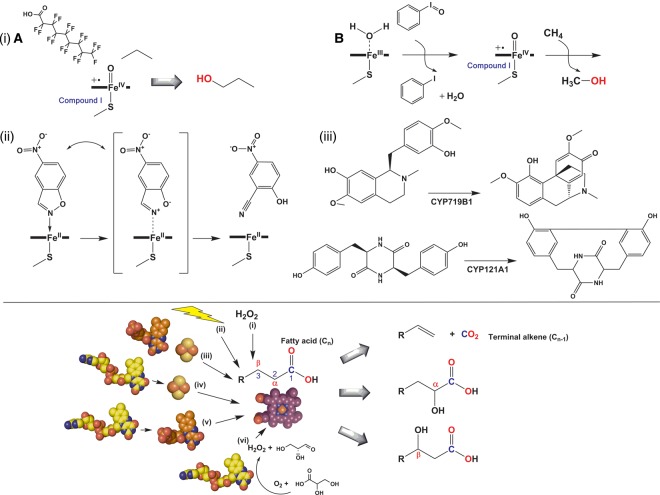
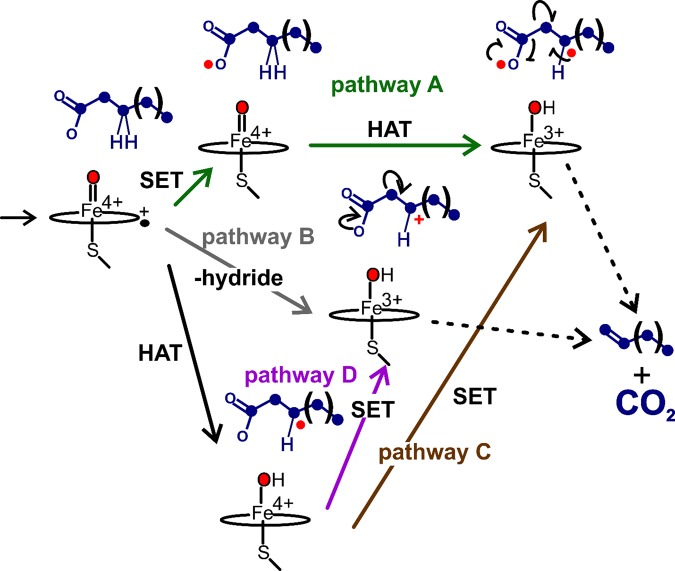
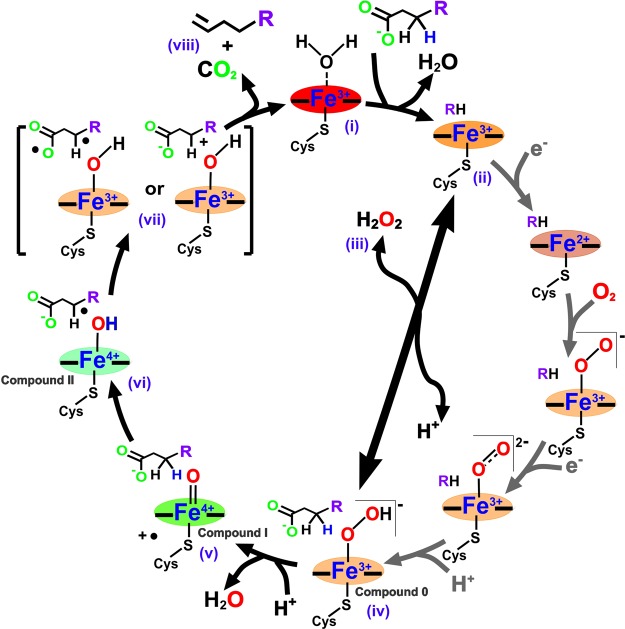
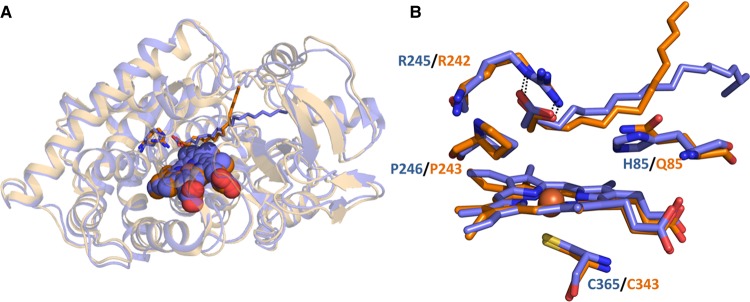
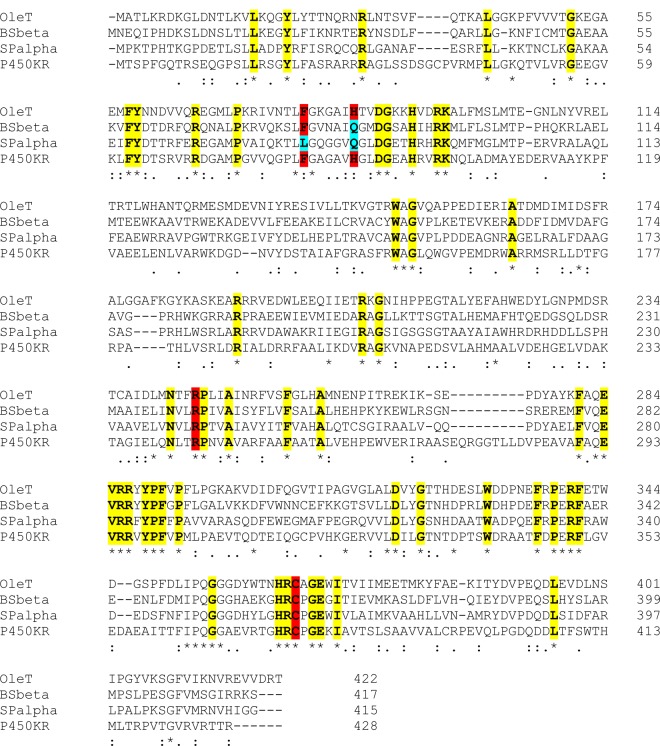
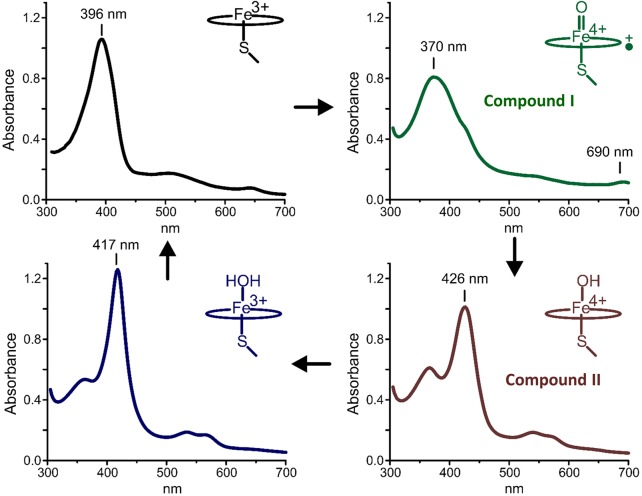
The cytochromes P450 (P450s or CYPs) constitute a large heme enzyme superfamily, members of which catalyze the oxidative transformation of a wide range of organic substrates, and whose functions are crucial to xenobiotic metabolism and steroid transformation in humans and other organisms. The P450 peroxygenases are a subgroup of the P450s that have evolved in microbes to catalyze the oxidative metabolism of fatty acids, using hydrogen peroxide as an oxidant rather than NAD(P)H-driven redox partner systems typical of the vast majority of other characterized P450 enzymes. Early members of the peroxygenase (CYP152) family were shown to catalyze hydroxylation at the α and β carbons of medium-to-long-chain fatty acids. However, more recent studies on other CYP152 family P450s revealed the ability to oxidatively decarboxylate fatty acids, generating terminal alkenes with potential applications as drop-in biofuels. Other research has revealed their capacity to decarboxylate and to desaturate hydroxylated fatty acids to form novel products. Structural data have revealed a common active site motif for the binding of the substrate carboxylate group in the peroxygenases, and mechanistic and transient kinetic analyses have demonstrated the formation of reactive iron-oxo species (compounds I and II) that are ultimately responsible for hydroxylation and decarboxylation of fatty acids, respectively. This short review will focus on the biochemical properties of the P450 peroxygenases and on their biotechnological applications with respect to production of volatile alkenes as biofuels, as well as other fine chemicals.
细胞色素 P450(P450 或 CYP)构成了一个庞大的血红素酶超家族,其成员催化广泛的有机底物的氧化转化,其功能对人类和其他生物体中外源生物代谢和类固醇转化至关重要。过氧化物酶 P450 是 P450 亚群的一个子集,在微生物中进化而来,用于催化脂肪酸的氧化代谢,使用过氧化氢作为氧化剂,而不是 NAD(P)H 驱动的氧化还原伙伴系统,这是绝大多数其他特征化 P450 酶的典型特征。过氧化物酶(CYP152)家族的早期成员被证明可以催化中长链脂肪酸的α和β碳原子的羟化。然而,对其他 CYP152 家族 P450 的最近研究表明,它们具有氧化脱羧脂肪酸的能力,生成具有作为即用型生物燃料潜力的末端烯烃。其他研究表明,它们能够脱羧和将羟化脂肪酸去饱和以形成新的产物。结构数据揭示了过氧化物酶中结合底物羧酸盐基团的常见活性位点基序,并且机制和瞬态动力学分析证明了活性铁-氧物种(化合物 I 和 II)的形成,这些物种最终负责脂肪酸的羟化和脱羧。这篇简短的综述将重点介绍过氧化物酶 P450 的生化特性及其在生产挥发性烯烃作为生物燃料以及其他精细化学品方面的生物技术应用。