Lu Yonghai, Chen Juanjuan, Huang Chong, Li Ning, Zou Li, Chia Sin Eng, Chen Shengsen, Yu Kangkang, Ling Qingxia, Cheng Qi, Zhu Mengqi, Zhang Weidong, Chen Mingquan, Ong Choon Nam
Saw Swee Hock School of Public Health, National University of Singapore, Singapore.
Institute of Nutrition and Health, Qingdao University, Qingdao, Shandong, China.
Oncotarget. 2017 Dec 13;9(4):5032-5043. doi: 10.18632/oncotarget.23494. eCollection 2018 Jan 12.
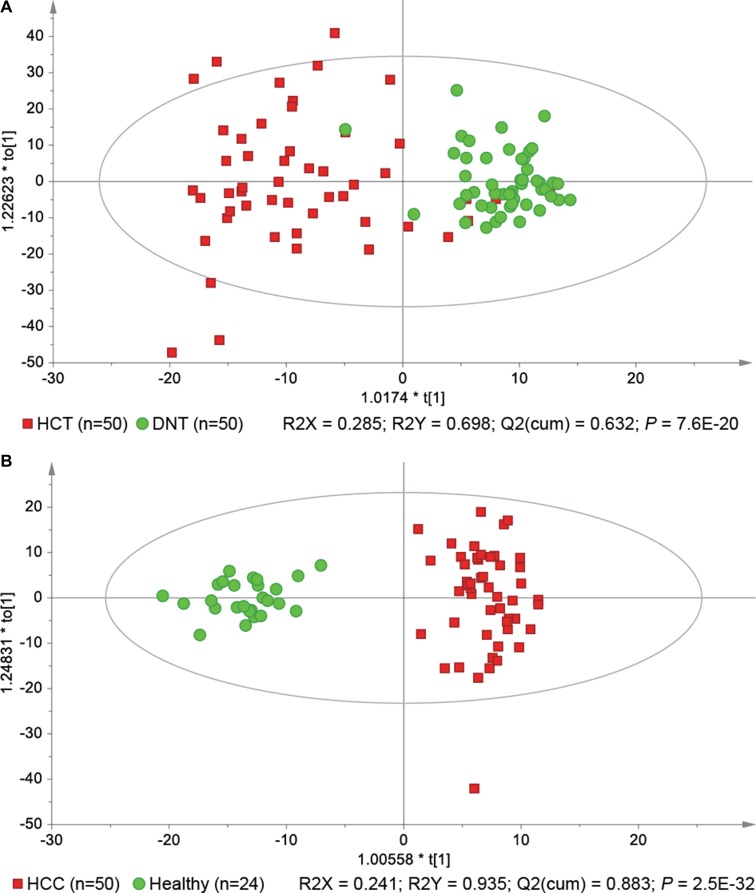
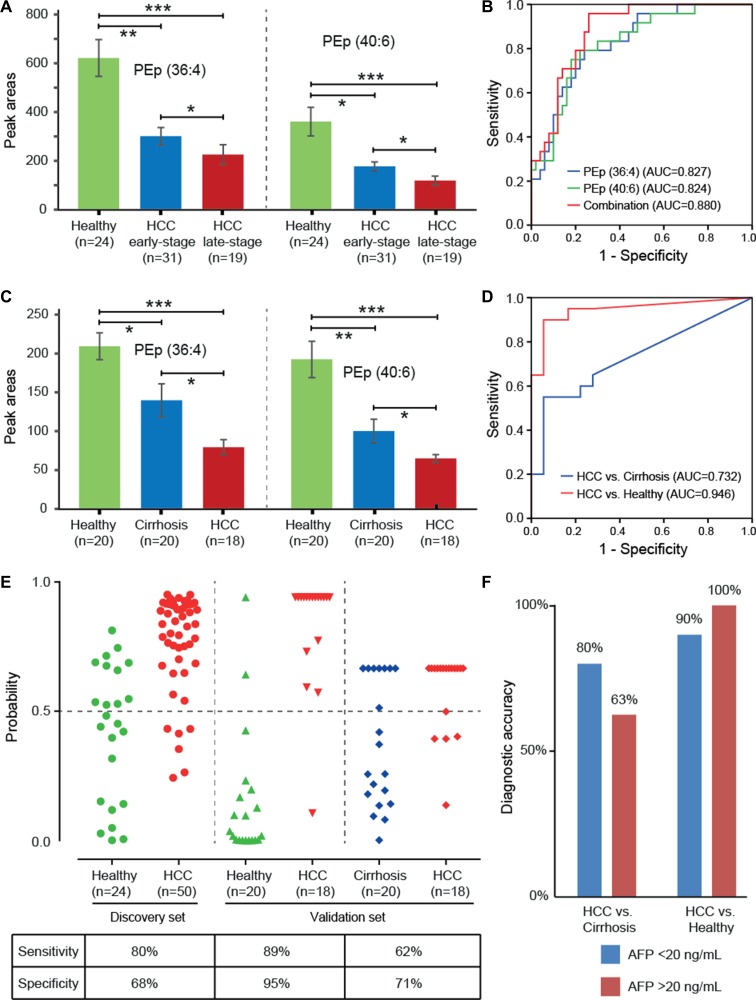
We compared hepatic and serum lipid changes in hepatocellular carcinoma (HCC) patients to have a better understanding of the molecular pathogenesis of this disease and discovery novel lipid biomarkers. Hepatic and serum lipid profiling was conducted in paired liver and serum samples from 50 HCC patients and 24 healthy controls. A total of 20 hepatic and 40 serum lipid signatures were identified, yet there was hardly any significant correlation between them. The results indicated that triglycerides and phosphatidylcholines contributed significantly to altered hepatic lipids, whereas triglycerides and phosphatidylethanolamine-based plasmalogens (PEp) contributed most to altered serum lipids. In serum, PEp (36:4) and (40:6) showed a fair capability to discriminate HCC patients from healthy controls, and were significantly associated with HCC tumor grades ( < 0.05), and thus were identified as potential diagnostic and prognostic biomarkers of HCC. These findings were confirmed by a validation study conducted in an independent cohort consisting of 18 HCC, 20 cirrhosis patients, and 20 healthy controls. This study suggests that hepatic and serum lipid signatures of HCC have to be considered as mostly independent, and the results imply potential roles of PEp species, particularly PEp (36:4) and (40:6), as serum biomarkers for HCC diagnosis and progression.
我们比较了肝细胞癌(HCC)患者的肝脏和血清脂质变化,以便更好地了解该疾病的分子发病机制并发现新的脂质生物标志物。对50例HCC患者和24例健康对照的配对肝脏和血清样本进行了肝脏和血清脂质谱分析。共鉴定出20种肝脏脂质特征和40种血清脂质特征,但它们之间几乎没有显著相关性。结果表明,甘油三酯和磷脂酰胆碱对肝脏脂质改变有显著贡献,而甘油三酯和基于磷脂酰乙醇胺的缩醛磷脂(PEp)对血清脂质改变贡献最大。在血清中,PEp(36:4)和(40:6)表现出较好的区分HCC患者和健康对照的能力,且与HCC肿瘤分级显著相关(<0.05),因此被确定为HCC潜在的诊断和预后生物标志物。在由18例HCC患者、20例肝硬化患者和20例健康对照组成的独立队列中进行的验证研究证实了这些发现。本研究表明,HCC的肝脏和血清脂质特征大多应被视为独立的,结果提示PEp种类,特别是PEp(36:4)和(40:6)作为HCC诊断和病情进展的血清生物标志物的潜在作用。