Mekonnen Tesfaye Hambisa, Tefera Mekuriaw Alemayewu, Melsew Yayehirad Alemu
1Department of Environmental and Occupational Health and Safety, Institute of Public Health, College of Medicine and Health Sciences, University of Gondar, P.O. Box 196, Gondar, Ethiopia.
2Department of Epidemiology and Biostatistics, Institute of Public Health, College of Medicine and Health Sciences, University of Gondar, Gondar, Ethiopia.
Ann Occup Environ Med. 2018 Feb 1;30:2. doi: 10.1186/s40557-018-0213-4. eCollection 2018.
Going to work despite feeling sick also known as sickness presenteeism is one of the emerging global occupational health challenges. Sickness presenteeism negatively affects both health of work forces and productivity of organizations in general. However, there is insufficient research exploring this situation in majority of the Sub-Saharan African countries, including Ethiopia. Thus this study intended to investigate the prevalence and determinant factors of sickness presenteeism among health care workers, Western Ethiopia.
This study used an institution based cross-sectional quantitative study design. The study period was from February to March, 2017. We employed simple random sampling method to select 360 study samples. Data collection was performed by pre-tested structured and self- administered questionnaire. We used SPSS version 20 to carry out binary logistic regression analysis. Odds ratio with 95% confidence intervals was calculated and significance of associations was determined at -value < 0.05.
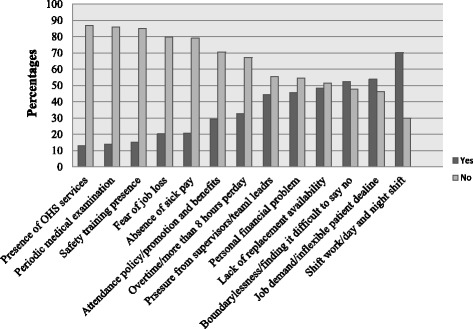
A total of 344 respondents fully completed the survey questionnaire. Mean age with standard deviation was 30.28 ± 6.181. Prevalence of sickness Presenteeism was 52.6% [95%CI: (47.4, 57.8)] in the past 12 months. Educational status [AOR:2.1, 95%CI: (1.17,3.90)], financial problem [AOR:1.9,95%CI:(1.07,3.46)], sickness absenteeism [AOR:2.7,95% CI:(1.50,5.02)], lack of staff replacement [AOR:2.7,95%CI:(1.50,5.02)], absence of occupational health services [AOR:3.0,95%CI:(1.34,6.70)], and pressure from supervisor [AOR:1.8,95% CI:(1.01,3.31)] were significant predictors of the dependent variable.
Relatively higher proportions of workers indicated sickness presenteeism as compared to other studies. Risk factors like educational status, personal financial problem, sickness absenteeism, lack of staff replacement, absence of occupational health services, and pressure from supervisors considerably increased the likely occurrence of employees' sick attendance. It is advisable for health care managers to hire adequate health care staffs, to implement basic occupational health services and to design strategies which reduce pressure from supervisors.
即使生病仍坚持上班,即所谓的带病出勤,是全球新出现的职业健康挑战之一。带病出勤总体上对劳动力健康和组织生产力都有负面影响。然而,在包括埃塞俄比亚在内的撒哈拉以南非洲大多数国家,对这种情况的研究不足。因此,本研究旨在调查埃塞俄比亚西部医护人员带病出勤的患病率及决定因素。
本研究采用基于机构的横断面定量研究设计。研究期间为2017年2月至3月。我们采用简单随机抽样方法选取360个研究样本。通过预先测试的结构化自填问卷进行数据收集。我们使用SPSS 20版进行二元逻辑回归分析。计算比值比及95%置信区间,并在p值<0.05时确定关联的显著性。
共有344名受访者完整填写了调查问卷。平均年龄及标准差为30.28±6.181。过去12个月带病出勤的患病率为52.6%[95%置信区间:(47.4, 57.8)]。教育程度[AOR:2.1, 95%置信区间:(1.17,3.90)]、经济问题[AOR:1.9,95%置信区间:(1.07,3.46)]、因病缺勤[AOR:2.7, 95%置信区间:(1.50,5.02)]、缺乏人员替代[AOR:2.7,95%置信区间:(1.50,5.02)]、缺乏职业健康服务[AOR:3.0,95%置信区间:(1.34,6.70)]以及来自上级的压力[AOR:1.8,95%置信区间:(1.01,3.31)]是因变量的显著预测因素。
与其他研究相比,相对较高比例的员工表示存在带病出勤情况。教育程度、个人经济问题、因病缺勤、缺乏人员替代、缺乏职业健康服务以及来自上级的压力等风险因素大大增加了员工带病出勤的可能性。建议医疗保健管理人员雇佣足够的医护人员,实施基本的职业健康服务,并制定减少上级压力的策略。