Shimabukuro David W, Barton Christopher W, Feldman Mitchell D, Mataraso Samson J, Das Ritankar
Division of Critical Care Medicine, Department of Anesthesia and Perioperative Care, University of California San Francisco, San Francisco, California, USA.
Department of Emergency Medicine, University of California San Francisco, San Francisco, California, USA.
BMJ Open Respir Res. 2017 Nov 9;4(1):e000234. doi: 10.1136/bmjresp-2017-000234. eCollection 2017.
Several methods have been developed to electronically monitor patients for severe sepsis, but few provide predictive capabilities to enable early intervention; furthermore, no severe sepsis prediction systems have been previously validated in a randomised study. We tested the use of a machine learning-based severe sepsis prediction system for reductions in average length of stay and in-hospital mortality rate.
We conducted a randomised controlled clinical trial at two medical-surgical intensive care units at the University of California, San Francisco Medical Center, evaluating the primary outcome of average length of stay, and secondary outcome of in-hospital mortality rate from December 2016 to February 2017. Adult patients (18+) admitted to participating units were eligible for this factorial, open-label study. Enrolled patients were assigned to a trial arm by a random allocation sequence. In the control group, only the current severe sepsis detector was used; in the experimental group, the machine learning algorithm (MLA) was also used. On receiving an alert, the care team evaluated the patient and initiated the severe sepsis bundle, if appropriate. Although participants were randomly assigned to a trial arm, group assignments were automatically revealed for any patients who received MLA alerts.
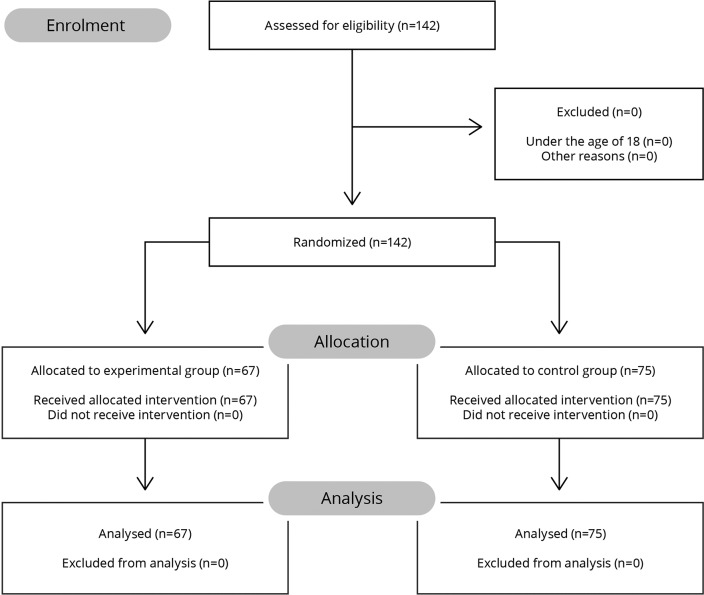
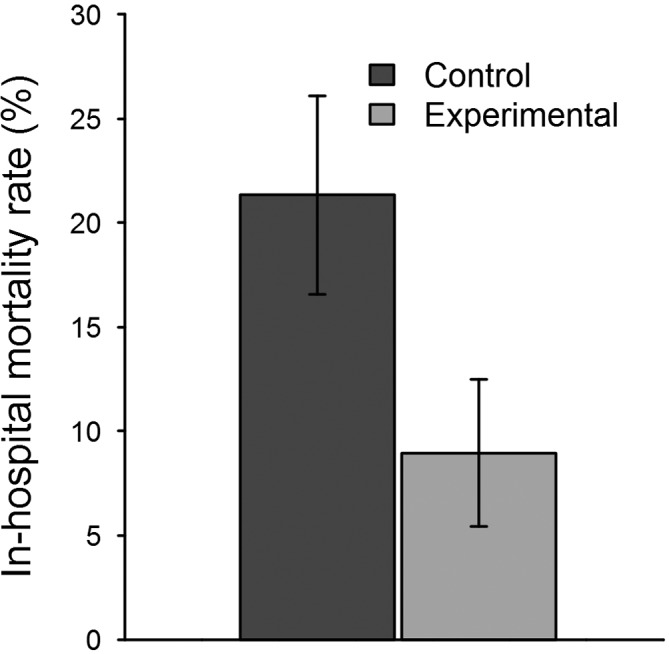
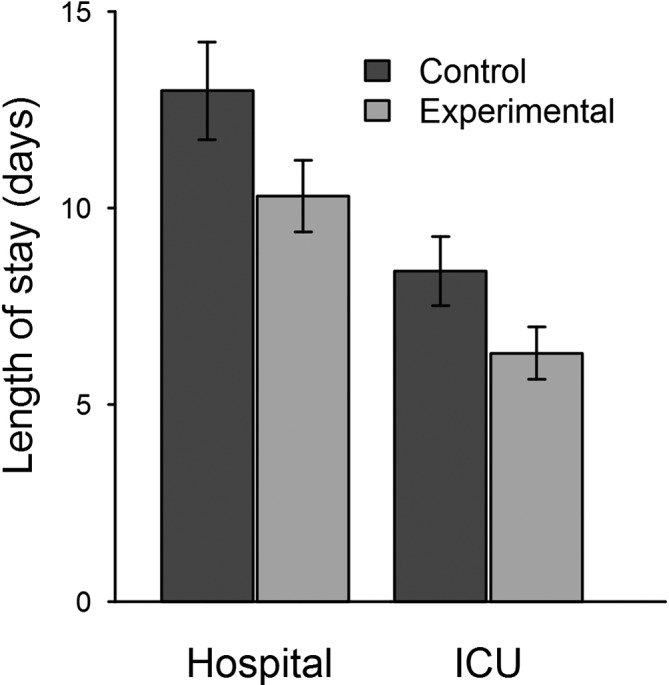
Outcomes from 75 patients in the control and 67 patients in the experimental group were analysed. Average length of stay decreased from 13.0 days in the control to 10.3 days in the experimental group (p=0.042). In-hospital mortality decreased by 12.4 percentage points when using the MLA (p=0.018), a relative reduction of 58.0%. No adverse events were reported during this trial.
The MLA was associated with improved patient outcomes. This is the first randomised controlled trial of a sepsis surveillance system to demonstrate statistically significant differences in length of stay and in-hospital mortality.
NCT03015454.
已经开发了几种方法来对严重脓毒症患者进行电子监测,但很少有方法具备预测能力以实现早期干预;此外,以前没有严重脓毒症预测系统在随机研究中得到验证。我们测试了一种基于机器学习的严重脓毒症预测系统对于缩短平均住院时间和降低住院死亡率的作用。
我们在加利福尼亚大学旧金山分校医学中心的两个内科-外科重症监护病房进行了一项随机对照临床试验,评估2016年12月至2017年2月期间的主要结局——平均住院时间,以及次要结局——住院死亡率。入住参与研究病房的成年患者(18岁及以上)符合这项析因、开放标签研究的条件。入选患者通过随机分配序列被分配到一个试验组。在对照组中,仅使用当前的严重脓毒症检测器;在试验组中,还使用机器学习算法(MLA)。在收到警报后,护理团队对患者进行评估,并在适当情况下启动严重脓毒症综合治疗方案。尽管参与者被随机分配到一个试验组,但对于任何收到MLA警报的患者,其组分配会自动显示。
分析了对照组75例患者和试验组67例患者的结局。平均住院时间从对照组的13.0天降至试验组的10.3天(p=0.042)。使用MLA时,住院死亡率降低了12.4个百分点(p=0.018),相对降低了58.0%。在该试验期间未报告不良事件。
MLA与改善患者结局相关。这是脓毒症监测系统的首次随机对照试验,证明在住院时间和住院死亡率方面存在统计学上的显著差异。
NCT03015454。