Farhat Maha, Shaheed Raja A, Al-Ali Haider H, Al-Ghamdi Abdullah S, Al-Hamaqi Ghadeer M, Maan Hawraa S, Al-Mahfoodh Zainab A, Al-Seba Hussain Z
Department of Biochemistry, Imam Abdulrahman Bin Faisal University, Dammam, Kindgdom of Saudi Arabia. E-mail.
Saudi Med J. 2018 Feb;39(2):137-141. doi: 10.15537/smj.2018.2.21587.
To investigate the presence of Legionella spp in cooling tower water. Legionella proliferation in cooling tower water has serious public health implications as it can be transmitted to humans via aerosols and cause Legionnaires' disease.
Samples of cooling tower water were collected from King Fahd Hospital of the University (KFHU) (Imam Abdulrahman Bin Faisal University, 2015/2016). The water samples were analyzed by a standard Legionella culture method, real-time polymerase chain reaction (RT-PCR), and 16S rRNA next-generation sequencing. In addition, the bacterial community composition was evaluated.
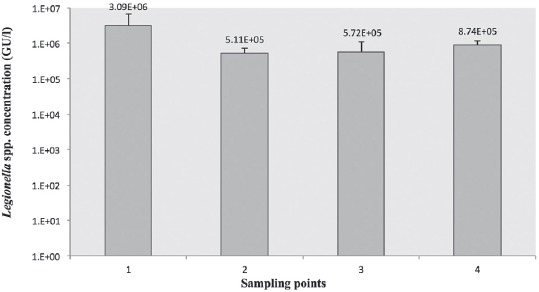
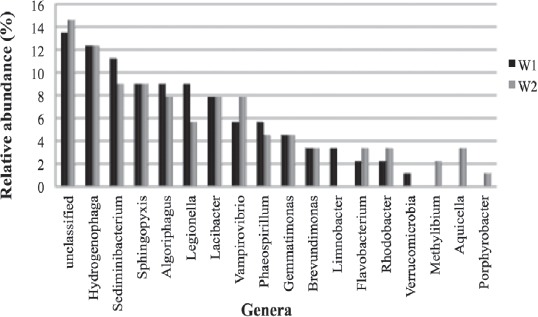
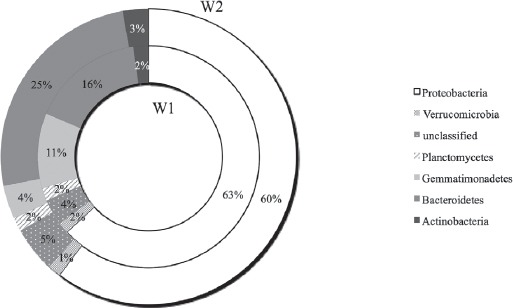
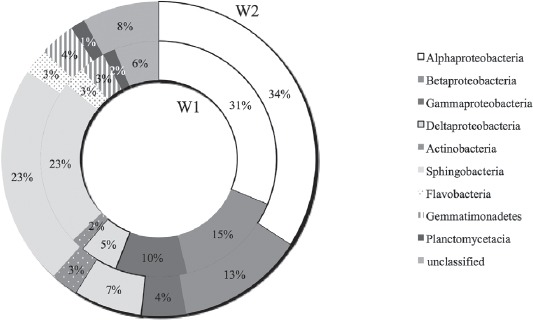
All samples were negative by conventional Legionella culture. In contrast, all water samples yielded positive results by real-time PCR (105 to 106 GU/L). The results of 16S rRNA next generation sequencing showed high similarity and reproducibility among the water samples. The majority of sequences were Alpha-, Beta-, and Gamma-proteobacteria, and Legionella was the predominant genus. The hydrogen-oxidizing gram-negative bacterium Hydrogenophaga was present at high abundance, indicating high metabolic activity. Sphingopyxis, which is known for its resistance to antimicrobials and as a pioneer in biofilm formation, was also detected.
Our findings indicate that monitoring of Legionella in cooling tower water would be enhanced by use of both conventional culturing and molecular methods.
调查冷却塔水中军团菌属的存在情况。冷却塔水中军团菌的增殖具有严重的公共卫生影响,因为它可通过气溶胶传播给人类并导致军团病。
从法赫德国王大学医院(KFHU)(伊玛目阿卜杜勒拉赫曼·本·费萨尔大学,2015/2016年)采集冷却塔水样。通过标准军团菌培养方法、实时聚合酶链反应(RT-PCR)和16S rRNA下一代测序对水样进行分析。此外,还评估了细菌群落组成。
所有样本通过传统军团菌培养均为阴性。相比之下,所有水样通过实时PCR均产生阳性结果(105至106 GU/L)。16S rRNA下一代测序结果显示水样之间具有高度相似性和可重复性。大多数序列为α-、β-和γ-变形菌纲,军团菌是主要属。氢氧化革兰氏阴性菌嗜氢菌大量存在,表明代谢活性高。还检测到以其对抗菌剂的抗性和作为生物膜形成先驱而闻名的鞘氨醇单胞菌。
我们的研究结果表明,同时使用传统培养和分子方法可加强对冷却塔水中军团菌的监测。