CSIRO Health and Biosecurity, P.O. Box 10041, Adelaide, SA 5000, Australia.
School of Pharmacy and Medical Sciences, University of South Australia, Adelaide, SA 5000, Australia.
Nutrients. 2018 Feb 11;10(2):197. doi: 10.3390/nu10020197.
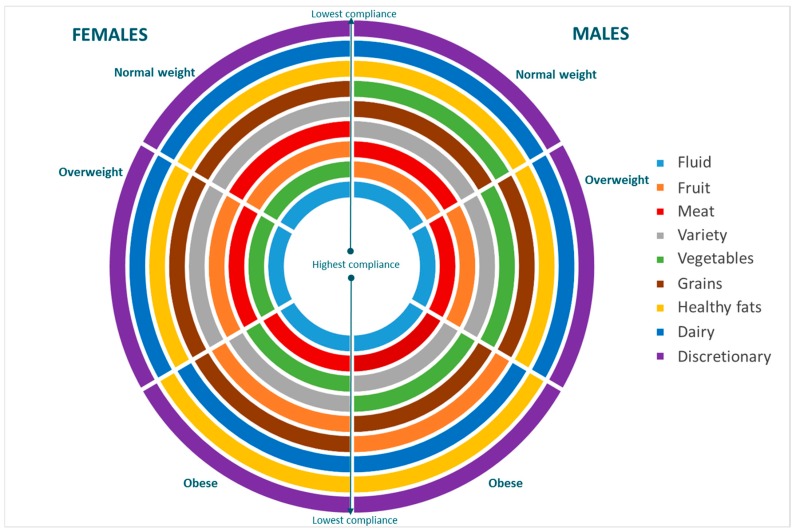
Population surveys have rarely identified dietary patterns associated with excess energy intake in relation to risk of obesity. This study uses self-reported food intake data from the validated Commonwealth Scientific and Industrial Research Organisation (CSIRO) Healthy Diet Score survey to examine whether apparent compliance with dietary guidelines varies by weight status. The sample of 185,951 Australian adults were majority female (71.8%), with 30.2%, 35.3% and 31.0% aged between 18-30, 31-50 and 51-70 years respectively. Using multinomial regression, in the adjusted model controlling for gender and age, individuals in the lowest quintile of diet quality were almost three times more likely to be obese than those in the highest quintile (OR 2.99, CI: 2.88:3.11; < 0.001). The differential components of diet quality between normal and obese adults were fruit (difference in compliance score 12.9 points out of a possible 100, CI: 12.3:13.5; < 0.001), discretionary foods (8.7 points, CI: 8.1:9.2; < 0.001), and healthy fats (7.7 points, CI: 7.2:8.1; < 0.001). Discretionary foods was the lowest scoring component across all gender and weight status groups, and are an important intervention target to improve diet quality. This study contributes to the evidence that diet quality is associated with health outcomes, including weight status, and will be useful in framing recommendations for obesity prevention and management.
人群调查很少发现与过量能量摄入相关的饮食模式与肥胖风险有关。本研究使用经过验证的英联邦科学与工业研究组织(CSIRO)健康饮食评分调查的自我报告食物摄入量数据,来研究饮食指南的明显遵守情况是否因体重状况而异。该样本包括 185951 名澳大利亚成年人,其中大多数为女性(71.8%),分别有 30.2%、35.3%和 31.0%的年龄在 18-30 岁、31-50 岁和 51-70 岁之间。使用多项回归,在调整了性别和年龄的模型中,饮食质量最低五分位数的个体肥胖的可能性几乎是最高五分位数的个体的三倍(OR 2.99,CI:2.88:3.11;<0.001)。正常体重和肥胖成年人之间饮食质量的差异成分是水果(遵守得分差异为 12.9 分,可能为 100 分,CI:12.3:13.5;<0.001)、可自由支配的食物(8.7 分,CI:8.1:9.2;<0.001)和健康脂肪(7.7 分,CI:7.2:8.1;<0.001)。可自由支配的食物是所有性别和体重状况组中得分最低的成分,是改善饮食质量的重要干预目标。本研究为饮食质量与健康结果(包括体重状况)相关的证据做出了贡献,将有助于制定肥胖预防和管理的建议。