University College London, London, UK.
Allen Institute for Brain Science, Seattle, WA, United States.
Curr Opin Neurobiol. 2018 Jun;50:92-100. doi: 10.1016/j.conb.2018.01.009. Epub 2018 Feb 13.
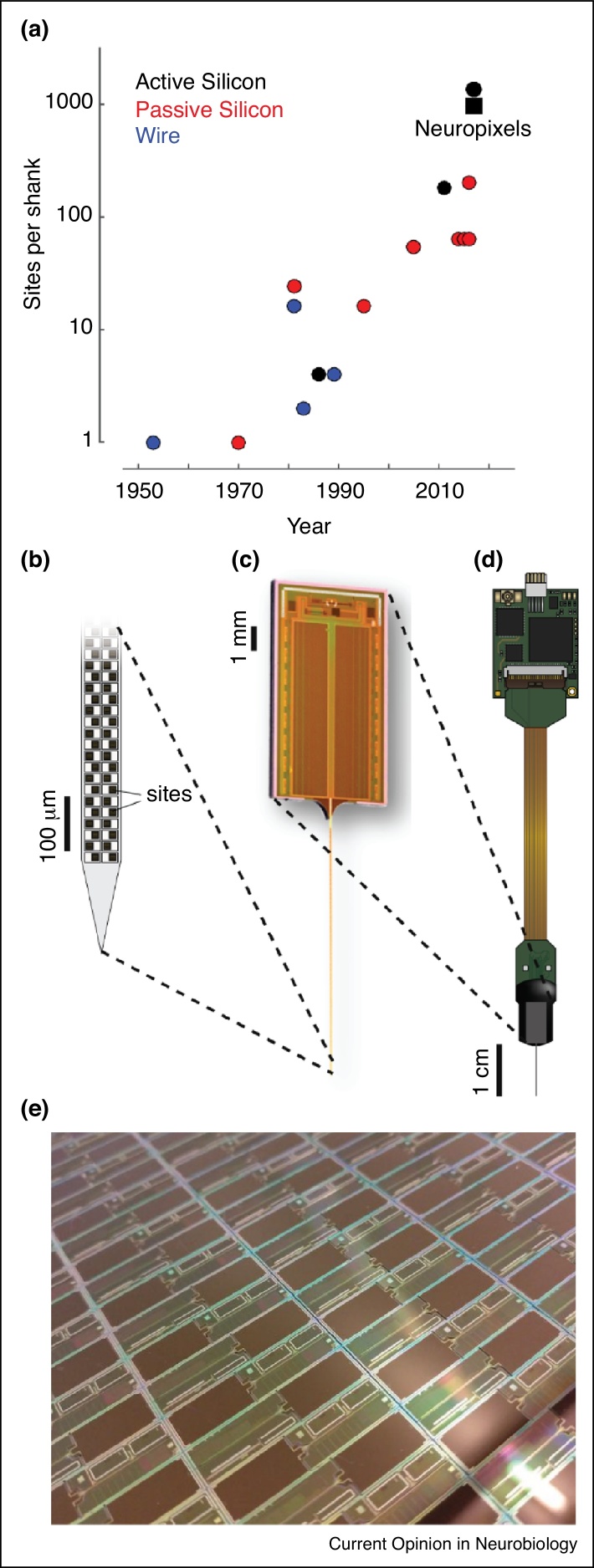
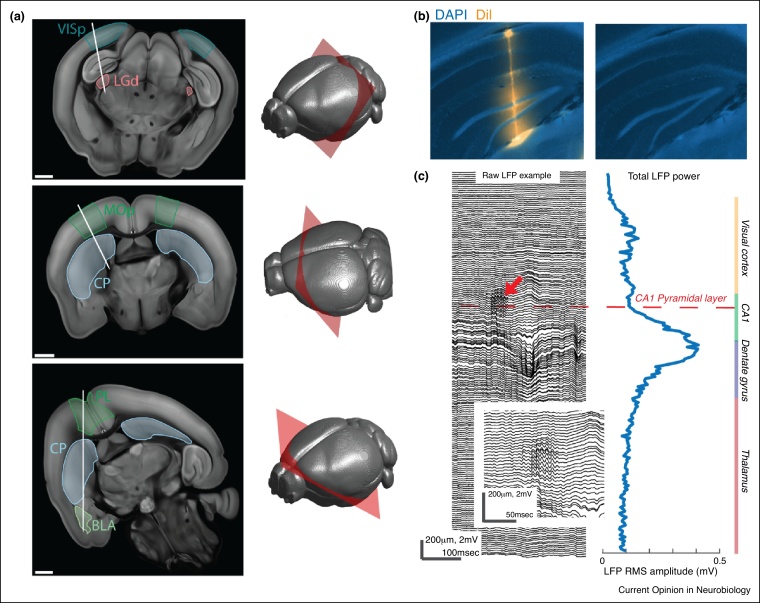
Electrophysiological methods are the gold standard in neuroscience because they reveal the activity of individual neurons at high temporal resolution and in arbitrary brain locations. Microelectrode arrays based on complementary metal-oxide semiconductor (CMOS) technology, such as Neuropixels probes, look set to transform these methods. Neuropixels probes provide ∼1000 recording sites on an extremely narrow shank, with on-board amplification, digitization, and multiplexing. They deliver low-noise recordings from hundreds of neurons, providing a step change in the type of data available to neuroscientists. Here we discuss the opportunities afforded by these probes for large-scale electrophysiology, the challenges associated with data processing and anatomical localization, and avenues for further improvements of the technology.
电生理学方法是神经科学的金标准,因为它们可以以高时间分辨率和任意脑区揭示单个神经元的活动。基于互补金属氧化物半导体 (CMOS) 技术的微电极阵列,如 Neuropixels 探针,有望改变这些方法。Neuropixels 探针在极细的探臂上提供了约 1000 个记录位点,具有板载放大、数字化和多路复用功能。它们可以从数百个神经元中获取低噪声记录,为神经科学家提供了可用数据类型的重大改变。在这里,我们讨论了这些探针在大规模电生理学方面带来的机遇,以及与数据处理和解剖定位相关的挑战,以及进一步改进该技术的途径。