Weiss Ingrid M, Muth Christina, Drumm Robert, Kirchner Helmut O K
1Institute of Biomaterials and Biomolecular Systems, University of Stuttgart, Pfaffenwaldring 57, Stuttgart, D-70569 Germany.
2INM-Leibniz Institute for New Materials, Campus D2 2, Saarbruecken, D-66123 Germany.
BMC Biophys. 2018 Feb 9;11:2. doi: 10.1186/s13628-018-0042-4. eCollection 2018.
The pathways of thermal instability of amino acids have been unknown. New mass spectrometric data allow unequivocal quantitative identification of the decomposition products.
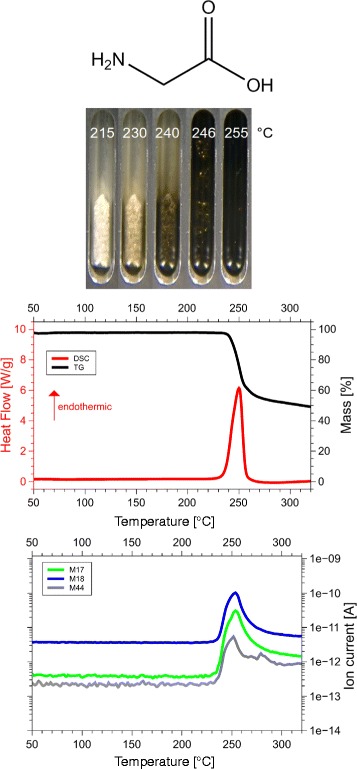
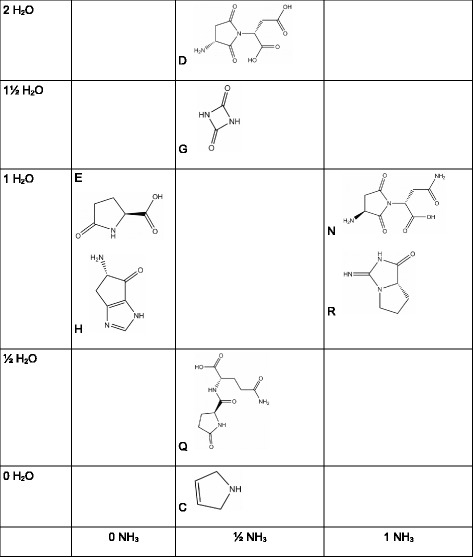
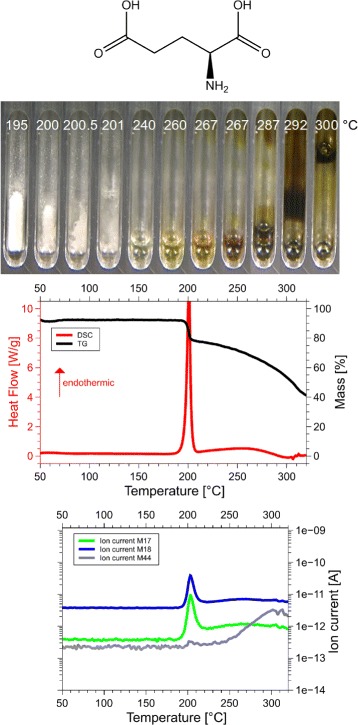
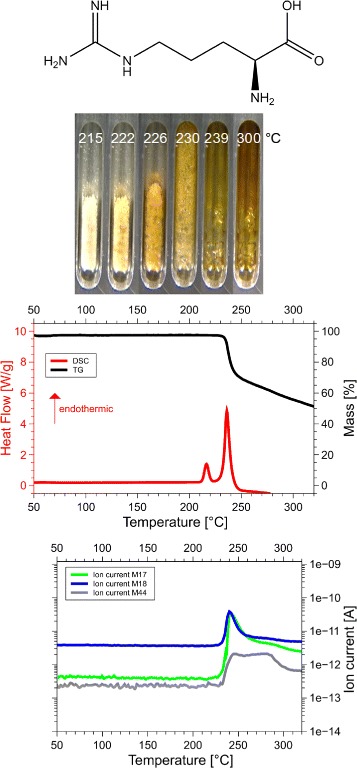
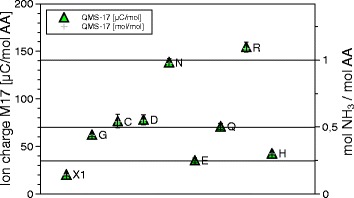
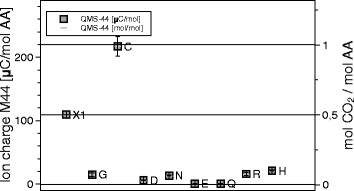
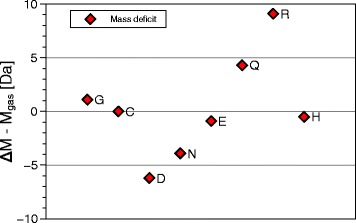
Calorimetry, thermogravimetry and mass spectrometry were used to follow the thermal decomposition of the eight amino acids G, C, D, N, E, Q, R and H between 185 °C and 280 °C. Endothermic heats of decomposition between 72 and 151 kJ/mol are needed to form 12 to 70% volatile products. This process is neither melting nor sublimation. With exception of cysteine they emit mainly HO, some NH and no CO. Cysteine produces CO and little else. The reactions are described by polynomials, AA→ NH+ HO+ CO+ HS+ residue, with integer or half integer coefficients. The solid monomolecular residues are rich in peptide bonds.
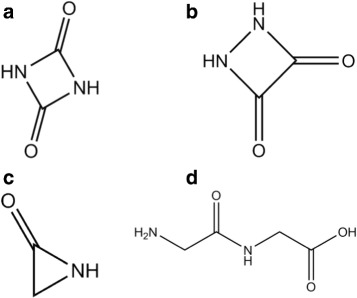
Eight of the 20 standard amino acids decompose at well-defined, characteristic temperatures, in contrast to commonly accepted knowledge. Products of decomposition are simple. The novel quantitative results emphasize the impact of water and cyclic condensates with peptide bonds and put constraints on hypotheses of the origin, state and stability of amino acids in the range between 200 °C and 300 °C.
氨基酸热不稳定性的途径尚不明确。新的质谱数据能够明确地对分解产物进行定量鉴定。
采用量热法、热重分析法和质谱法跟踪了甘氨酸(G)、半胱氨酸(C)、天冬氨酸(D)、天冬酰胺(N)、谷氨酸(E)、谷氨酰胺(Q)、精氨酸(R)和组氨酸(H)这8种氨基酸在185℃至280℃之间的热分解过程。形成12%至70%的挥发性产物需要72至151kJ/mol的吸热分解热。此过程既不是熔化也不是升华。除半胱氨酸外,它们主要释放HO、一些NH且不释放CO。半胱氨酸产生CO且几乎没有其他产物。这些反应可用多项式描述,即氨基酸→NH + HO + CO + HS + 残余物,系数为整数或半整数。固体单分子残余物富含肽键。
与普遍认知相反,20种标准氨基酸中的8种在明确的特征温度下分解。分解产物简单。这些新的定量结果强调了水和含肽键的环状缩合物的影响,并对200℃至300℃范围内氨基酸的起源、状态和稳定性假说施加了限制。