Department of Surgery Oncology and Gastroenterology, University of Padova, Via Giustiniani 2, 35128, Padova, Italy.
Istituto Oncologico Veneto, IOV-IRCCS, Padova, Italy.
BMC Med. 2018 Feb 19;16(1):20. doi: 10.1186/s12916-018-1010-1.
Dysfunction of the circadian clock and single polymorphisms of some circadian genes have been linked to cancer susceptibility, although data are scarce and findings inconsistent. We aimed to investigate the association between circadian pathway genetic variation and risk of developing common cancers based on the findings of genome-wide association studies (GWASs).
Single nucleotide polymorphisms (SNPs) of 17 circadian genes reported by three GWAS meta-analyses dedicated to breast (Discovery, Biology, and Risk of Inherited Variants in Breast Cancer (DRIVE) Consortium; cases, n = 15,748; controls, n = 18,084), prostate (Elucidating Loci Involved in Prostate Cancer Susceptibility (ELLIPSE) Consortium; cases, n = 14,160; controls, n = 12,724) and lung carcinoma (Transdisciplinary Research In Cancer of the Lung (TRICL) Consortium; cases, n = 12,160; controls, n = 16,838) in patients of European ancestry were utilized to perform pathway analysis by means of the adaptive rank truncated product (ARTP) method. Data were also available for the following subgroups: estrogen receptor negative breast cancer, aggressive prostate cancer, squamous lung carcinoma and lung adenocarcinoma.
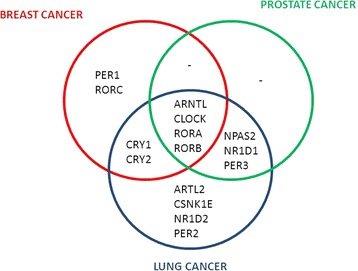
We found a highly significant statistical association between circadian pathway genetic variation and the risk of breast (pathway P value = 1.9 × 10; top gene RORA, gene P value = 0.0003), prostate (pathway P value = 4.1 × 10; top gene ARNTL, gene P value = 0.0002) and lung cancer (pathway P value = 6.9 × 10; top gene RORA, gene P value = 2.0 × 10), as well as all their subgroups. Out of 17 genes investigated, 15 were found to be significantly associated with the risk of cancer: four genes were shared by all three malignancies (ARNTL, CLOCK, RORA and RORB), two by breast and lung cancer (CRY1 and CRY2) and three by prostate and lung cancer (NPAS2, NR1D1 and PER3), whereas four genes were specific for lung cancer (ARNTL2, CSNK1E, NR1D2 and PER2) and two for breast cancer (PER1, RORC).
Our findings, based on the largest series ever utilized for ARTP-based gene and pathway analysis, support the hypothesis that circadian pathway genetic variation is involved in cancer predisposition.
尽管数据有限且结果不一致,但昼夜节律钟功能障碍和一些昼夜节律基因的单一多态性已与癌症易感性相关。我们旨在根据全基因组关联研究(GWAS)的结果,研究昼夜节律途径遗传变异与常见癌症发病风险之间的关联。
基于三项专门针对乳腺癌(发现、生物学和乳腺癌遗传变异风险(DRIVE)联盟的风险;病例,n=15748;对照,n=18084)、前列腺癌(阐明前列腺癌易感性相关基因(ELLIPSE)联盟;病例,n=14160;对照,n=12724)和肺癌(癌症的跨学科研究(TRICL)联盟;病例,n=12160;对照,n=16838)的三个 GWAS 荟萃分析报告的 17 个昼夜节律基因的单核苷酸多态性(SNP),用于通过适应性秩截断乘积(ARTP)方法进行途径分析。还可获得以下亚组的数据:雌激素受体阴性乳腺癌、侵袭性前列腺癌、鳞状肺癌和肺腺癌。
我们发现昼夜节律途径遗传变异与乳腺癌(途径 P 值=1.9×10;顶级基因 RORA,基因 P 值=0.0003)、前列腺癌(途径 P 值=4.1×10;顶级基因 ARNTL,基因 P 值=0.0002)和肺癌(途径 P 值=6.9×10;顶级基因 RORA,基因 P 值=2.0×10)的风险之间存在高度显著的统计学关联,以及所有这些亚组。在研究的 17 个基因中,有 15 个与癌症风险显著相关:四个基因在三种恶性肿瘤中均存在(ARNTL、CLOCK、RORA 和 RORB),两个基因在乳腺癌和肺癌中存在(CRY1 和 CRY2),三个基因在前列腺癌和肺癌中存在(NPAS2、NR1D1 和 PER3),而四个基因在肺癌中是特异性的(ARNTL2、CSNK1E、NR1D2 和 PER2),两个基因在乳腺癌中是特异性的(PER1、RORC)。
我们的研究结果基于迄今为止最大的 ARTP 基因和途径分析系列,支持昼夜节律途径遗传变异参与癌症易感性的假说。