Ye Dan, Guan Kun-Liang, Xiong Yue
Molecular and Cell Biology Lab, Institute of Biomedical Sciences, Shanghai Medical College, Fudan University, Shanghai 200032, China; Department of General Surgery, Huashan Hospital, Fudan University, Shanghai 200040, China.
Molecular and Cell Biology Lab, Institute of Biomedical Sciences, Shanghai Medical College, Fudan University, Shanghai 200032, China; Department of Pharmacology and Moores Cancer Center, University of California, San Diego, La Jolla, CA 92093, USA.
Trends Cancer. 2018 Feb;4(2):151-165. doi: 10.1016/j.trecan.2017.12.005. Epub 2018 Jan 5.
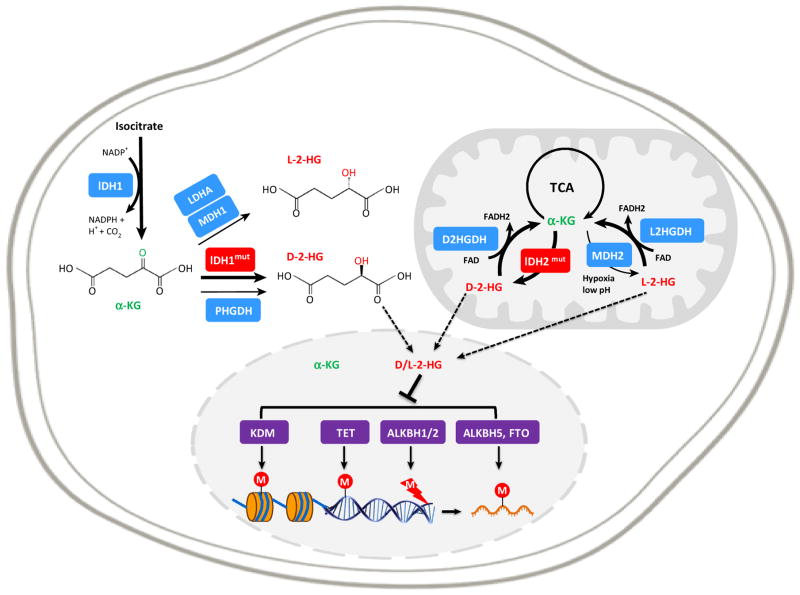
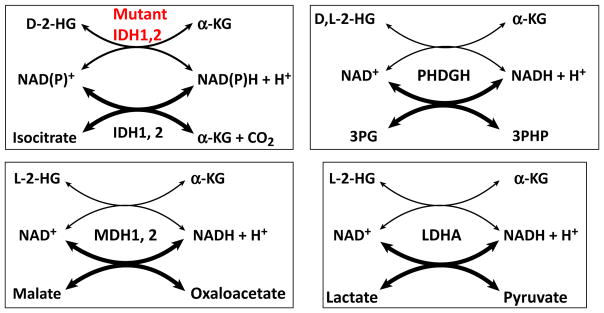
Isocitrate dehydrogenases (IDH1/2) are frequently mutated in multiple types of human cancer, resulting in neomorphic enzymes that convert α-ketoglutarate (α-KG) to 2-hydroxyglutarate (2-HG). The current view on the mechanism of IDH mutation holds that 2-HG acts as an antagonist of α-KG to competitively inhibit the activity of α-KG-dependent dioxygenases, including those involved in histone and DNA demethylation. Recent studies have implicated 2-HG in activities beyond epigenetic modification. Multiple enzymes have been discovered that lack mutations but that can nevertheless produce 2-HG promiscuously under hypoxic or acidic conditions. Therapies are being developed to treat IDH-mutant cancers by targeting either the mutant IDH enzymes directly or the pathways sensitized by 2-HG.
异柠檬酸脱氢酶(IDH1/2)在多种人类癌症中经常发生突变,产生新的酶,将α-酮戊二酸(α-KG)转化为2-羟基戊二酸(2-HG)。目前关于IDH突变机制的观点认为,2-HG作为α-KG的拮抗剂,竞争性抑制α-KG依赖性双加氧酶的活性,包括参与组蛋白和DNA去甲基化的酶。最近的研究表明,2-HG的作用超出了表观遗传修饰。已经发现多种酶虽然没有突变,但在缺氧或酸性条件下仍能大量产生2-HG。目前正在开发通过直接靶向突变的IDH酶或由2-HG致敏的途径来治疗IDH突变癌症的疗法。