Bhat Sudipta, Kattoor Jobin Jose, Malik Yashpal Singh, Sircar Shubhankar, Deol Pallavi, Rawat Vinita, Rakholia Ritu, Ghosh Souvik, Vlasova Anastasia N, Nadia Touil, Dhama Kuldeep, Kobayashi Nobumichi
Division of Biological Standardization, ICAR-Indian Veterinary Research Institute, Izatnagar, Bareilly 243122, India.
Department of Microbiology, Government Medical College, Haldwani, Nainital, Uttarakhand 263 139, India.
Pathogens. 2018 Feb 17;7(1):23. doi: 10.3390/pathogens7010023.
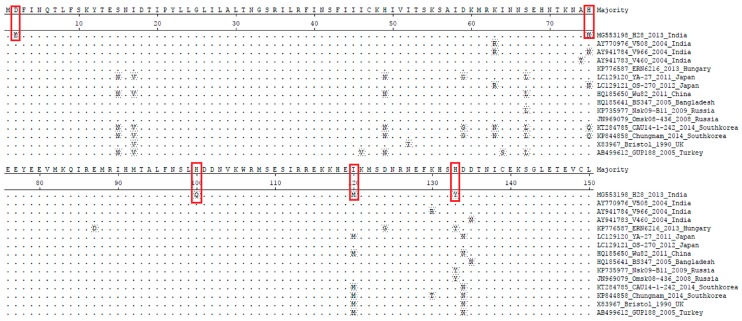
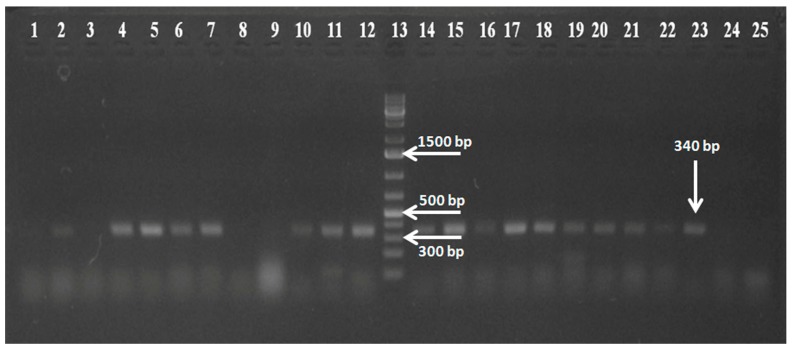
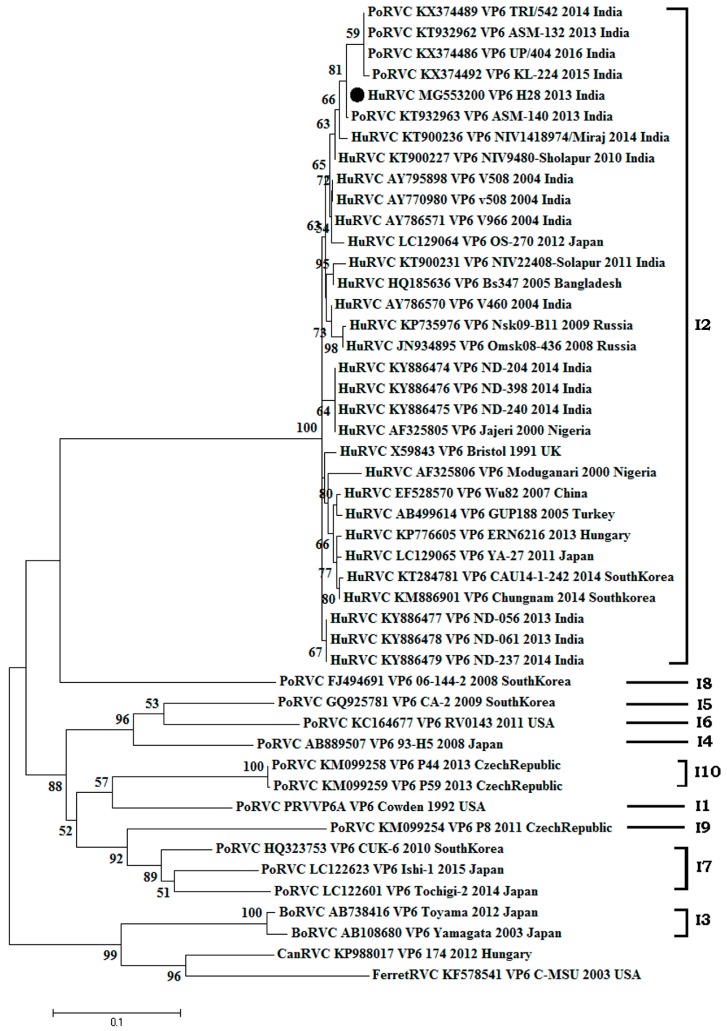
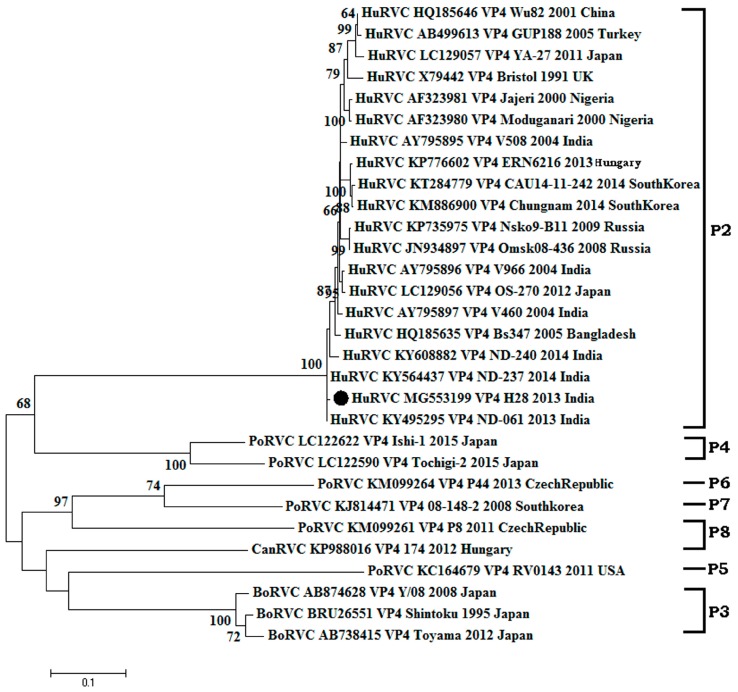
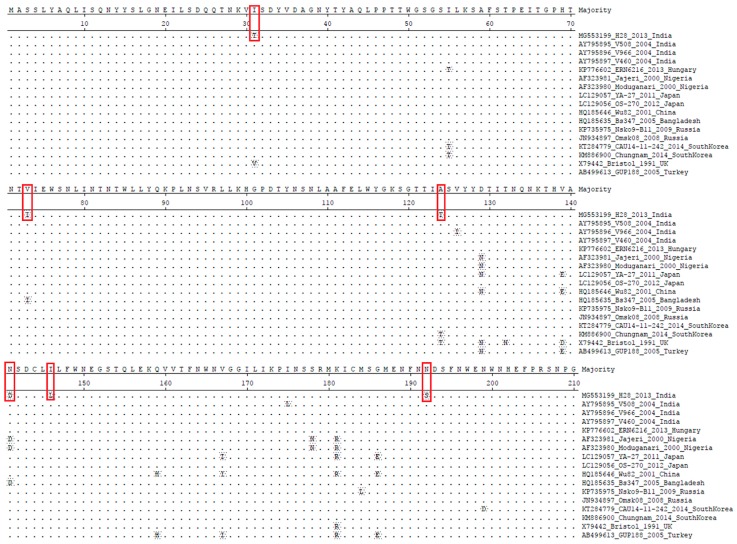
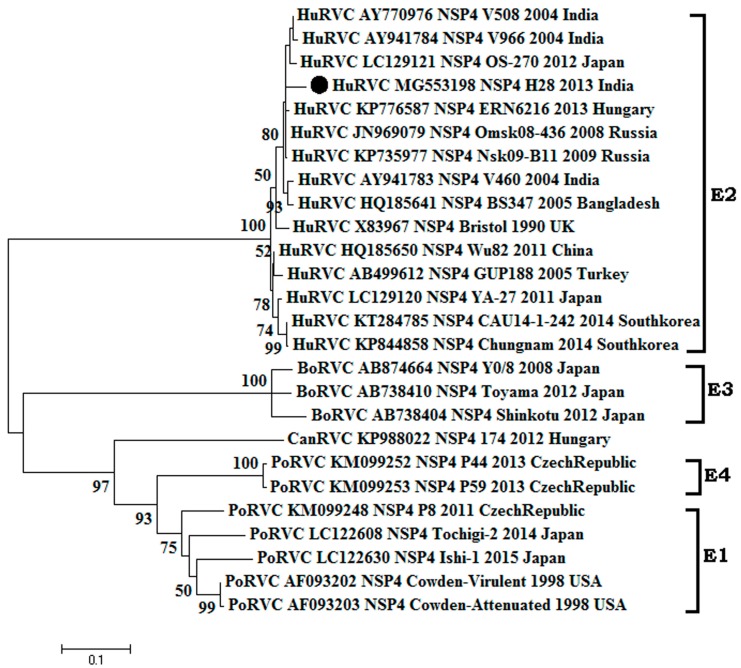
All over the world, children and adults are severely affected by acute gastroenteritis, caused by one of the emerging enteric pathogens, rotavirus C (RVC). At present, no extensive surveillance program is running for RVC in India, and its prevalence is largely unknown except cases of local outbreaks. Here, we intended to detect the presence of RVC in diarrheic children visiting or admitted to hospitals in Haldwani (state of Uttarakhand, India), a city located in the foothills of the Himalayas. During 2010-2013, we screened 119 samples for RVC by an RVC VP6 gene-specific RT-PCR. Of these, 38 (31.93%) were found positive, which is higher than the incidence rates reported so far from India. The phylogenetic analysis of the derived nucleotide sequences from one of the human RVC (HuRVC) isolates, designated as HuRVC/H28/2013/India, showed that the study isolate belongs to genotype I2, P2 and E2 for RVC structural genes 6 and 4 (VP6, and VP4) and non-structural gene 4 (NSP4), respectively. Furthermore, the VP6 gene of HuRVC/H28/2013/India shows the highest similarity to a recently-reported human-like porcine RVC (PoRVC/ASM140/2013/India, KT932963) from India suggesting zoonotic transmission. We also report a full-length NSP4 gene sequence of human RVC from India. Under the One-health platforms there is a need to launch combined human and animal RVC surveillance programs for a better understanding of the epidemiology of RVC infections and for implementing control strategies., possess 11 double-stranded segments of RNA that encode six structural viral proteins (VP1, VP2, VP3, VP4, VP6, VP7) and five/six non-structural proteins (NSP1-NSP5/6) [7]. Based on the antigenic properties of the major inner capsid protein (VP6), RVs are subdivided into eight well-characterized species (A-H) and two putative species viz. I and J [8-10]. Humans and other mammalian species are affected by species A, B, C and H rotaviruses and birds by species D, F and G, and species E has been reported exclusively in pigs [7,8,11-17]. The newly-proposed species I is reported in dogs [18] and cats [19], whereas species J is found in bats [10].
在世界各地,儿童和成人都受到急性肠胃炎的严重影响,这是由一种新出现的肠道病原体——轮状病毒C(RVC)引起的。目前,印度尚未开展针对RVC的广泛监测项目,除了局部暴发的病例外,其流行情况 largely unknown。在此,我们旨在检测在印度北阿坎德邦哈德瓦尼市(位于喜马拉雅山脚下的一座城市)就诊或住院的腹泻儿童中RVC的存在情况。在2010 - 2013年期间,我们通过RVC VP6基因特异性逆转录聚合酶链反应(RT-PCR)对119份样本进行了RVC筛查。其中,38份(31.93%)被检测为阳性,这一比例高于目前印度报道的发病率。对一株人类RVC(HuRVC)分离株(命名为HuRVC/H28/2013/印度)的推导核苷酸序列进行系统发育分析表明,该研究分离株的RVC结构基因6和4(VP6和VP4)以及非结构基因4(NSP4)分别属于I2、P2和E2基因型。此外,HuRVC/H28/2013/印度的VP6基因与最近报道的一株来自印度的类人猪RVC(PoRVC/ASM140/2013/印度,KT9,提示人畜共患病传播。我们还报道了来自印度的人类RVC的全长NSP4基因序列。在“同一健康”平台下,有必要启动人类和动物联合的RVC监测项目,以便更好地了解RVC感染的流行病学情况并实施控制策略。轮状病毒拥有11条双链RNA片段,编码6种病毒结构蛋白(VP1、VP2、VP3、VP4、VP6、VP7)和5/种非结构蛋白(NSP1-NSP5/6)[7]。根据主要内衣壳蛋白(VP6)的抗原特性,轮状病毒可细分为8个特征明确的种(A - H)和2个假定种,即I和J[8 - 10]。人类和其他哺乳动物受到A、B、C和H种轮状病毒的影响,鸟类受到D、F和G种轮状病毒的影响,而E种轮状病毒仅在猪中被报道[7,8,11 - 17]。新提出的I种轮状病毒在狗[18]和猫[19]中被报道,而J种轮状病毒在蝙蝠[10]中被发现。 (注:原文中“largely unknown”未准确翻译,可根据上下文理解其含义为“很大程度上未知” ;“5/种非结构蛋白”表述有误,原文为“five/six non-structural proteins”,推测应为“5或6种非结构蛋白” )