BioMedical Research Center, Qatar University, Doha, Qatar.
Department of Biomedical Science, College of Health Sciences, and.
Sex Transm Dis. 2018 Jul;45(7):482-487. doi: 10.1097/OLQ.0000000000000791.
There are limited data on herpes simplex virus type 2 (HSV-2) seroprevalence in the Middle East and North Africa (MENA). We examined country- and age-specific HSV-2 seroprevalence among select MENA populations residing in Qatar.
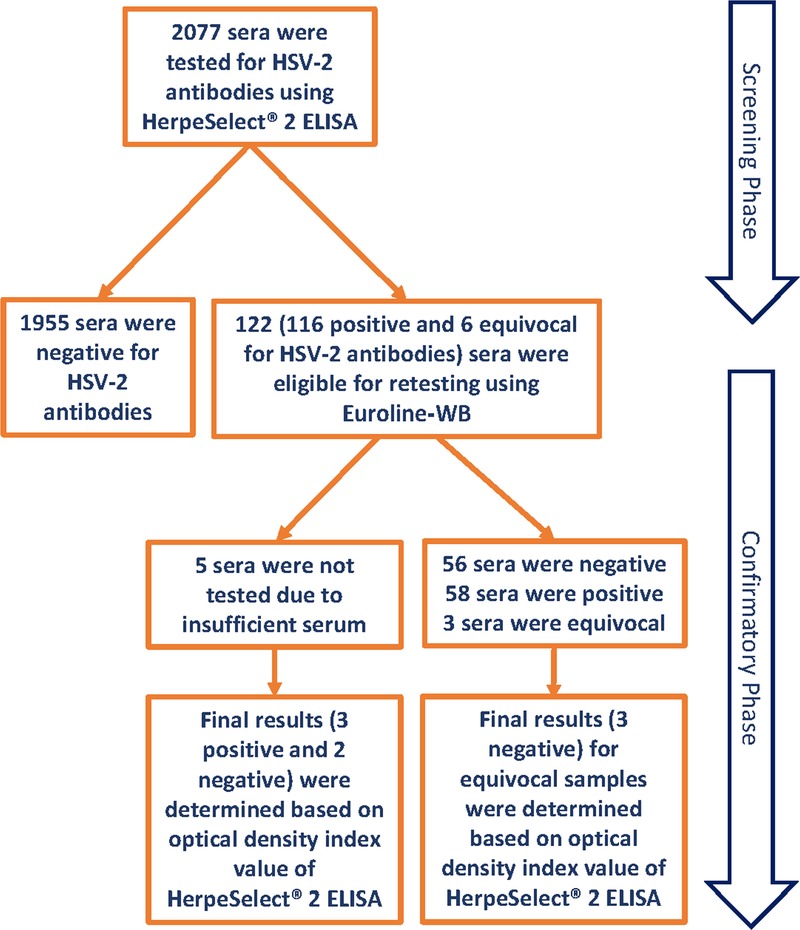
Sera were collected from male blood donors attending Hamad Medical Corporation between June 2013 and June 2016. Specimens were screened for anti-HSV-2 IgG antibodies following a 2-test algorithm: HerpeSelect 2 ELISA was used to identify HSV-2-positive specimens, and Euroline-WB was used to confirm positive and equivocal specimens for final HSV-2 status. Trends and associations with HSV-2 seropositivity were assessed.
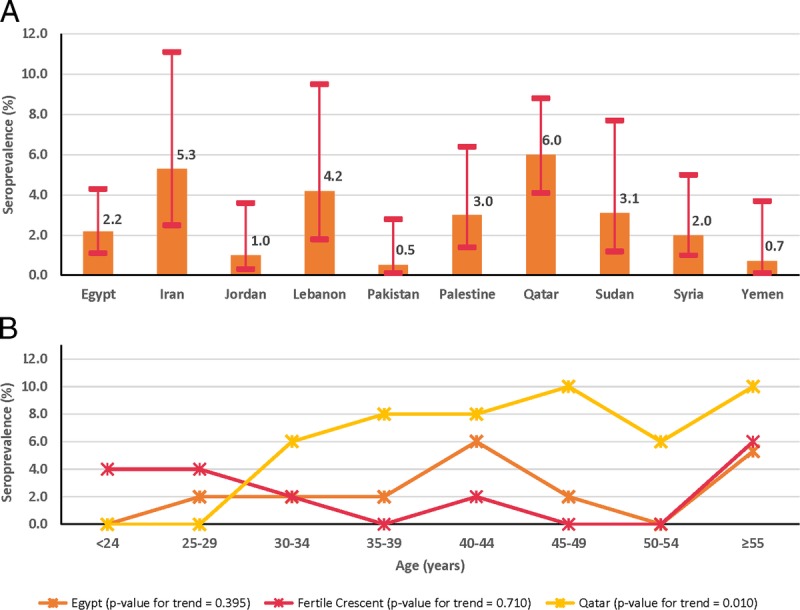
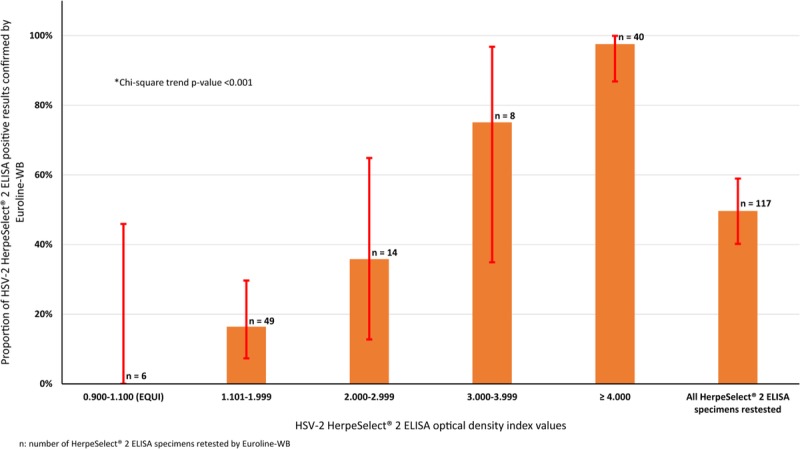
Of the 2077 tested sera, 61 were found and confirmed positive. The proportion of those confirmed positive increased steadily with HerpeSelect 2 ELISA index value, ranging from 16.3% for index values of 1.101 to 1.999 to 92.9% for index values of 4 or greater. Nationality-specific seroprevalence was 6.0% (95% confidence interval [CI], 4.1%-8.8%) in Qataris, 5.3% (95% CI, 2.5%-11.1%) in Iranians, 4.2% (95% CI, 1.8%-9.5%) in Lebanese, 3.1% (95% CI, 1.2%-7.7%) in Sudanese, 3.0% (95% CI, 1.4%-6.4%) in Palestinians, 2.2% (95% CI, 1.1%-4.3%) in Egyptians, 2.0% (95% CI, 1.0%-5.0%) in Syrians, 1.0% (95% CI, 0.3%-3.6%) in Jordanians, 0.7% (95% CI, 0.1%-3.7%) in Yemenis, and 0.5% (95% CI, 0.1%-2.8%) in Pakistanis. There was evidence for higher seroprevalence in older age groups.
The seroprevalence of HSV-2 was in the range of few percentage points. There were no major differences in seroprevalence by nationality. These findings add to our understanding of HSV-2 epidemiology in MENA and indicate unmet needs for sexual health and control of sexually transmitted infections.
在中东和北非(MENA)地区,关于单纯疱疹病毒 2 型(HSV-2)血清流行率的数据有限。我们研究了居住在卡塔尔的 MENA 特定人群的国家和年龄特异性 HSV-2 血清流行率。
2013 年 6 月至 2016 年 6 月期间,从在哈马德医疗公司就诊的男性献血者中采集血清。使用 2 种测试算法对血清进行抗 HSV-2 IgG 抗体筛查:使用 HerpeSelect 2 ELISA 鉴定 HSV-2 阳性标本,使用 Euroline-WB 对最终 HSV-2 状态的阳性和可疑标本进行确认。评估 HSV-2 血清阳性率的趋势和相关性。
在 2077 份检测血清中,发现并确认了 61 份阳性血清。随着 HerpeSelect 2 ELISA 指数值的增加,确认阳性的比例稳步上升,范围从指数值为 1.101 至 1.999 的 16.3%到指数值为 4 或更高的 92.9%。卡塔尔人、伊朗人、黎巴嫩人、苏丹人、巴勒斯坦人、埃及人、叙利亚人、约旦人、也门人和巴基斯坦人的血清流行率分别为 6.0%(95%置信区间 [CI],4.1%-8.8%)、5.3%(95% CI,2.5%-11.1%)、4.2%(95% CI,1.8%-9.5%)、3.1%(95% CI,1.2%-7.7%)、3.0%(95% CI,1.4%-6.4%)、2.2%(95% CI,1.1%-4.3%)、2.0%(95% CI,1.0%-5.0%)、1.0%(95% CI,0.3%-3.6%)、0.7%(95% CI,0.1%-3.7%)、0.5%(95% CI,0.1%-2.8%)。年龄较大的人群中血清流行率更高。
HSV-2 的血清流行率在几个百分点范围内。血清流行率在国籍之间没有明显差异。这些发现增加了我们对 MENA 地区 HSV-2 流行病学的了解,并表明在性健康和性传播感染控制方面存在未满足的需求。