Sieng Socheat, Walkden-Brown Stephen W, Kerr James
School of Behavioural, Cognitive and Social SciencesUniversity of New EnglandArmidaleNew South WalesAustralia.
General Directorate of Animal Health and ProductionPhnom PenhCambodia.
Vet Med Sci. 2017 Nov 29;4(1):35-44. doi: 10.1002/vms3.86. eCollection 2018 Feb.
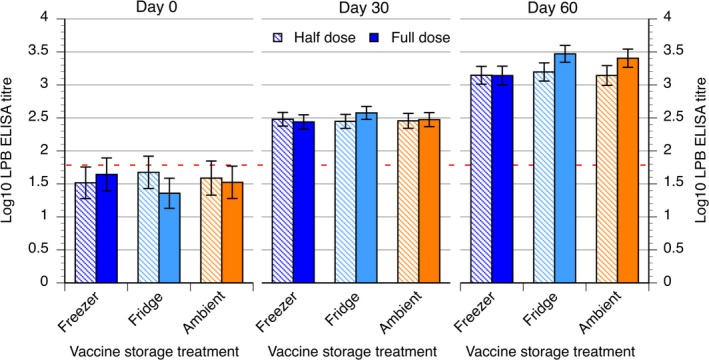
A field study investigated the effects of foot and mouth disease vaccine storage temperature for 7 days (frozen, refrigerated or held at ambient temperature) and dose (half or full dose) on the serological response to vaccination. It utilised a complete factorial design replicated on 18 smallholder cattle farms in three villages in Pursat province, Cambodia. Antibody responses from the 108 cattle involved were assessed by serological examination of blood samples collected at primary vaccination (day 0), at booster vaccination (day 30) and finally at 60 days post primary vaccination. Vaccination responses to the inactivated vaccine were assessed by testing for antibodies directed against FMD structural proteins in a liquid-phase blocking ELISA (LPBE test) and differentiated from responses to natural infection by examining antibody titres against non-structural viral proteins (NSPE test). LPBE results indicated that the mean log LPBE antibody titres of all experimental cattle increased from below protective levels at day 0 to protective levels at 30 days post primary vaccination, and increased further at 60 days post primary vaccination. Storage at ambient temperature for 1 week had no effect on antibody response to vaccination. However, freezing the vaccine for a week or use of a half dose resulted in significant reduction in titres at day 60 ( = 0.04 and = 0.02, respectively). The results of this study reinforce the need to store FMD vaccines within the range recommended by the manufacturers and to adhere to the specified dosage instructions.
一项实地研究调查了口蹄疫疫苗7天的储存温度(冷冻、冷藏或常温保存)和剂量(半剂量或全剂量)对疫苗接种血清学反应的影响。该研究采用完全析因设计,在柬埔寨菩萨省三个村庄的18个小农户养牛场进行了重复实验。对108头牛的抗体反应通过在初次接种疫苗时(第0天)、加强接种疫苗时(第30天)以及初次接种疫苗后60天采集的血样进行血清学检测来评估。通过液相阻断ELISA(LPBE检测)检测针对口蹄疫结构蛋白的抗体来评估对灭活疫苗的接种反应,并通过检测针对非结构病毒蛋白的抗体滴度(NSPE检测)与自然感染反应相区分。LPBE结果表明,所有实验牛的平均对数LPBE抗体滴度从第0天的低于保护水平增加到初次接种疫苗后30天的保护水平,并在初次接种疫苗后60天进一步增加。在常温下储存1周对接种疫苗的抗体反应没有影响。然而,将疫苗冷冻1周或使用半剂量导致在第60天滴度显著降低(分别为P = 0.04和P = 0.02)。本研究结果强化了将口蹄疫疫苗储存在制造商推荐范围内并遵守指定剂量说明的必要性。