Etesami Hassan, Beattie Gwyn A
Department of Soil Science, Faculty of Agricultural Engineering & Technology, University of Tehran, Tehran, Iran.
Department of Plant Pathology and Microbiology, Iowa State University, Ames, IA, United States.
Front Microbiol. 2018 Feb 8;9:148. doi: 10.3389/fmicb.2018.00148. eCollection 2018.
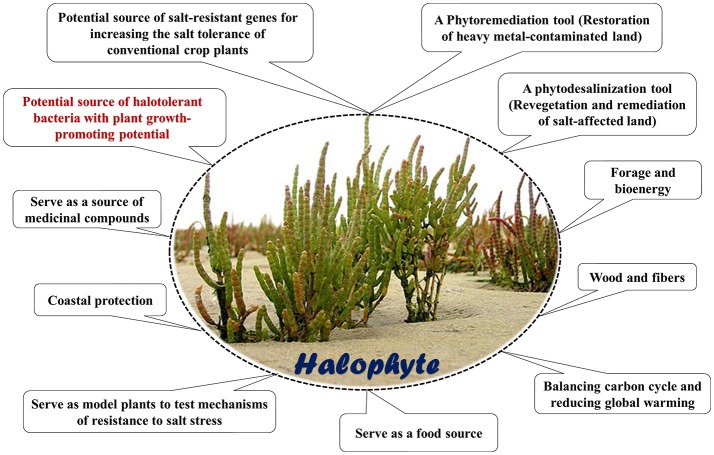
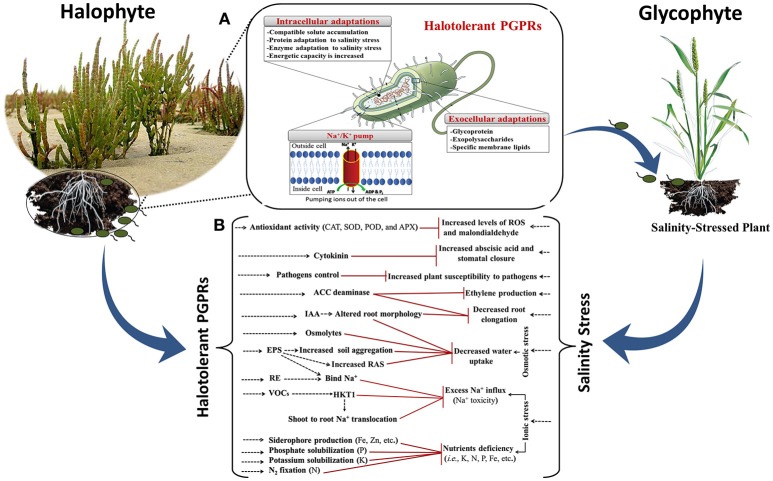
Salinity stress is one of the major abiotic stresses limiting crop production in arid and semi-arid regions. Interest is increasing in the application of PGPRs (plant growth promoting rhizobacteria) to ameliorate stresses such as salinity stress in crop production. The identification of salt-tolerant, or halophilic, PGPRs has the potential to promote saline soil-based agriculture. Halophytes are a useful reservoir of halotolerant bacteria with plant growth-promoting capabilities. Here, we review recent studies on the use of halophilic PGPRs to stimulate plant growth and increase the tolerance of non-halophytic crops to salinity. These studies illustrate that halophilic PGPRs from the rhizosphere of halophytic species can be effective bio-inoculants for promoting the production of non-halophytic species in saline soils. These studies support the viability of bioinoculation with halophilic PGPRs as a strategy for the sustainable enhancement of non-halophytic crop growth. The potential of this strategy is discussed within the context of ensuring sustainable food production for a world with an increasing population and continuing climate change. We also explore future research needs for using halotolerant PGPRs under salinity stress.
盐胁迫是限制干旱和半干旱地区作物生产的主要非生物胁迫之一。人们对应用植物根际促生细菌(PGPRs)来缓解作物生产中的盐胁迫等胁迫的兴趣日益增加。耐盐或嗜盐PGPRs的鉴定有可能促进盐碱地农业发展。盐生植物是具有植物生长促进能力的耐盐细菌的有用来源。在此,我们综述了近期关于利用嗜盐PGPRs刺激植物生长并提高非盐生作物耐盐性的研究。这些研究表明,来自盐生植物根际的嗜盐PGPRs可以成为促进盐碱地中非盐生植物生产的有效生物接种剂。这些研究支持了用嗜盐PGPRs进行生物接种作为可持续提高非盐生作物生长的一种策略的可行性。在为人口不断增长且气候变化持续的世界确保可持续粮食生产的背景下,讨论了该策略的潜力。我们还探讨了在盐胁迫下使用耐盐PGPRs的未来研究需求。