Ramos Hernández Cristina, Núñez Fernández Marta, Pallares Sanmartín Abel, Mouronte Roibas Cecilia, Cerdeira Domínguez Luz, Botana Rial Maria Isabel, Blanco Cid Nagore, Fernández Villar Alberto
Department of Pneumonology, University Hospital Complex of Vigo, Pontevedra, Spain.
Neumo Vigo I + i. Institute of Health Research South Galicia (IISGS), Vigo, Pontevedra, Spain.
PLoS One. 2018 Feb 23;13(2):e0192789. doi: 10.1371/journal.pone.0192789. eCollection 2018.
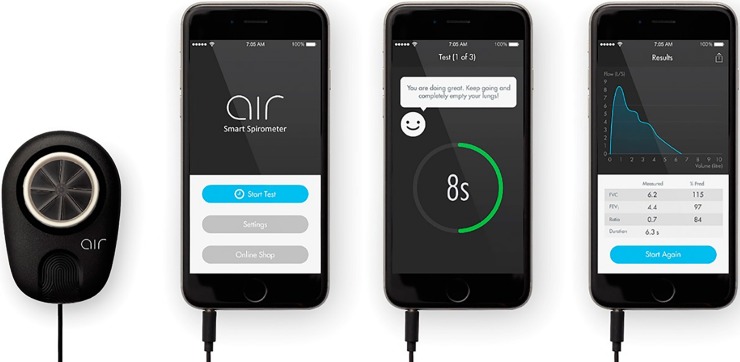
The Air-Smart Spirometer is the first portable device accepted by the European Community (EC) that performs spirometric measurements by a turbine mechanism and displays the results on a smartphone or a tablet.
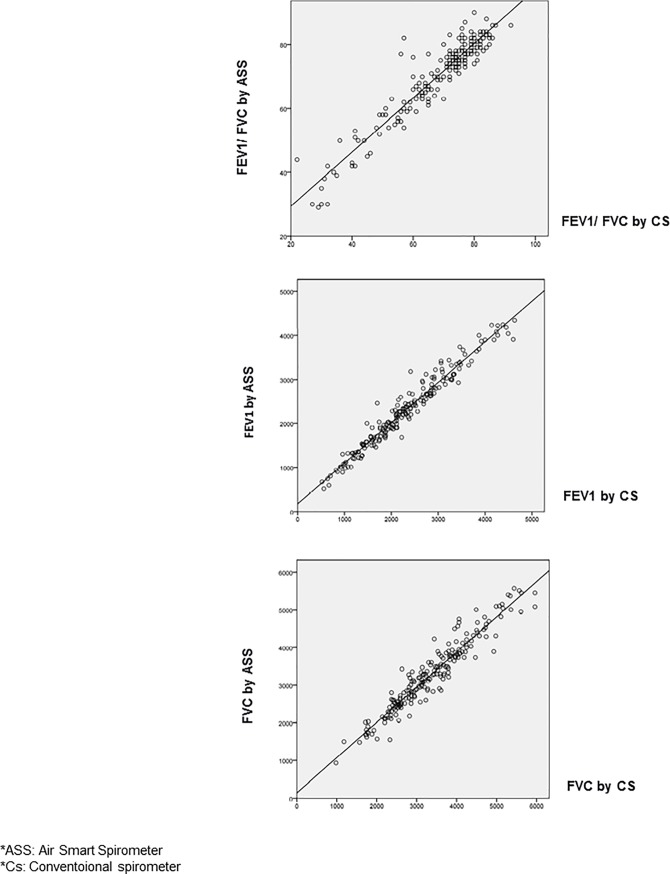
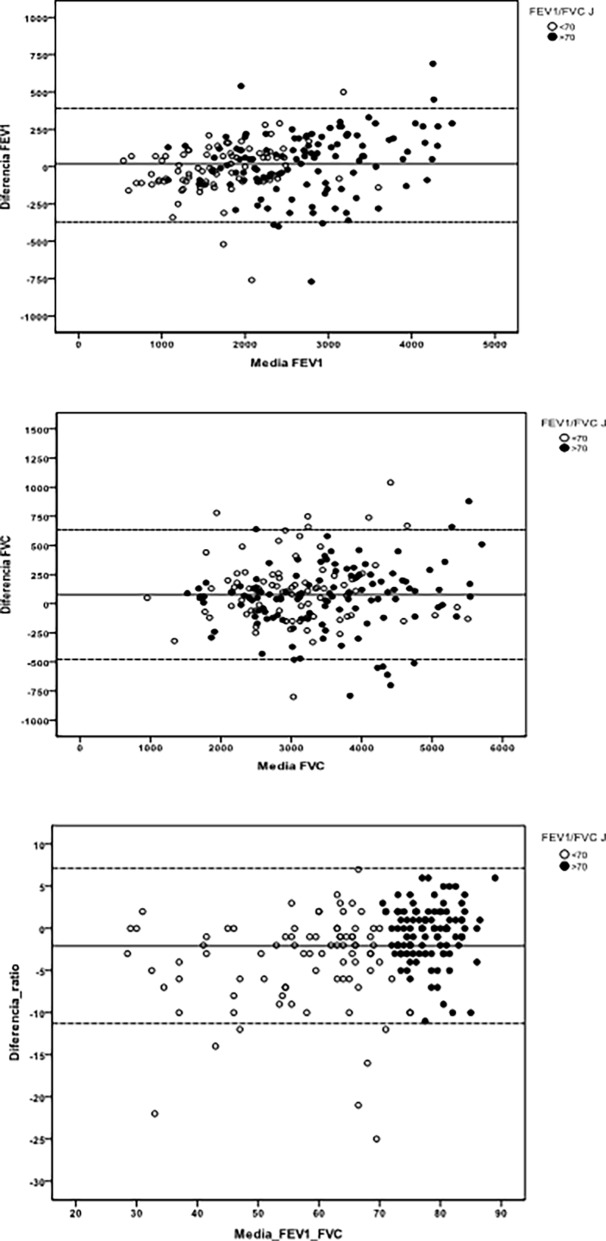
In this multicenter, descriptive and cross-sectional prospective study carried out in 2 hospital centers, we compare FEV1, FVC, FEV1/FVC ratio measured with the Air Smart-Spirometer device and a conventional spirometer, and analyze the ability of this new portable device to detect obstructions. Patients were included for 2 consecutive months. We calculate sensitivity, specificity, positive and negative predictive value (PPV and NPV) and likelihood ratio (LR +, LR-) as well as the Kappa Index to evaluate the concordance between the two devices for the detection of obstruction. The agreement and relation between the values of FEV1 and FVC in absolute value and the FEV1/FVC ratio measured by both devices were analyzed by calculating the intraclass correlation coefficient (ICC) and the Pearson correlation coefficient (r) respectively.
200 patients (100 from each center) were included with a mean age of 57 (± 14) years, 110 were men (55%). Obstruction was detected by conventional spirometry in 73 patients (40.1%). Using a FEV1/FVC ratio smaller than 0.7 to detect obstruction with the Air Smart-Spirometer, the kappa index was 0.88, sensitivity (90.4%), specificity (97.2%), PPV (95.7%), NPV (93.7%), positive likelihood ratio (32.29), and negative likelihood ratio (0.10). The ICC and r between FEV1, FVC, and FEV1 / FVC ratio measured by the Air Smart Spirometer and the conventional spirometer were all higher than 0.94.
The Air-Smart Spirometer is a simple and very precise instrument for detecting obstructive airway diseases. It is easy to use, which could make it especially useful non-specialized care and in other areas.
Air-Smart肺活量计是首个被欧洲共同体(EC)认可的便携式设备,它通过涡轮机制进行肺活量测量,并在智能手机或平板电脑上显示结果。
在两个医院中心开展的这项多中心、描述性横断面前瞻性研究中,我们比较了使用Air Smart肺活量计设备和传统肺活量计测量的第一秒用力呼气容积(FEV1)、用力肺活量(FVC)、FEV1/FVC比值,并分析了这种新型便携式设备检测气道阻塞的能力。患者连续纳入两个月。我们计算敏感性、特异性、阳性和阴性预测值(PPV和NPV)以及似然比(LR+,LR-)以及kappa指数,以评估两种设备在检测阻塞方面的一致性。通过分别计算组内相关系数(ICC)和Pearson相关系数(r),分析了两种设备测量的FEV1和FVC绝对值以及FEV1/FVC比值之间的一致性和关系。
纳入200例患者(每个中心100例),平均年龄57(±14)岁,男性110例(55%)。通过传统肺活量测定法在73例患者(40.1%)中检测到阻塞。使用小于0.7的FEV1/FVC比值通过Air Smart肺活量计检测阻塞,kappa指数为0.88,敏感性(90.4%),特异性(97.2%),PPV(95.7%),NPV(93.7%),阳性似然比(32.29),阴性似然比(0.10)。Air Smart肺活量计和传统肺活量计测量的FEV1、FVC以及FEV1/FVC比值之间的ICC和r均高于0.94。
Air-Smart肺活量计是一种用于检测阻塞性气道疾病的简单且非常精确的仪器。它易于使用,这可能使其在非专科护理和其他领域特别有用。