Leszczynska Aleksandra, Murphy J Mary
Regenerative Medicine Institute, Cedars-Sinai Medical Center, Los Angeles, CA, United States.
Regenerative Medicine Institute, National University of Ireland Galway, Galway, Ireland.
Front Bioeng Biotechnol. 2018 Feb 9;6:10. doi: 10.3389/fbioe.2018.00010. eCollection 2018.
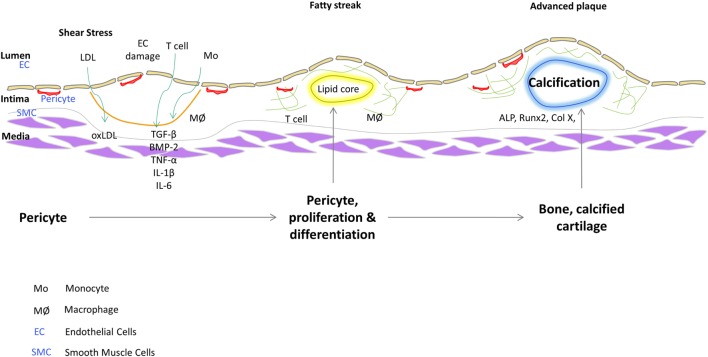
Vascular calcification (VC) has witnessed a surge of interest. Vasculature is virtually an omnipresent organ and has a notably high capacity for repair throughout embryonic and adult life. Of the vascular diseases, atherosclerosis is a leading cause of morbidity and mortality on account of ectopic cartilage and bone formation. Despite the identification of a number of risk factors, all the current theories explaining pathogenesis of VC in atherosclerosis are far from complete. The most widely accepted response to injury theory and smooth muscle transdifferentiation to explain the VC observed in atherosclerosis is being challenged. Recent focus on circulating and resident progenitor cells in the vasculature and their role in atherogenesis and VC has been the driving force behind this review. This review discusses intrinsic cellular players contributing to fate determination of cells and tissues to form ectopic cartilage and bone formation.
血管钙化(VC)已引发了人们浓厚的兴趣。血管实际上是一个无处不在的器官,在胚胎期和成年期都具有显著的高修复能力。在血管疾病中,动脉粥样硬化是由于异位软骨和骨形成导致发病和死亡的主要原因。尽管已确定了许多风险因素,但目前所有解释动脉粥样硬化中VC发病机制的理论都远未完善。用于解释在动脉粥样硬化中观察到的VC的最广泛接受的损伤反应理论和平滑肌转分化理论正受到挑战。最近对血管中循环和驻留祖细胞及其在动脉粥样硬化和VC中的作用的关注是本综述的驱动力。本综述讨论了有助于细胞和组织命运决定以形成异位软骨和骨形成的内在细胞因素。