Laboratory of Applied Brain and Cognitive Sciences, School of Business and Management, Shanghai International Studies University, Shanghai, China.
Center for Functional Neuroimaging, Department of Neurology, Perelman School of Medicine, University of Pennsylvania, Philadelphia, PA, USA.
Sci Rep. 2018 Feb 27;8(1):3712. doi: 10.1038/s41598-018-21820-0.
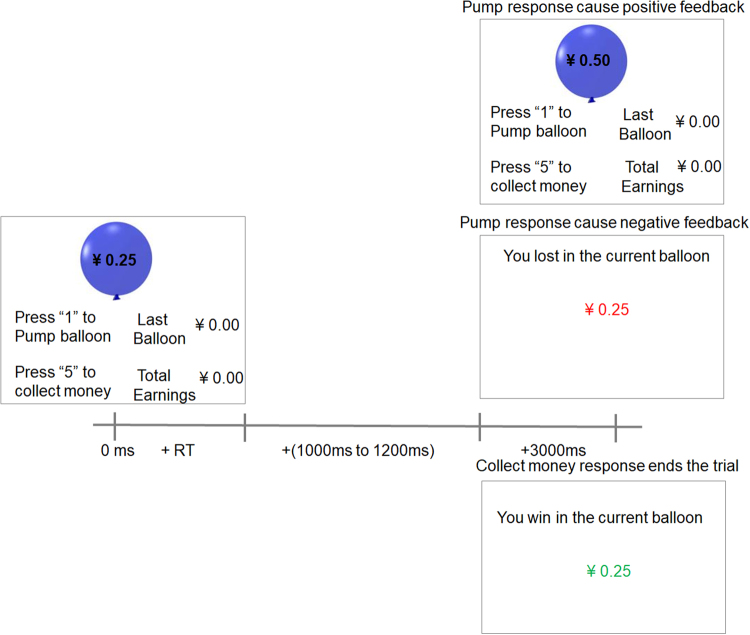
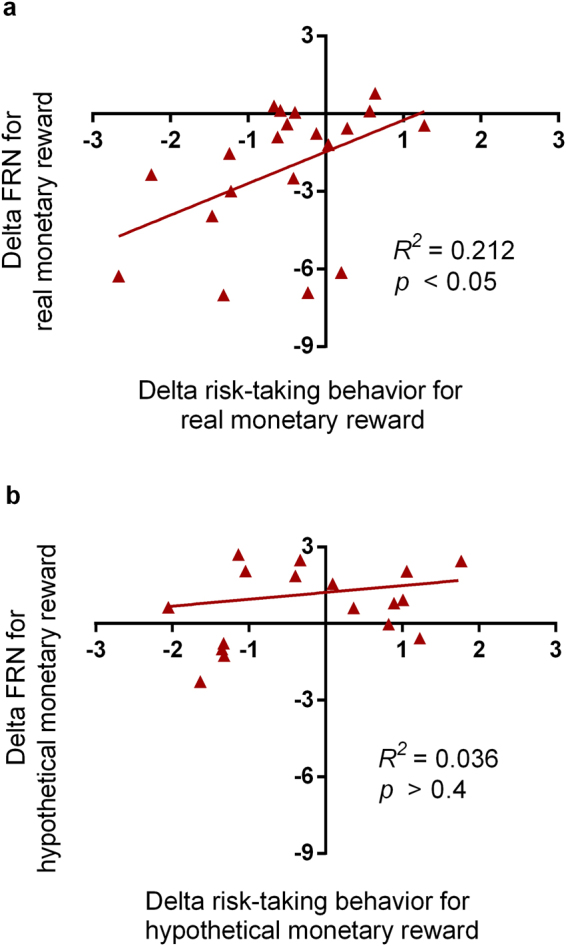
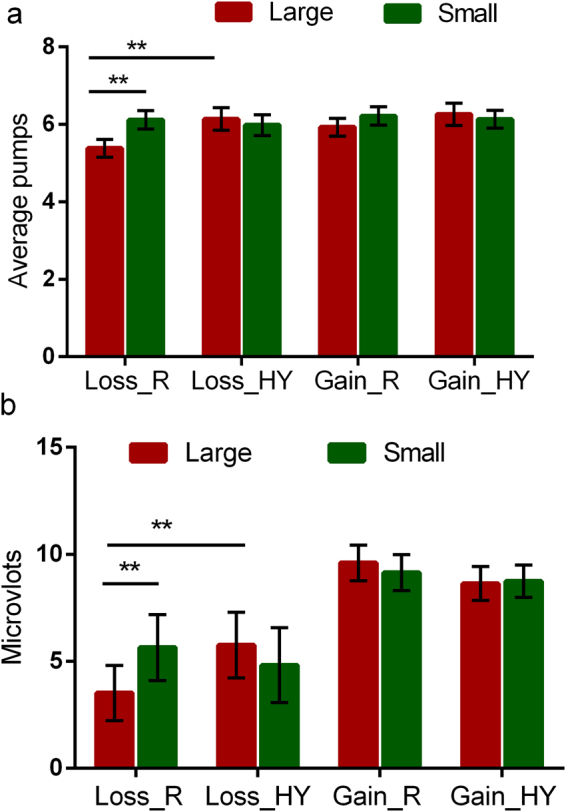
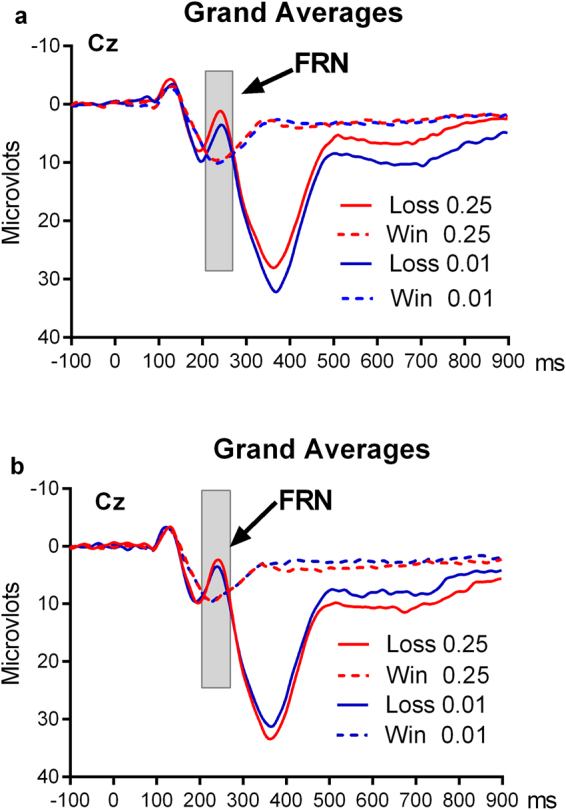
Human decisions are more easily affected by a larger amount of money than a smaller one. Although numerous studies have used hypothetical money as incentives to motivate human behavior, the validity of hypothetical versus real monetary rewards remains controversial. In the present study, we used event-related potential (ERP) with the balloon analogue risk task to investigate how magnitudes of real and hypothetical monetary rewards modulate risk-taking behavior and feedback-related negativity (FRN). Behavioral data showed that participants were more risk averse after negative feedback with increased magnitude of real monetary rewards, while no behavior differences were observed between large and small hypothetical monetary rewards. Similarly, ERP data showed a larger FRN in response to negative feedback during risk taking with large compared to small real monetary rewards, while no FRN differences were observed between large and small hypothetical monetary rewards. Moreover, FRN amplitude differences correlated with risk-taking behavior changes from small to large real monetary rewards, while such correlation was not observed for hypothetical monetary rewards. These findings suggest that the magnitudes of real and hypothetical monetary rewards have differential effects on risk-taking behavior and brain activity. Real and hypothetical money incentives may have different validity for modulating human decisions.
人们的决策更容易受到大量金钱的影响,而不是少量金钱的影响。尽管许多研究都使用假设的金钱作为激励因素来激发人类行为,但假设的与实际货币奖励的有效性仍然存在争议。在本研究中,我们使用事件相关电位(ERP)和气球模拟风险任务来研究实际和假设的货币奖励的大小如何调节风险行为和反馈相关负波(FRN)。行为数据表明,参与者在受到负反馈后,实际货币奖励的金额增加,风险厌恶程度更高,而大、小假设货币奖励之间则没有观察到行为差异。同样,ERP 数据显示,在大实际货币奖励下的风险行为中,与小实际货币奖励相比,对负反馈的 FRN 更大,而大、小假设货币奖励之间则没有 FRN 差异。此外,FRN 振幅差异与从小额实际货币奖励到大额实际货币奖励的风险行为变化相关,而假设货币奖励则没有这种相关性。这些发现表明,实际和假设的货币奖励的大小对风险行为和大脑活动有不同的影响。实际和假设的金钱激励可能对调节人类决策有不同的有效性。