Zhu Xiangru, Wu Haiyan, Yang Suyong, Gu Ruolei
Institute of Cognition and Behavior, Henan University, Kaifeng China.
Institute of Psychology, Chinese Academy of Sciences, Beijing China.
Front Psychol. 2016 Jun 13;7:877. doi: 10.3389/fpsyg.2016.00877. eCollection 2016.
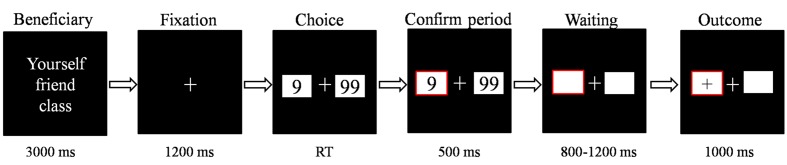
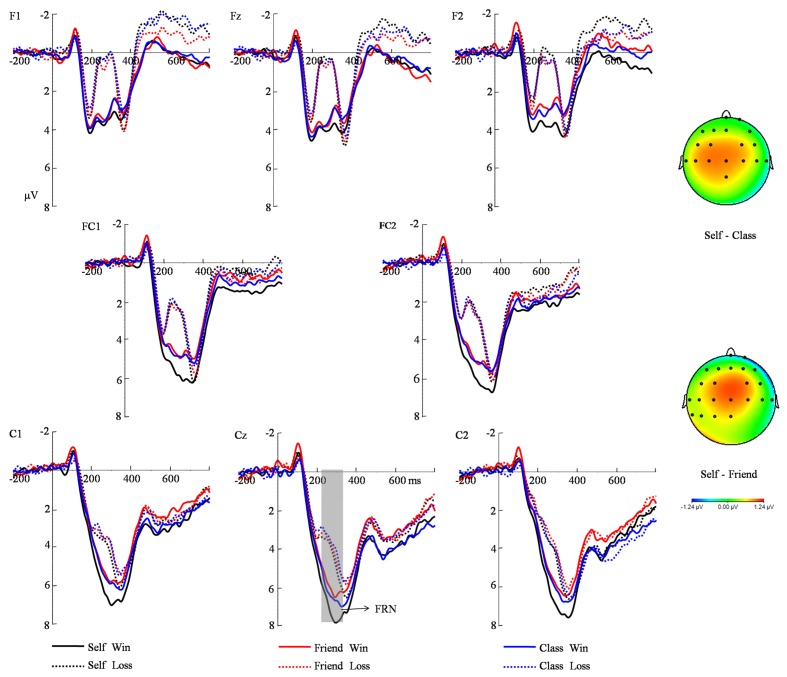
According to the three-tier hierarchy of motivational potency in the self system, the self can be divided into individual self, relational self, and collective self, and individual self is at the top of the motivational hierarchy in Western culture. However, the motivational primacy of the individual self is challenged in Chinese culture, which raises the question about whether the three-tier hierarchy of motivational potency in the self system can be differentiated in the collectivist brain. The present study recorded the event-related potentials (ERPs) to evaluate brain responses when participants gambled for individual self, for a close friend (relational self), or for the class (collective self). The ERP results showed that when outcome feedback was positive, gambling for individual self evoked a larger reward positivity compared with gambling for a friend or for the class, while there is no difference between the latter two conditions. In contrast, when outcome feedback was negative, no significant effect was found between conditions. The present findings provide direct electrophysiological evidence that individual self is at the top of the three-tier hierarchy of the motivational system in the collectivist brain, which supports the classical pancultural view that individual self has motivational primacy.
根据自我系统中动机强度的三层等级结构,自我可分为个体自我、关系自我和集体自我,在西方文化中个体自我处于动机等级结构的顶端。然而,在中国文化中个体自我的动机首要性受到挑战,这就引出了一个问题:在集体主义文化背景下的大脑中,自我系统中动机强度的三层等级结构是否能够区分开来。本研究记录了事件相关电位(ERP),以评估参与者为个体自我、亲密朋友(关系自我)或班级(集体自我)进行赌博时的大脑反应。ERP结果显示,当结果反馈为正时,与为朋友或班级赌博相比,为个体自我赌博诱发的奖励正性更大,而后两者之间没有差异。相反,当结果反馈为负时,各条件之间未发现显著影响。本研究结果提供了直接的电生理证据,表明在集体主义文化背景下的大脑中,个体自我处于动机系统三层等级结构的顶端,这支持了个体自我具有动机首要性的经典跨文化观点。