Institute of Medical Sociology, Centre for Health and Society, Medical Faculty, University of Duesseldorf, Universitaetsstrasse 1, 40225, Duesseldorf, Germany.
Institute of Psychology, Work and Organizational Psychology, University of Duisburg-Essen, Universitätsstrasse 2, 45141, Essen, Germany.
Int Arch Occup Environ Health. 2018 May;91(4):479-496. doi: 10.1007/s00420-018-1298-3. Epub 2018 Feb 28.
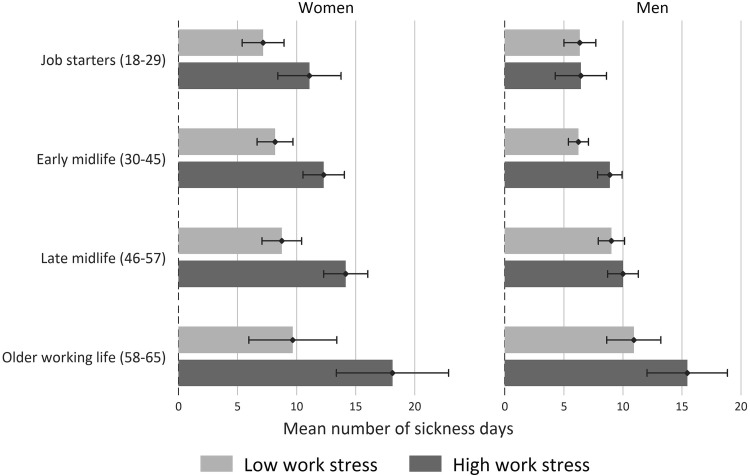
We aim to extend current knowledge on associations between stressful work and sickness absence, first, by studying associations between ERI and sickness absence among full-time employees from various occupations, and second, by investigating if associations vary by age.
We use data from four waves of the German socio-economic panel (GSOEP), collected among men and women between 2006 and 2012, with 9418 observations. Stressful work is measured with a short form of the ERI questionnaire. We investigate an imbalance between effort and reward (ER ratio) as well as the two main components ("high effort" and "low reward"). Sickness absence is measured by self-reported number of sickness days (assessed the following year). After descriptive analyses, we estimate a series of multivariable regressions, including tests for interactions between age and work stress.
Each of the three indicators of stressful work is related to higher number of sickness days, with except of "high effort" in case of men. Findings remain significant after adjusting for social position (income, education and occupational class) and health. In addition, for both men and women, associations were slightly higher among older workers, though interactions did not reach statistical significance.
Our findings support that stressful work is linked to sickness absence across a wide spectrum of jobs with varying incomes and educational levels, and also that associations are slightly more pronounced among older workers.
我们旨在扩展关于工作压力与病假之间关联的现有知识,首先,研究不同职业的全职员工中 ERI 与病假之间的关联,其次,调查关联是否因年龄而异。
我们使用了德国社会经济小组(GSOEP)在 2006 年至 2012 年间收集的四个波次的数据,共包含 9418 个观测值。工作压力采用 ERI 问卷的简短形式进行衡量。我们研究了努力与回报之间的不平衡(ER 比)以及两个主要组成部分(“高努力”和“低回报”)。病假通过自我报告的病假天数(次年评估)进行衡量。在描述性分析之后,我们估计了一系列多变量回归,包括测试年龄与工作压力之间的交互作用。
工作压力的三个指标都与更多的病假天数相关,除了男性中的“高努力”。在调整了社会地位(收入、教育和职业阶层)和健康状况后,这些发现仍然具有统计学意义。此外,对于男性和女性来说,在年龄较大的工人中,关联略高,尽管交互作用没有达到统计学意义。
我们的研究结果表明,工作压力与收入和教育水平各异的各种工作中的病假之间存在关联,而且在年龄较大的工人中,关联更为明显。