Fu Xueyan, Harshman Stephanie G, Shen Xiaohua, Haytowitz David B, Karl J Philip, Wolfe Benjamin E, Booth Sarah L
Jean Mayer USDA Human Nutrition Research Center on Aging at Tufts University, Boston, MA.
Beltsville Human Nutrition Research Center, USDA-Agricultural Research Service, Beltsville, MD.
Curr Dev Nutr. 2017 Jun 1;1(6):e000638. doi: 10.3945/cdn.117.000638. eCollection 2017 Jun.
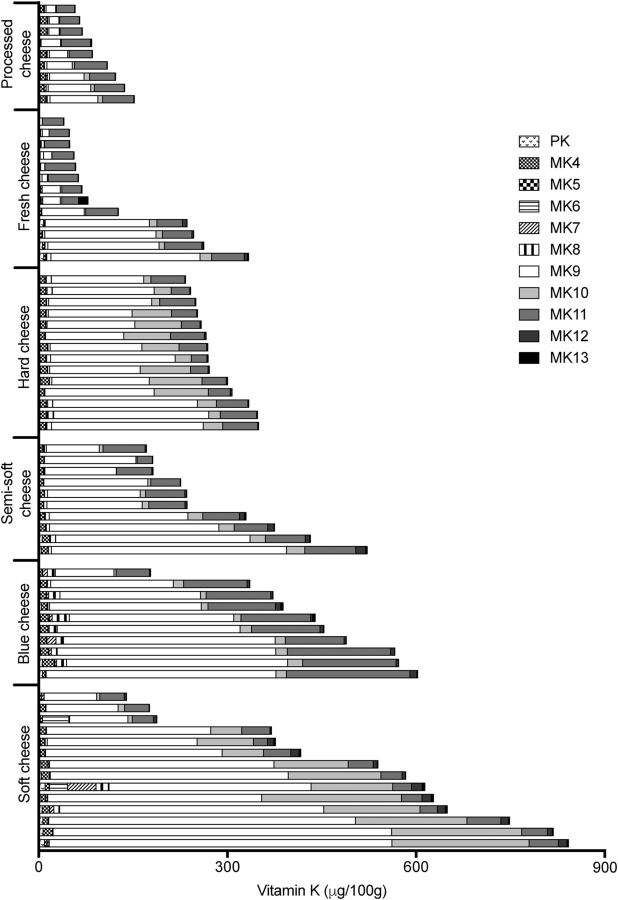
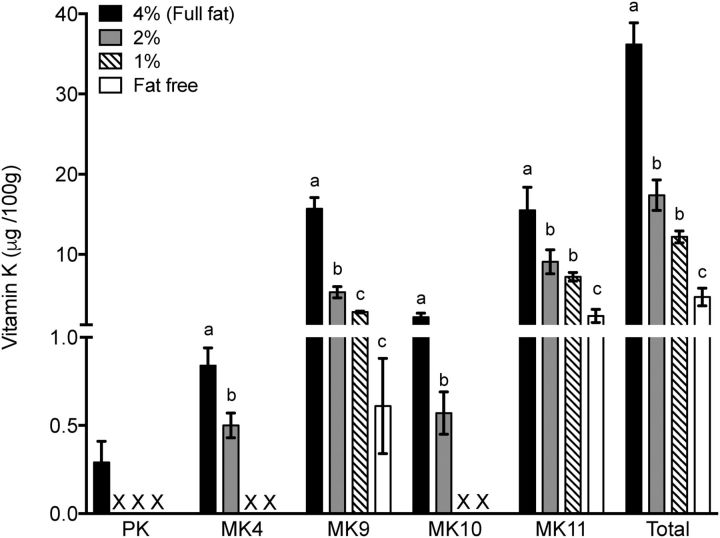
The plant-based form of vitamin K (phylloquinone, vitamin K-1) has been well quantified in the US diet. Menaquinones (vitamin K-2) are another class of vitamin K compounds that differ from phylloquinone in the length and saturation of their side chain, but they have not been well characterized in foods. The objectives of this study were to ) quantify phylloquinone and the different forms of menaquinones [menaquinone (MK) 4-MK13] in milk, yogurt, Greek yogurt, creams, and cheeses and ) compare the menaquinone contents of full-fat, reduced-fat, and nonfat dairy products. All dairy samples were either obtained from the USDA National Food and Nutrient Analysis Program or purchased from retail outlets. Phylloquinone and menaquinone concentrations in these dairy products were quantified by mass spectrometry technology. Full-fat dairy products contained appreciable amounts of menaquinones, primarily in the forms of MK9, MK10, and MK11. We also measured modest amounts of phylloquinone, MK4, MK8, and MK12 in these products. In contrast, there was little MK5-7 or MK13 detected in the majority of dairy products. The total vitamin K contents of soft cheese, blue cheese, semi-soft cheese, and hard cheese were (means ± SEMs): 506 ± 63, 440 ± 41, 289 ± 38, and 282 ± 5.0 µg/100 g, respectively. Nonfermented cheeses, such as processed cheese, contained lower amounts of vitamin K (98 ± 11 µg/100 g). Reduced-fat or fat-free dairy products contained ∼5-22% of the vitamin K found in full-fat equivalents. For example, total vitamin K contents of full-fat milk (4% fat), 2%-fat milk, 1%-fat milk, and nonfat milk were 38.1 ± 8.6, 19.4 ± 7.7, 12.9 ± 2.0, and 7.7 ± 2.9 µg/100 g, respectively. To the best of our knowledge, this is the first report of menaquinone contents of US dairy products. Findings indicate that the amount of vitamin K contents in dairy products is high and proportional to the fat content of the product.
在美国饮食中,植物性维生素K(叶绿醌,维生素K-1)的含量已得到充分量化。甲萘醌(维生素K-2)是另一类维生素K化合物,其侧链长度和饱和度与叶绿醌不同,但它们在食物中的特征尚未得到充分研究。本研究的目的是:(1)量化牛奶、酸奶、希腊酸奶、奶油和奶酪中叶绿醌和不同形式的甲萘醌[甲萘醌(MK)4 - MK13]的含量;(2)比较全脂、低脂和脱脂乳制品中甲萘醌的含量。所有乳制品样本均来自美国农业部国家食品和营养分析计划或从零售商店购买。通过质谱技术对这些乳制品中叶绿醌和甲萘醌的浓度进行了量化。全脂乳制品含有大量的甲萘醌,主要形式为MK9、MK10和MK11。我们还在这些产品中检测到了少量的叶绿醌、MK4、MK8和MK12。相比之下,大多数乳制品中几乎检测不到MK5 - 7或MK13。软奶酪、蓝纹奶酪、半软奶酪和硬奶酪的总维生素K含量(均值±标准误)分别为:506±63、440±41、289±38和282±5.0μg/100g。非发酵奶酪,如加工奶酪,维生素K含量较低(98±11μg/100g)。低脂或脱脂乳制品中的维生素K含量约为全脂同类产品的5% - 22%。例如,全脂牛奶(4%脂肪)、2%脂肪牛奶、1%脂肪牛奶和脱脂牛奶的总维生素K含量分别为38.1±8.6、19.4±7.7、12.9±2.0和7.7±2.9μg/100g。据我们所知,这是关于美国乳制品中甲萘醌含量的首次报告。研究结果表明,乳制品中维生素K的含量很高,且与产品的脂肪含量成正比。