Elasyed Hamada, Rincon Romero Acacio, Molino Giulia, Vitale Brovarone Chiara, Bernardo Enrico
Department of Industrial Engineering, University of Padova, Via Marzolo 9, 35131 Padova, Italy.
Ceramics Department, National Research Centre, El-Bohous Street, Cairo 12622, Egypt.
Materials (Basel). 2018 Feb 27;11(3):349. doi: 10.3390/ma11030349.
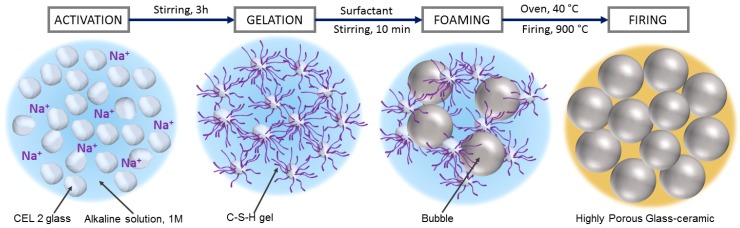
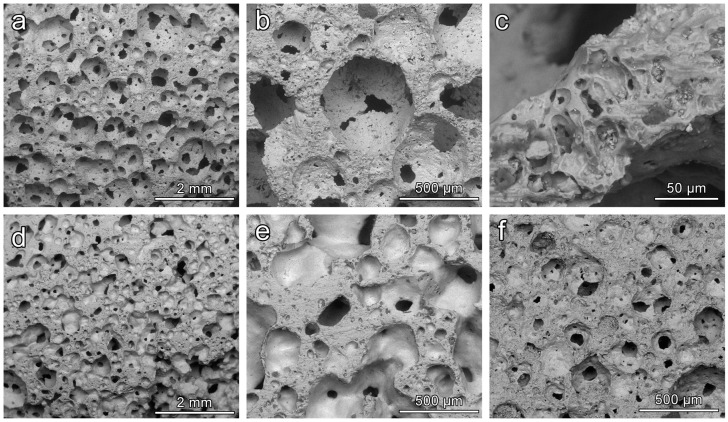
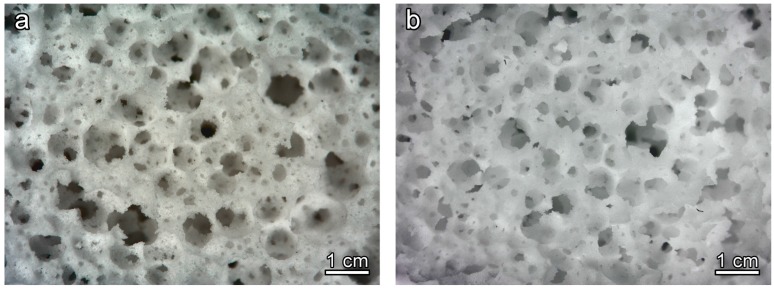
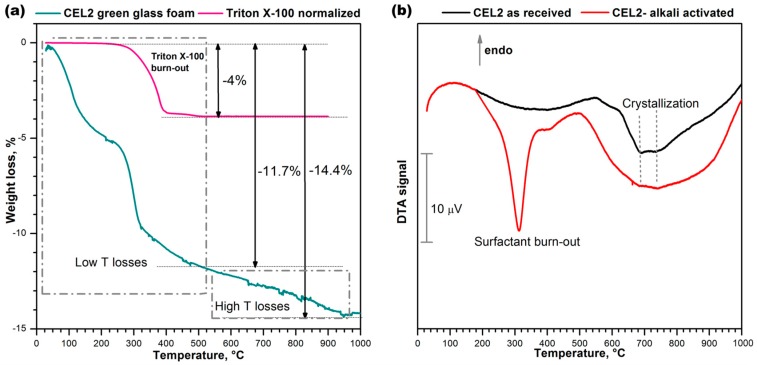
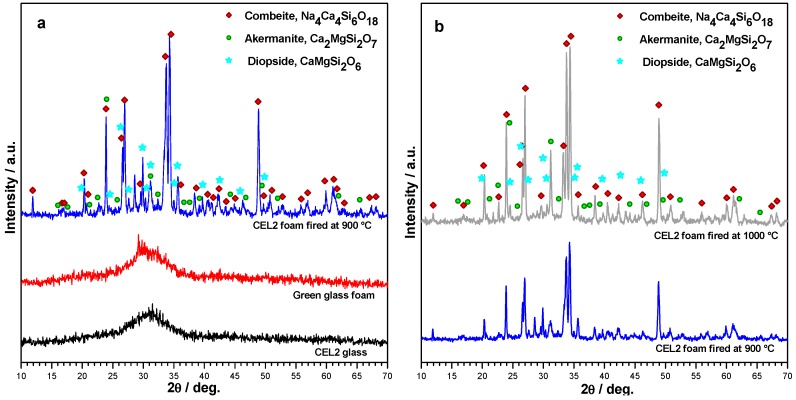
Highly porous bioactive glass-ceramic scaffolds were effectively fabricated by an inorganic gel casting technique, based on alkali activation and gelification, followed by viscous flow sintering. Glass powders, already known to yield a bioactive sintered glass-ceramic (CEL2) were dispersed in an alkaline solution, with partial dissolution of glass powders. The obtained glass suspensions underwent progressive hardening, by curing at low temperature (40 °C), owing to the formation of a C-S-H (calcium silicate hydrate) gel. As successful direct foaming was achieved by vigorous mechanical stirring of gelified suspensions, comprising also a surfactant. The developed cellular structures were later heat-treated at 900-1000 °C, to form CEL2 glass-ceramic foams, featuring an abundant total porosity (from 60% to 80%) and well-interconnected macro- and micro-sized cells. The developed foams possessed a compressive strength from 2.5 to 5 MPa, which is in the range of human trabecular bone strength. Therefore, CEL2 glass-ceramics can be proposed for bone substitutions.
基于碱活化和凝胶化,通过无机凝胶铸造技术,随后进行粘性流烧结,有效地制备了高度多孔的生物活性玻璃陶瓷支架。已知能产生生物活性烧结玻璃陶瓷(CEL2)的玻璃粉末分散在碱性溶液中,玻璃粉末部分溶解。由于形成了C-S-H(硅酸钙水合物)凝胶,所得玻璃悬浮液通过在低温(40°C)下固化而逐渐硬化。通过对包含表面活性剂的凝胶化悬浮液进行剧烈机械搅拌,成功实现了直接发泡。随后将所形成的多孔结构在900-1000°C下进行热处理,以形成CEL2玻璃陶瓷泡沫,其具有丰富的总孔隙率(60%至80%)以及相互连通良好的宏观和微观尺寸的孔。所制备的泡沫的抗压强度为2.5至5MPa,处于人体小梁骨强度范围内。因此,CEL2玻璃陶瓷可用于骨替代。