Division of Endocrinology, Department of Internal Medicine, Gangnam Severance Hospital, Yonsei University College of Medicine, Seoul, Korea.
Department of Internal Medicine, H-plus Yangji General Hospital, Seoul, Korea.
PLoS One. 2018 Mar 2;13(3):e0193646. doi: 10.1371/journal.pone.0193646. eCollection 2018.
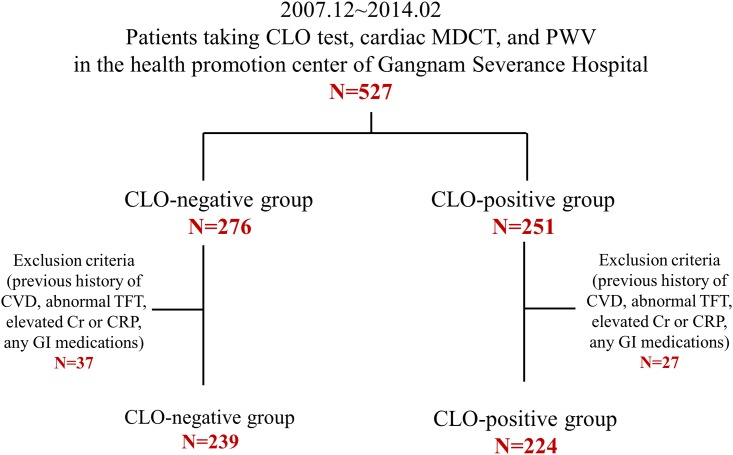
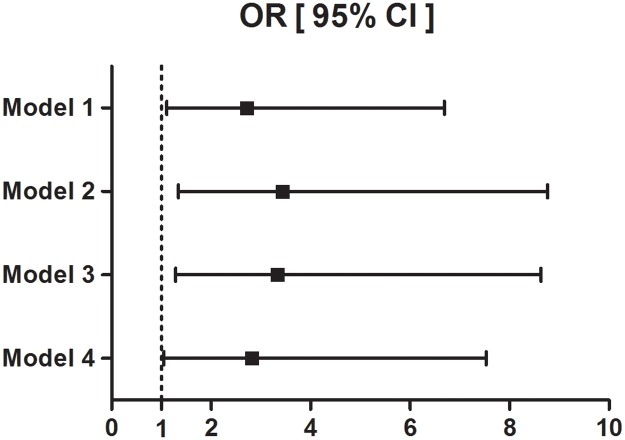
Helicobacter pylori is a gastrointestinal pathogen known to be associated with cardiovascular disease (CVD). However, most analyses about the effect of H. pylori infection have been done in patients with a history of CVD but not in healthy subjects. We evaluated the association between H. pylori infection and subclinical atherosclerosis by using cardiac multidetector computed tomography (MDCT) in healthy subjects without previous CVD. From December 2007 to February 2014, 463 subjects who underwent the rapid urease test (CLO test), pulse-wave velocity (PWV) measurement, and MDCT for a self-referred health check-up were enrolled to this study. Helicobacter pylori infection was defined on the basis of CLO test positivity on endoscopic gastric biopsy. Significant coronary artery stenosis was defined as ≥50% stenosis in any of the major epicardial coronary vessel on MDCT. The CLO-positive subjects had a lower high-density lipoprotein-cholesterol (HDL-cholesterol) level compared to the CLO-negative subjects. The incidence of significant coronary stenosis was higher in the CLO-positive group (7.6% vs. 2.9%, P = 0.01). Furthermore, the number of subjects with coronary artery calcium score >0 and log{(number of segments with plaque)+1} were also significantly higher in the CLO-positive group. However, there was no statistical difference in the number of subjects with coronary artery calcium score >100, the prevalence of any plaque nor the plaque characteristics (calcified, mixed, or soft). Pulse-wave velocity (PWV) was neither associated with CLO test positivity. The CLO-positive group was 3-fold more likely to have significant coronary artery stenosis even after adjusting for confounding factors (adjusted odds ratio 2.813, 95% confidence interval 1.051-7.528, P = 0.04). In a healthy population, current H. pylori infection was associated with subclinical but significant coronary artery stenosis. The causal relationship between H. pylori infection and subclinical atherosclerosis in a "healthy" population remains to be investigated in the future.
幽门螺杆菌是一种与心血管疾病(CVD)相关的胃肠道病原体。然而,大多数关于幽门螺杆菌感染影响的分析都是在有 CVD 病史的患者中进行的,而不是在健康受试者中进行的。我们在没有先前 CVD 的健康受试者中使用心脏多层螺旋 CT(MDCT)评估了幽门螺杆菌感染与亚临床动脉粥样硬化之间的关系。从 2007 年 12 月至 2014 年 2 月,463 名因健康体检接受快速尿素酶试验(CLO 试验)、脉搏波速度(PWV)测量和 MDCT 的患者纳入本研究。根据内镜胃活检 CLO 试验阳性来定义幽门螺杆菌感染。MDCT 上任何主要心外膜冠状动脉的≥50%狭窄定义为显著冠状动脉狭窄。CLO 阳性组的高密度脂蛋白胆固醇(HDL-胆固醇)水平低于 CLO 阴性组。CLO 阳性组的显著冠状动脉狭窄发生率较高(7.6%比 2.9%,P=0.01)。此外,CLO 阳性组的冠状动脉钙评分>0 和 log{(斑块节段数)+1}的受试者数量也明显较高。然而,在冠状动脉钙评分>100、任何斑块的患病率或斑块特征(钙化、混合或软)方面,两组间无统计学差异。脉搏波速度(PWV)也与 CLO 试验阳性无关。即使在调整了混杂因素后,CLO 阳性组发生显著冠状动脉狭窄的可能性仍高出 3 倍(调整后优势比 2.813,95%置信区间 1.051-7.528,P=0.04)。在健康人群中,目前的幽门螺杆菌感染与亚临床但显著的冠状动脉狭窄有关。在“健康”人群中,幽门螺杆菌感染与亚临床动脉粥样硬化之间的因果关系仍有待未来研究。