University of Oxford Centre for Clinical Magnetic Resonance Research (OCMR), Division of Cardiovascular Medicine, Radcliffe Department of Medicine, Oxford, UK.
Division of Cardiovascular Medicine, Linköping University, Linköping, Sweden.
J Cardiovasc Magn Reson. 2018 Mar 2;20(1):15. doi: 10.1186/s12968-018-0432-4.
Quantification and visualisation of left ventricular (LV) blood flow is afforded by three-dimensional, time resolved phase contrast cardiovascular magnetic resonance (CMR 4D flow). However, few data exist upon the repeatability and variability of these parameters in a healthy population. We aimed to assess the repeatability and variability over time of LV 4D CMR flow measurements.
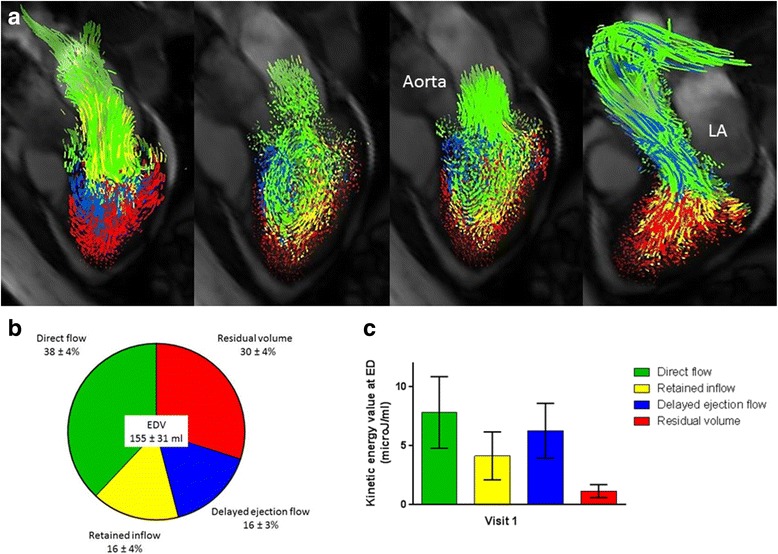
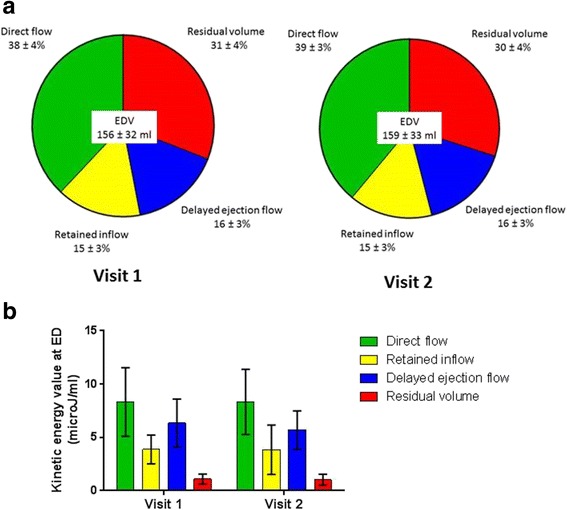
Forty five controls underwent CMR 4D flow data acquisition. Of these, 10 underwent a second scan within the same visit (scan-rescan), 25 returned for a second visit (interval scan; median interval 52 days, IQR 28-57 days). The LV-end diastolic volume (EDV) was divided into four flow components: 1) Direct flow: inflow that passes directly to ejection; 2) Retained inflow: inflow that enters and resides within the LV; 3) Delayed ejection flow: starts within the LV and is ejected and 4) Residual volume: blood that resides within the LV for > 2 cardiac cycles. Each flow components' volume was related to the EDV (volume-ratio). The kinetic energy at end-diastole (ED) was measured and divided by the components' volume.
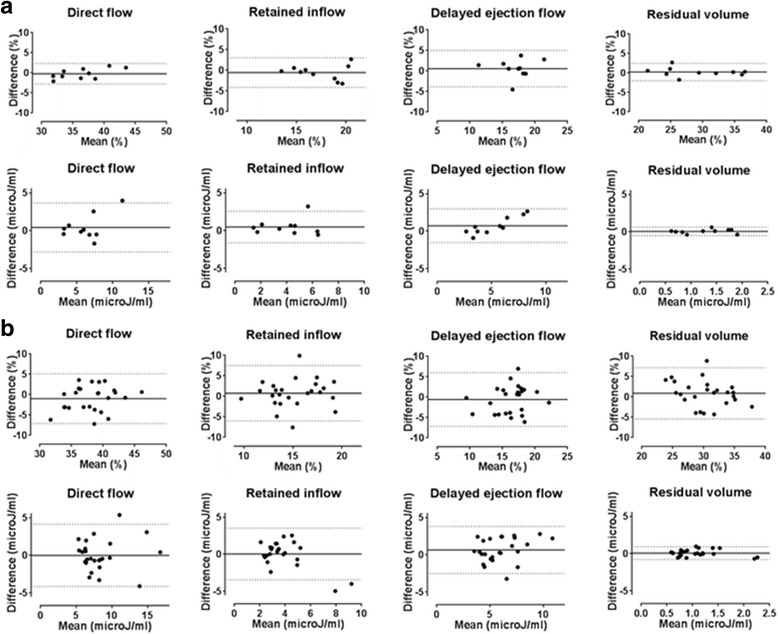
The dominant flow component in all 45 controls was the direct flow (volume ratio 38 ± 4%) followed by the residual volume (30 ± 4%), then delayed ejection flow (16 ± 3%) and retained inflow (16 ± 4%). The kinetic energy at ED for each component was direct flow (7.8 ± 3.0 microJ/ml), retained inflow (4.1 ± 2.0 microJ/ml), delayed ejection flow (6.3 ± 2.3 microJ/ml) and the residual volume (1.2 ± 0.5 microJ/ml). The coefficients of variation for the scan-rescan ranged from 2.5%-9.2% for the flow components' volume ratio and between 13.5%-17.7% for the kinetic energy. The interval scan results showed higher coefficients of variation with values from 6.2-16.1% for the flow components' volume ratio and 16.9-29.0% for the kinetic energy of the flow components.
LV flow components' volume and their associated kinetic energy values are repeatable and stable within a population over time. However, the variability of these measurements in individuals over time is greater than can be attributed to sources of error in the data acquisition and analysis, suggesting that additional physiological factors may influence LV flow measurements.
三维时间分辨相位对比心血管磁共振(CMR 4D 流)可定量和可视化左心室(LV)血流。然而,在健康人群中,关于这些参数的重复性和可变性的数据很少。我们旨在评估 LV 4D CMR 流测量的重复性和随时间的可变性。
45 名对照者接受 CMR 4D 流数据采集。其中 10 名在同一就诊期间进行第二次扫描(扫描-重扫),25 名在第二次就诊时返回(间隔扫描;中位间隔 52 天,IQR 28-57 天)。LV 舒张末期容积(EDV)分为四个血流成分:1)直接血流:直接流入射血;2)滞留的流入:流入并驻留在 LV 内;3)延迟射流:开始于 LV 内并被射出;4)残余容积:在 LV 内停留超过 2 个心动周期的血液。每个血流成分的体积与 EDV 相关(体积比)。在舒张末期(ED)测量动能,并除以各成分的体积。
所有 45 名对照者的主要血流成分均为直接血流(体积比 38±4%),其次为残余容积(30±4%),然后为延迟射流(16±3%)和滞留的流入(16±4%)。每个成分在 ED 的动能分别为直接血流(7.8±3.0 微焦耳/毫升)、滞留的流入(4.1±2.0 微焦耳/毫升)、延迟射流(6.3±2.3 微焦耳/毫升)和残余容积(1.2±0.5 微焦耳/毫升)。扫描-重扫的变异系数为血流成分体积比的 2.5%-9.2%,动能的 13.5%-17.7%。间隔扫描结果显示,血流成分体积比的变异系数较高,为 6.2-16.1%,动能的变异系数为 16.9-29.0%。
LV 血流成分的体积及其相关动能值在人群中随时间具有重复性和稳定性。然而,个体随时间的这些测量值的可变性大于可以归因于数据采集和分析中的误差源,这表明其他生理因素可能会影响 LV 血流测量。